Devlog 3 — 20 May 2020
The Grind of Night Shifts
After the Nirvana video went out, the response was genuinely encouraging. People got it. They could see what I was trying to build and they wanted more. I planned to pour my free time into the studio and push it to the next level. The problem was that “free time” increasingly meant “the hours between midnight and 3 AM.”
Working only at night wears you down. Your progress is measured in tiny increments, and the gap between what you’ve built and what you want to build starts to feel enormous. On top of that, I was dealing with version hell — Unity kept updating, and every major version brought breaking changes. The VR framework I was using had already been deprecated twice. I was on my third framework at this point, which meant rebuilding functionality I’d already built. Twice. There’s nothing quite as demoralising as rewriting working code because the platform shifted under your feet.
Life Gets in the Way
Meanwhile, the day job demanded more and more attention. Filming, photography, editing — the freelance work that actually pays the bills. I travelled to the USA twice to shoot for a Harley Davidson travel company, which sounds glamorous and honestly kind of was, but it also meant weeks away from the studio with zero development time.
I don’t resent any of that work. It’s what keeps the lights on and it’s work I enjoy. But every time I came home from a shoot, the VR project felt a little more distant. The codebase had cobwebs. The motivation tank was running low. I started to wonder if this was going to be one of those projects that just quietly fades away.
The Silver Lining of a Pandemic
Then COVID-19 hit, and the world stopped.
All my freelance work evaporated overnight. Shoots cancelled, projects shelved indefinitely. I survived on savings and picked up the occasional streaming gig or camera rental job, but for the most part, my calendar went blank. It was scary. I won’t pretend it wasn’t.
But somewhere in that uncertainty, something shifted. For the first time in years, I had daytime hours to work on the studio. Not stolen hours between midnight and exhaustion, but actual, proper, focused work time. The irony wasn’t lost on me — it took a global pandemic to give this project the attention it deserved.
Visual and Technical Upgrades
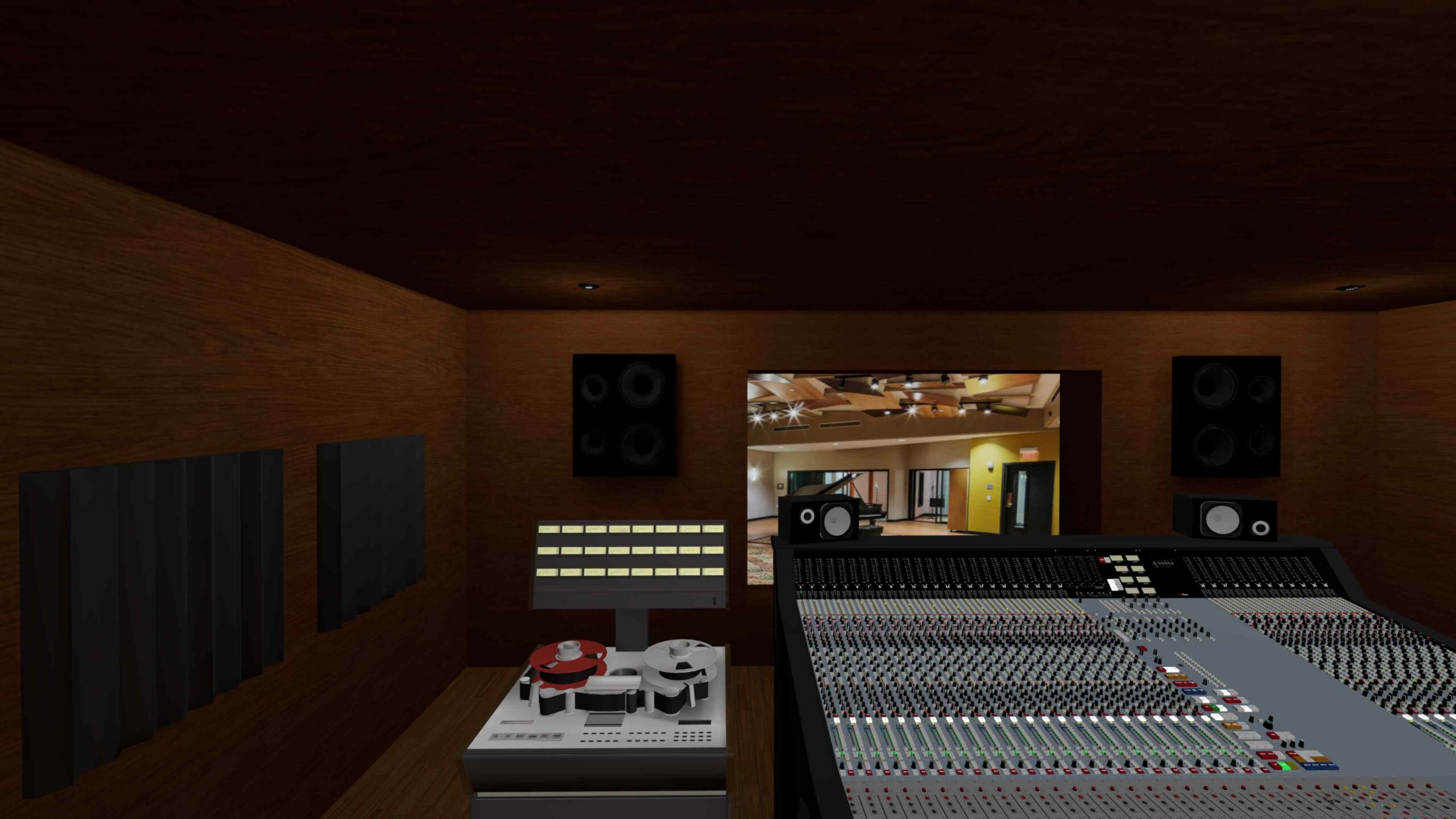
With real development time on my hands, progress accelerated fast. I went back into Blender and re-modelled large portions of the studio environment. Better geometry, cleaner topology, improved textures across the board. The control room started to look like a place you’d actually want to work in, not just a proof of concept.
On the code side, the improvements ran deep. Optimisation passes that I’d been putting off for months finally got done. New functionality that had been sitting in my notebook as “someday” features got implemented. The audio engine became more robust. The VR interaction system became more intuitive. When you can work on something for eight hours a day instead of two hours at midnight, the compound effect is remarkable.
I put together a new demo video to capture where things stood. Compared to the earlier builds, the difference was night and day. The studio felt real in a way it hadn’t before — and for the first time, I could see a path from where I was to something genuinely releasable.
The pandemic took a lot from a lot of people, and I’m not going to romanticise it. But for this project, specifically, it was the turning point. The studio came out of lockdown in better shape than it went in — and so did my commitment to seeing it through.