Devlog 6 — September 2021
Beyond Mixing
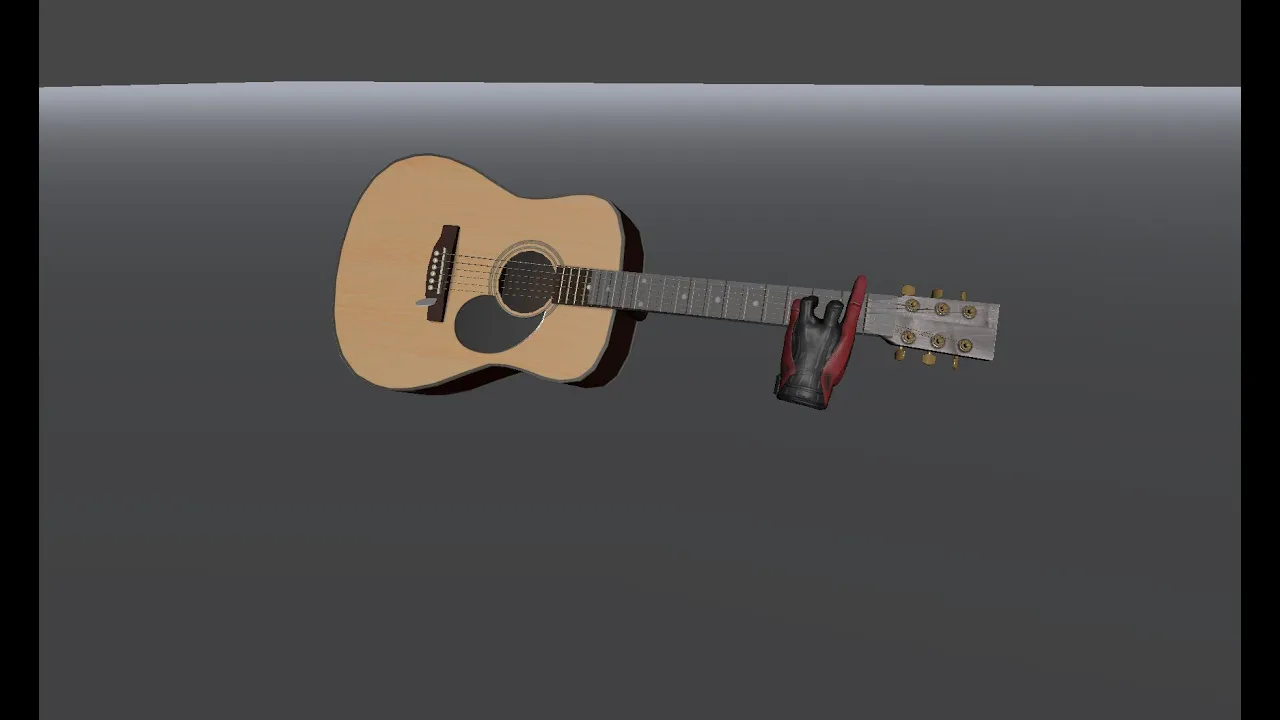
Up to this point the studio has been all about mixing — loading tracks, adjusting levels, processing audio through the console and outboard gear. But I’ve been wanting to push into something more: actually playing music inside the space. The studio already had drums you could hit and a piano you could touch to produce sound, though playing piano with VR controllers still needs more work to feel natural. This update adds the next instrument to the lineup — an acoustic guitar.
I should say upfront: I’m not a great guitar player. I know my chords and can handle simple arpeggios, which turned out to be just enough knowledge to figure out how this should work in VR. Sometimes being a beginner at something helps you design for accessibility rather than virtuosity.
How the Guitar Works
The big challenge was mapping a six-string instrument onto two VR controllers. Here’s the scheme I landed on: different buttons and joystick positions on the left controller select your chord shape. You can switch between bar chord forms based on E/Em and A/Am shapes, and modify them to add 7ths, 9ths, or diminished voicings. The position of your left hand along the neck determines the pitch, just like fretting on a real guitar.
Your right hand handles the strumming. You move the right controller across the virtual strings to play them. It works, but I quickly ran into the reality that hitting the right strings with precise timing using a controller is genuinely difficult. The spatial resolution just isn’t quite there yet for fine motor work like strumming individual strings.
The Arpeggio Solution
To get around the strumming accuracy problem, I added an arpeggio mode on the right hand. Instead of manually hitting each string, you can trigger automated picking patterns that cycle through the strings of whatever chord you’re holding. It keeps the musical expression — you’re still choosing chords, still controlling the timing and feel — but takes the micro-precision of individual string hits out of the equation.
It’s a good compromise. You can still strum freely if you want that raw feel, but the arpeggio mode means you can actually sit down and play something that sounds musical without fighting the controllers the whole time.
What’s Next for Instruments
I’m keeping an eye on hand tracking as the real long-term solution here. Once that technology matures, the whole controller mapping problem goes away — you could just reach out and play the strings with your actual fingers. That would change everything for the piano as well.
In the shorter term, I’m thinking about bass guitar and electric guitar versions using the same controller framework. There might also be a standalone Quest app for just the instrument side of things, separate from the full studio. But that’s further down the road. For now, the acoustic guitar is in and playable, and I’m pretty happy with how it turned out.