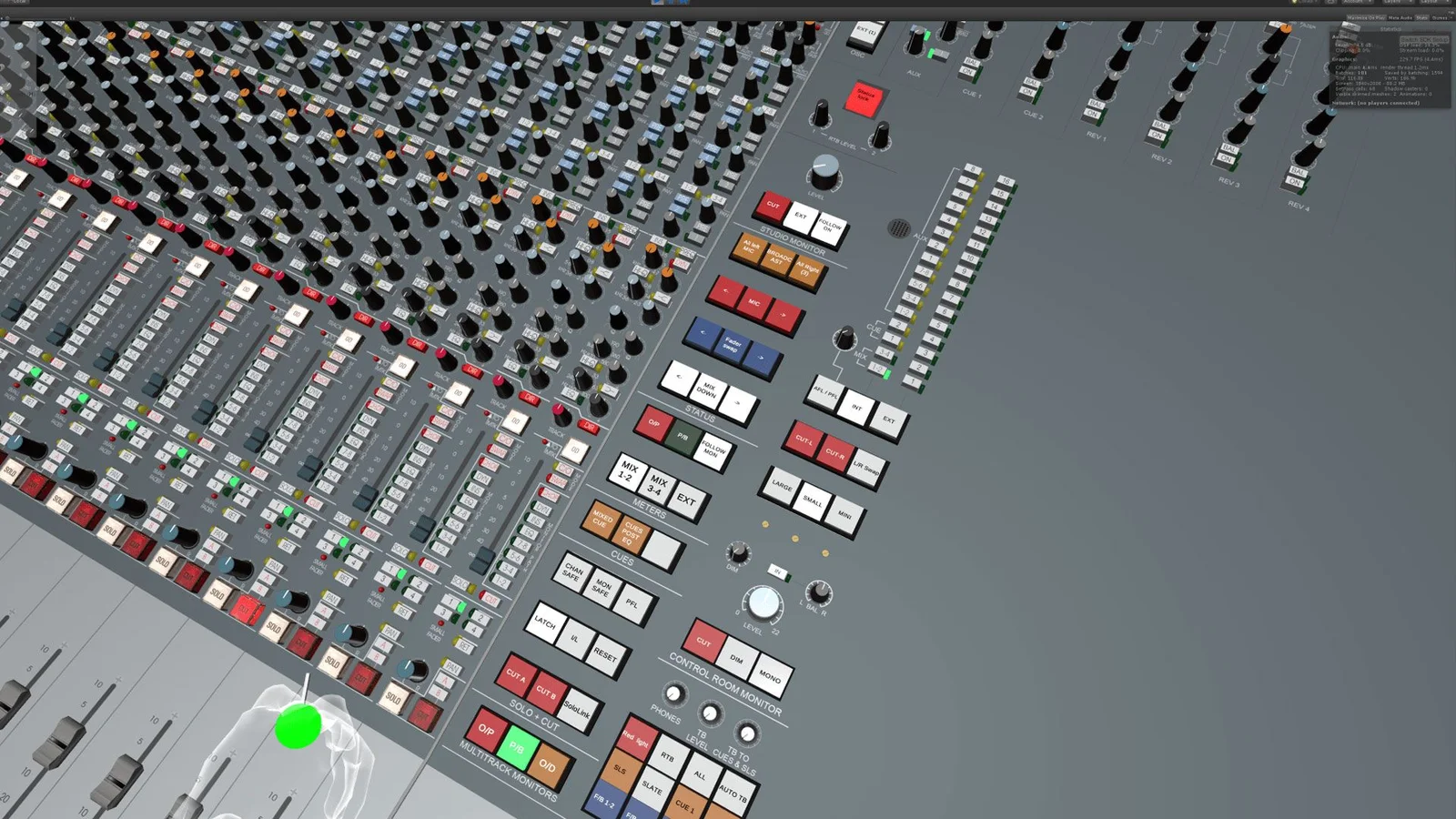
Devlog 2 — 21 May 2018
The Funding Reality
Let me be upfront about something: this has always been a self-funded passion project. There’s no studio backing this, no grants, no investors writing cheques. Every hour I spend building the VR studio is an hour I’m not spending on paid work. That’s a trade-off I’ve been willing to make, but it means development happens in bursts — whenever time and savings allow.
I started making videos to show what the project could do. Partly because I’m proud of the work, but honestly? I was also hoping to catch someone’s attention. An investor, a collaborator, someone in the audio industry who’d see this and think “we should support that.” The videos helped get the word out, and the feedback was encouraging — but funding remained elusive.
A Full Rebuild
Sometimes you have to tear everything down to build it right. That’s essentially what happened here. I rebuilt the entire studio from the ground up using the latest versions of Unity3D and Blender 3D. The old codebase had accumulated too much technical debt, and the VR landscape had shifted significantly since I started.
The main goal of the rebuild was full compatibility with modern XR and VR headsets. The industry was moving fast — new controllers, new tracking systems, new rendering pipelines. If I wanted this project to have a future, it needed to sit on a foundation that could keep up. So I rebuilt it. All of it.
Expanding the Audio Engine
The audio processing side got a major overhaul too. The original engine was a mix of C++ custom plugins and Unity’s built-in AudioMixer. For this rebuild I expanded the C# layer significantly, giving me more flexibility without sacrificing the performance-critical C++ components where they mattered most.
The result was a hybrid audio engine — C++ handling the heavy DSP work, C# managing routing, UI interaction, and higher-level logic, all talking to Unity’s audio system. More channels, more processing options, and crucially, a much cleaner architecture that would be easier to extend in the future.
Testing with Nirvana
At some point you need to stop building and start mixing. I found the multitrack stems for Nirvana’s “Smells Like Teen Spirit” online — one of those legendary recordings that’s been picked apart by engineers for decades. It felt like the perfect test case. If the studio could handle that track, with its dynamic range and raw energy, it could handle anything.
Loading those stems into the virtual Studer, pushing up the faders on the Neve, and hearing Kurt Cobain’s vocals come through while standing in a VR control room — that was a moment. It wasn’t just a technical test anymore. It was the experience I’d been trying to build since day one. The mix wasn’t going to win any awards, but the fact that I could do it at all? That was the point.
Back to Reality
By mid-2019, real life came knocking again. Paid video and photography work picked up, and I had to make the responsible choice. Bills don’t pay themselves, and the studio — as much as I love it — doesn’t generate income. So development went on pause. Not abandoned, never abandoned, just sleeping.
That’s the rhythm of a self-funded passion project. You push as hard as you can when you have the time, you put it down when you don’t, and you trust that the next window will open eventually. It always does.