Devlog 1 — May 2017
The Question That Started It All
Can I build a realistic audio mixer in VR?
That was it. That was the whole question. I didn’t set out to recreate a full recording studio. I just wanted to know if a mixing console — a real one, with faders and knobs and VU meters that actually respond — could work in virtual reality. Turns out it could. And once the first few channels were up and running, I couldn’t stop.
The studio I wanted to build should feel like walking into the legendary rooms that shaped music — the SSLs, the Neves, the tape machines spinning in the background. Not a toy. Not a tech demo. A place where you could actually load your own tracks and mix them on vintage gear.
Behind the Console
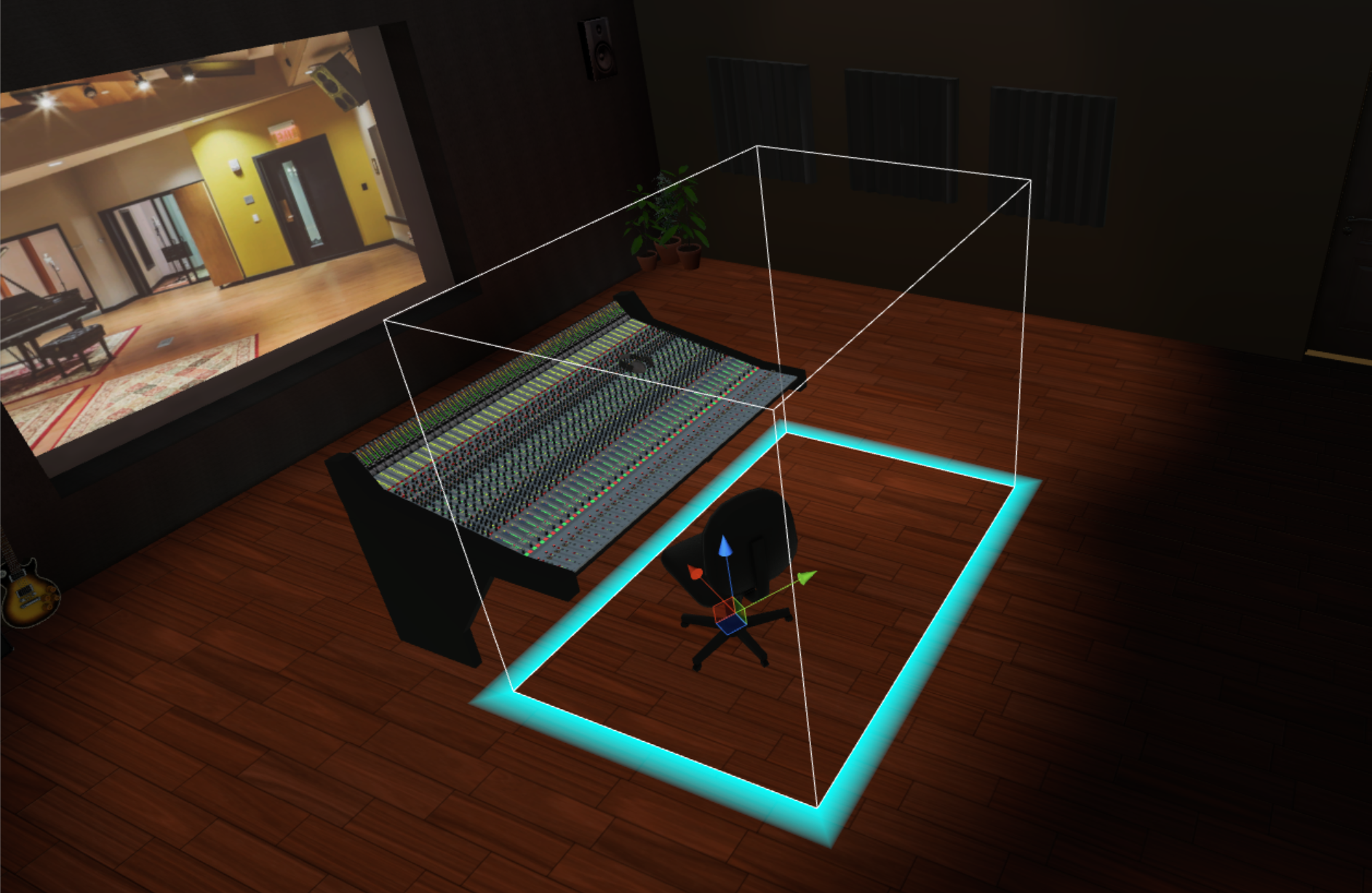
The console is the heart of everything. I recreated SSL and Neve mixing boards using original equipment manuals, archival photographs, and reference footage — matching the physical dimensions, the colour schemes, the surface textures, the exact behaviour of every knob, fader, and switch. Engineers who’ve worked on the real hardware should look at this and feel something familiar.
And it’s not just cosmetic. Every channel has real signal flow behind it. When you push a fader up, audio moves through the chain. When you dial in EQ, the frequency curve responds with vintage-modelled characteristics. The VU meters have proper ballistics — they react the way analogue meters actually react, not like animated graphics pretending to be meters.
What the Audio Engine Can Do
Building the visual side was one challenge. Building an audio engine that could keep up in real-time VR was another. Here’s where things stand:
- 24 to 48 channels of mixing — full professional track count
- Real-time EQ on every channel with vintage-modelled curves
- Analogue-style compression and dynamics processing
- Reverb on dedicated aux channels — lush analog ambiance, not a plug-in preset
- Flexible routing to subgroups and auxiliary sends
- High and low-pass filters plus a full 5-band parametric EQ section
- Pan controls for positioning instruments in the stereo field
- Professional metering with accurate ballistics on every channel
You load your session through a vintage multitrack remote control interface — stems in WAV, OGG, or MP3. Press play, and up to 24 individual tracks flow through the console, ready for your hands. Fast-forward, rewind, locate — just like working with real multitrack tape.
Mix Recording
One of the most exciting recent developments: the engine can now record your mix in real-time. Every fader move, every EQ adjustment, captured as it happens. This is the foundation for something bigger — eventually, not just mixing but actual music creation inside the virtual studio. Recording sessions in VR. That’s the long-term goal.
For now, you can practice on iconic tracks. Load up separated stems from Queen’s “Bohemian Rhapsody” or classic Police recordings and see what you can do with a console that most people only ever see in photographs.
Where This Is Going
The application was originally built for HTC Vive, and support for Oculus Rift and Quest is coming. Making this accessible to a broader audience matters — professional VR mixing shouldn’t be locked to one headset.
What started as a simple experiment has turned into a comprehensive 80s and 90s recording studio simulation. Years of development, research, and an unhealthy obsession with preserving the golden era of analogue recording. The next devlog will show how far the studio has come since this first version — the environment has grown significantly, and a new demonstration video is in the works.
The virtual studio doors are open. Come stand behind the console.