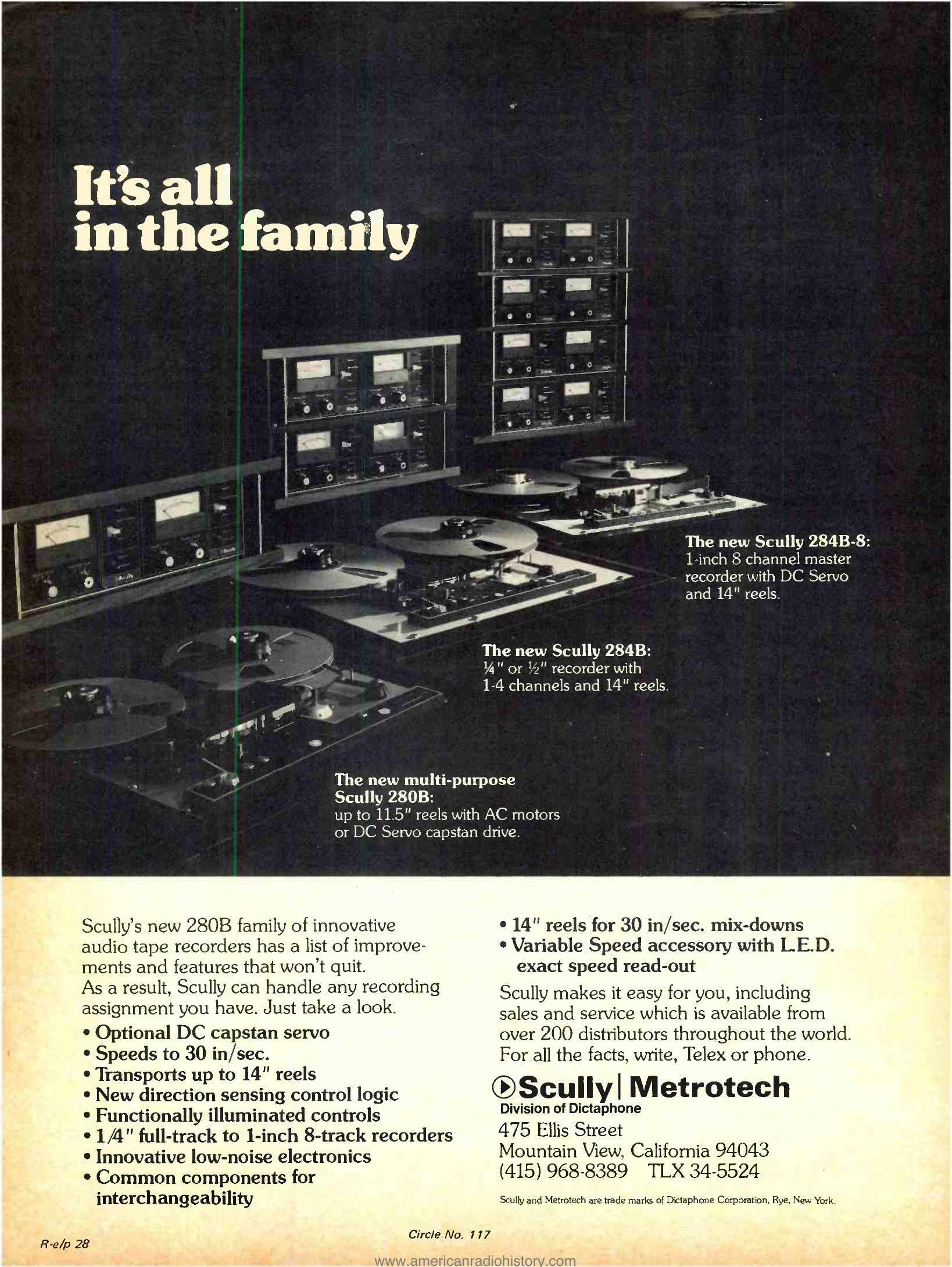
Retro Recordings XR — Heritage — Tape Machines

The machines that
captured everything.

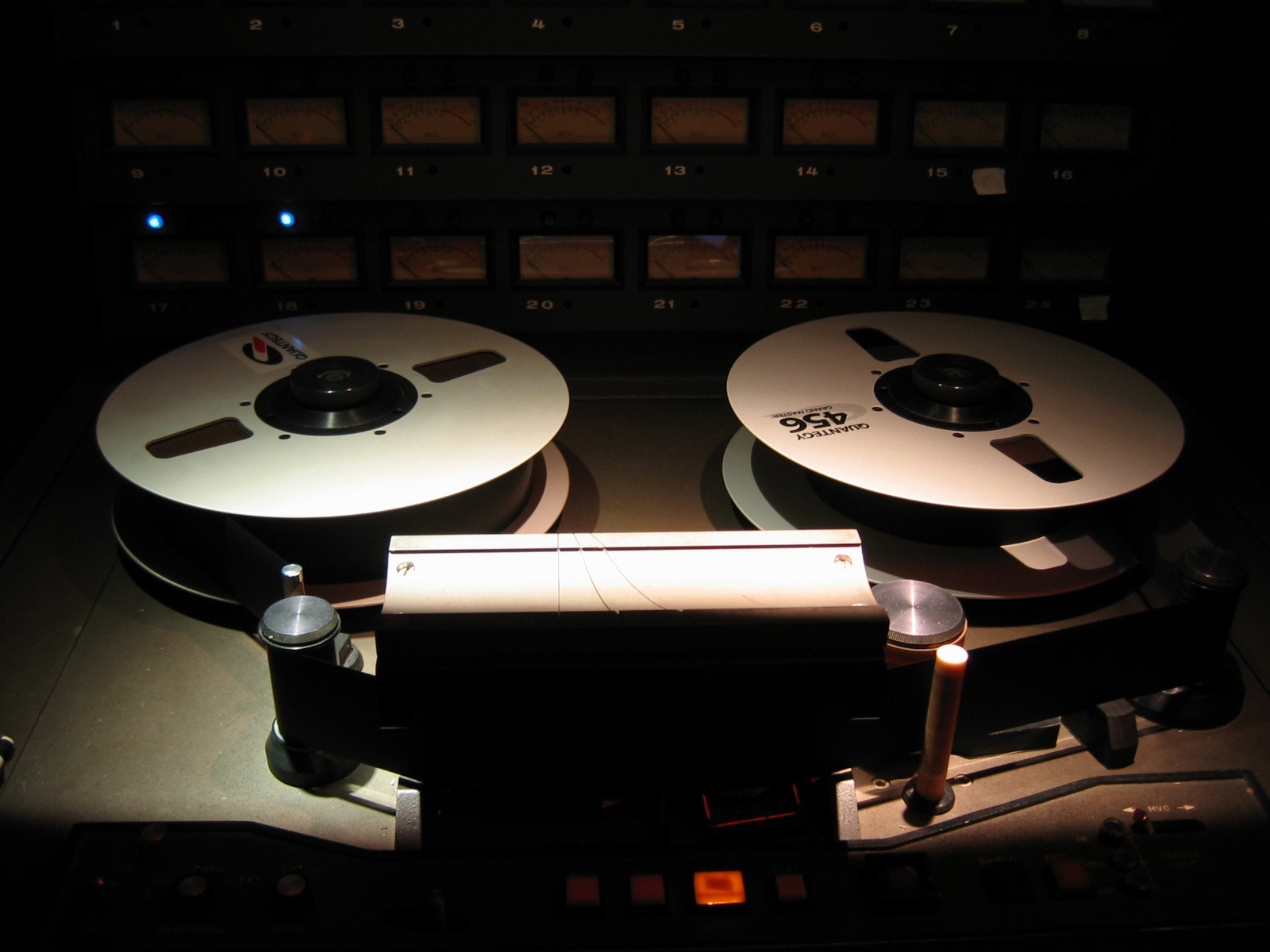
Every record you've ever loved started on tape. Before it was a waveform in a DAW, it was oxide particles magnetised by a moving head, captured by a transport spinning at 15 or 30 inches per second. The machine mattered as much as the microphone.

This archive covers the professional multitrack and mastering machines that defined the sound of recorded music from the 1960s through the 1990s — their engineering, their character, the studios that used them, and why engineers still seek them out today.

42 machines across 17 brands — Studer, Revox, Nagra, Ampex, Otari, MCI, Sony, TEAC, Fostex, Tascam, 3M, Telefunken, Telex/Magnecord, Crown, Custom Fidelity, Gauss, and Stephens Electronics.

🇨🇭 Studer

Switzerland — est. 1948

Swiss Precision. No Compromise.

studer.com ↗

Studer was founded by Willi Studer in Zurich in 1948 as a radio and electronics company. By the early 1950s the company had developed its first professional tape recorder, and through the 1960s and 1970s Studer became the global standard for broadcast and studio-quality tape machines.

The combination of Swiss engineering precision, exceptionally low noise floors, and legendary transport reliability made Studer the machine of choice for classical recording labels, national broadcasters, and top-tier commercial studios worldwide. Abbey Road, Capitol, Decca, and virtually every major label installed Studer machines at their core facilities.

Studer C37

1960 – 1967  ·  2-track  ·  ¼ inch (6.35 mm)

Golden Age 7½ ips 15 ips

The predecessor to the A80, the C37 established Studer's reputation for quality in the early stereo era. Tube-based electronics gave it a warmth that engineers of the period valued, while the vacuum capstan — unusual for its time — delivered speed stability that set it apart from competitors. Produced in fewer than 800 units, working C37s are highly sought after by collectors and engineers pursuing the sound of early 1960s classical and stereo recordings.

Tube electronics 3-motor transport Vacuum capstan Professional XLR connectors

Notable users

Early stereo recording studios, European broadcasters

Technical specs

Frequency response 40Hz – 15kHz ±3dB at 15 ips
Signal-to-noise >60 dB
Wow & flutter <0.15%
Speed accuracy ±0.3%
Head config Record / Play / Erase
Motor AC induction

Market value

$5,000 – $15,000

Rarity

Rare

Studer A80 (2-track mastering)

1967 – 1985  ·  2-track stereo mastering  ·  ¼ inch (6.35 mm)

Golden Age 7½ ips 15 ips 30 ips

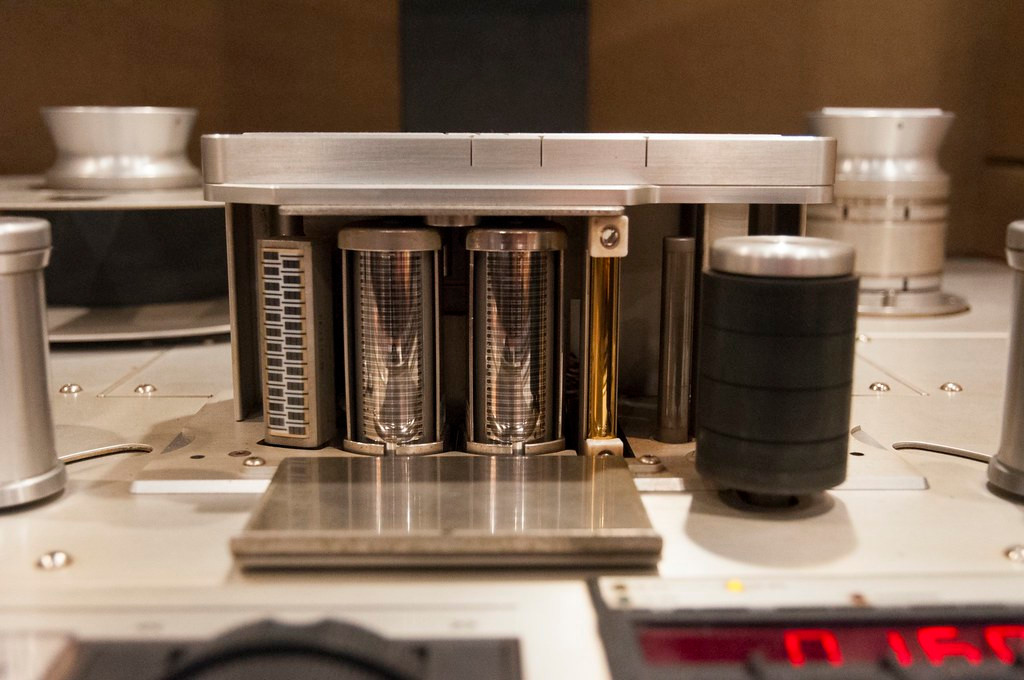
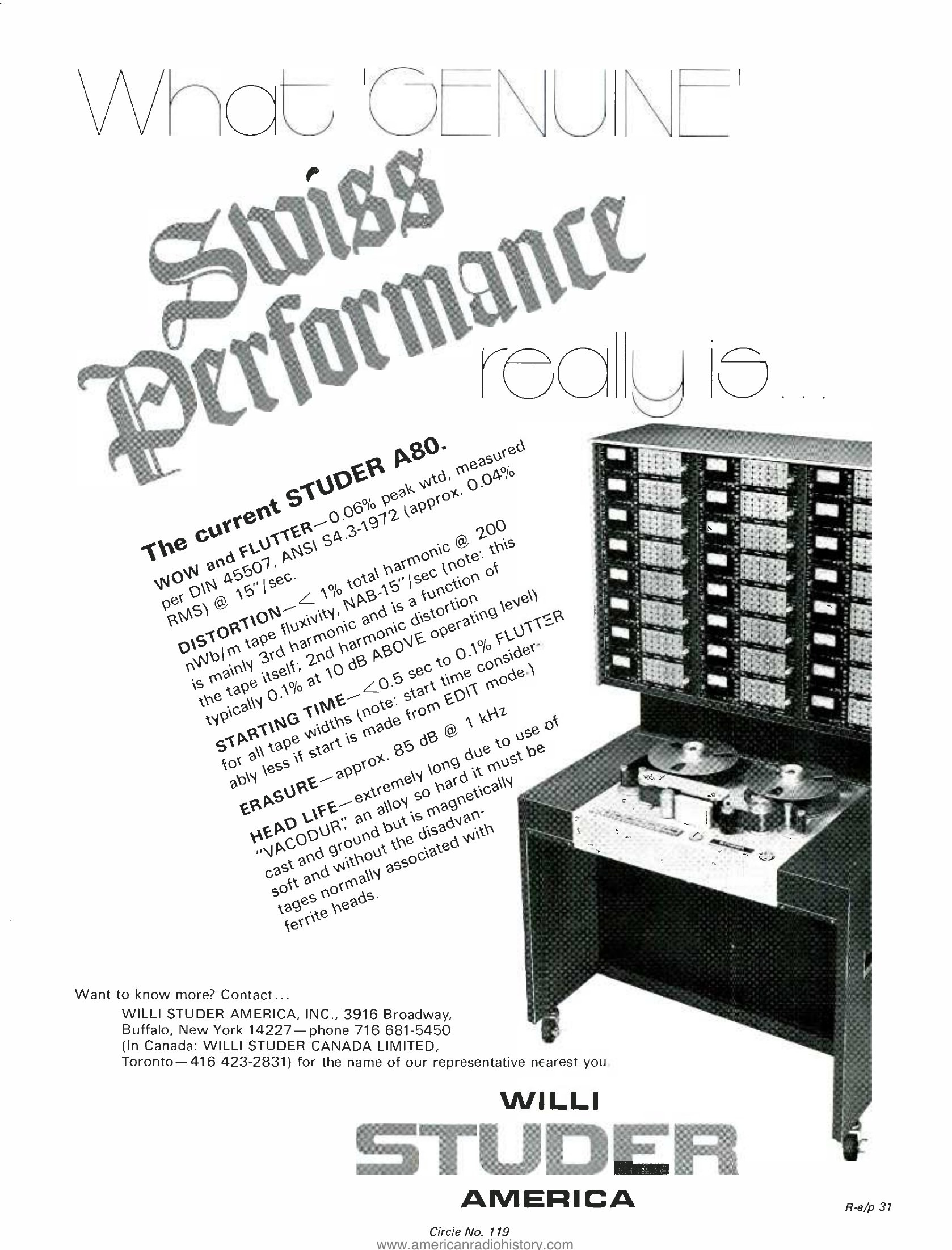
Considered by many engineers to be the finest 2-track tape machine ever made. The A80 RC — RC standing for Remote Control, the standard mastering configuration — was the universal standard for stereo mastering and classical recording throughout the 1970s and 1980s. Abbey Road, Capitol, Decca, and EMI studios worldwide relied on it for their final masters. The vacuum capstan servo system regulated tape speed with feedback from a quartz oscillator, achieving wow and flutter figures that contemporary digital playback systems still struggle to better. Its electronic tape tension control prevented the stretch and damage that plagued machines with purely mechanical braking. In classical recording, where the integrity of a single take could represent days of orchestral work, no machine inspired more confidence. The A80 2-track appears in more mastering suites and classical recording venues than any other machine built before or since.

Vacuum capstan servo Quartz PLL speed lock Electronic tape tension control Variable speed ±15% XLR balanced I/O Remote control Optional noise reduction

Notable users

Abbey Road Studios, Capitol Studios, Decca Records, EMI Studios worldwide, Deutsche Grammophon, Phillips Classics

Technical specs

Frequency response 30Hz – 20kHz ±2dB at 15 ips
Signal-to-noise >70 dB (A-weighted)
Wow & flutter <0.05% (DIN weighted)
Speed accuracy ±0.1%
Tape width ¼ inch (6.35 mm)
Head config Erase / Record / Repro
Motor DC servo capstan, AC reel motors

Market value

$8,000 – $25,000

Rarity

Moderate

Studer A80 Multitrack (4-, 8-, 16-, 24-track)

1968 – 1980  ·  Multitrack  ·  ½ inch · 1 inch · 2 inch

Golden Age 15 ips 30 ips

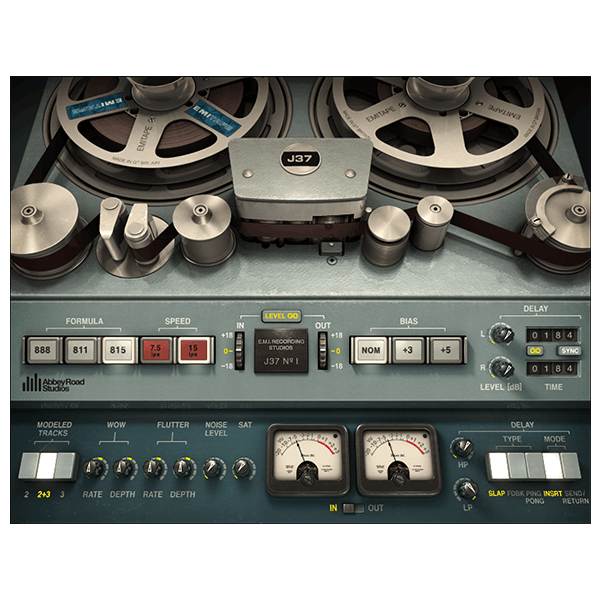
The A80 transport was not only a mastering machine — Studer built it as a modular platform, fitting the same chassis and servo system with interchangeable headstacks and channel electronics for 4-, 8-, 16-, and 24-track operation. Each configuration used a different tape width: 4-track ran on ½ inch, the 8-track on 1 inch, and the 16- and 24-track versions on 2 inch. The 8-track on 1-inch tape deserves particular attention — it was the dominant multitrack format in major studios from roughly 1968 to 1973. Running 8 tracks across a full inch of tape meant each track was 100 thou wide, compared to about 60 thou on a 16-track 2-inch machine. Wider tracks meant a higher signal level for a given tape speed, a better signal-to-noise ratio, and less print-through between adjacent tracks — qualities that gave early 1970s recordings a density and warmth that engineers still reference. The Beatles' own multitrack work at Abbey Road during 1968–69 used an 8-track machine (the earlier Studer J37), and many contemporaries were recording 8-track A80s at the same time. The A80 Multitrack platform was eventually succeeded by the dedicated A800 (1978) once 24-track became the clear industry standard, but studios that owned A80 8-track machines often ran them alongside newer machines for years, using them as slave units or for overdub work.

Modular headstack system Shared A80 transport / servo 8-track on 1-inch tape 16- and 24-track on 2-inch Sync (sel-sync) playback Remote control Optional noise reduction

Notable users

Major studios during the 8-track era (1968–1973), Record Plant (New York), Sunset Sound (Hollywood), Trident Studios (London), AIR Studios

Technical specs

Frequency response 30Hz – 20kHz ±2dB at 15 ips
Signal-to-noise >66 dB (A-weighted, 8-track / 1 inch)
Wow & flutter <0.05% (DIN)
Speed accuracy ±0.1%
Tape width ½ inch (4-tr) · 1 inch (8-tr) · 2 inch (16/24-tr)
Head config Sync / Record / Repro (multitrack)
Motor DC servo capstan, AC reel motors

Market value

$6,000 – $20,000

Rarity

Moderate

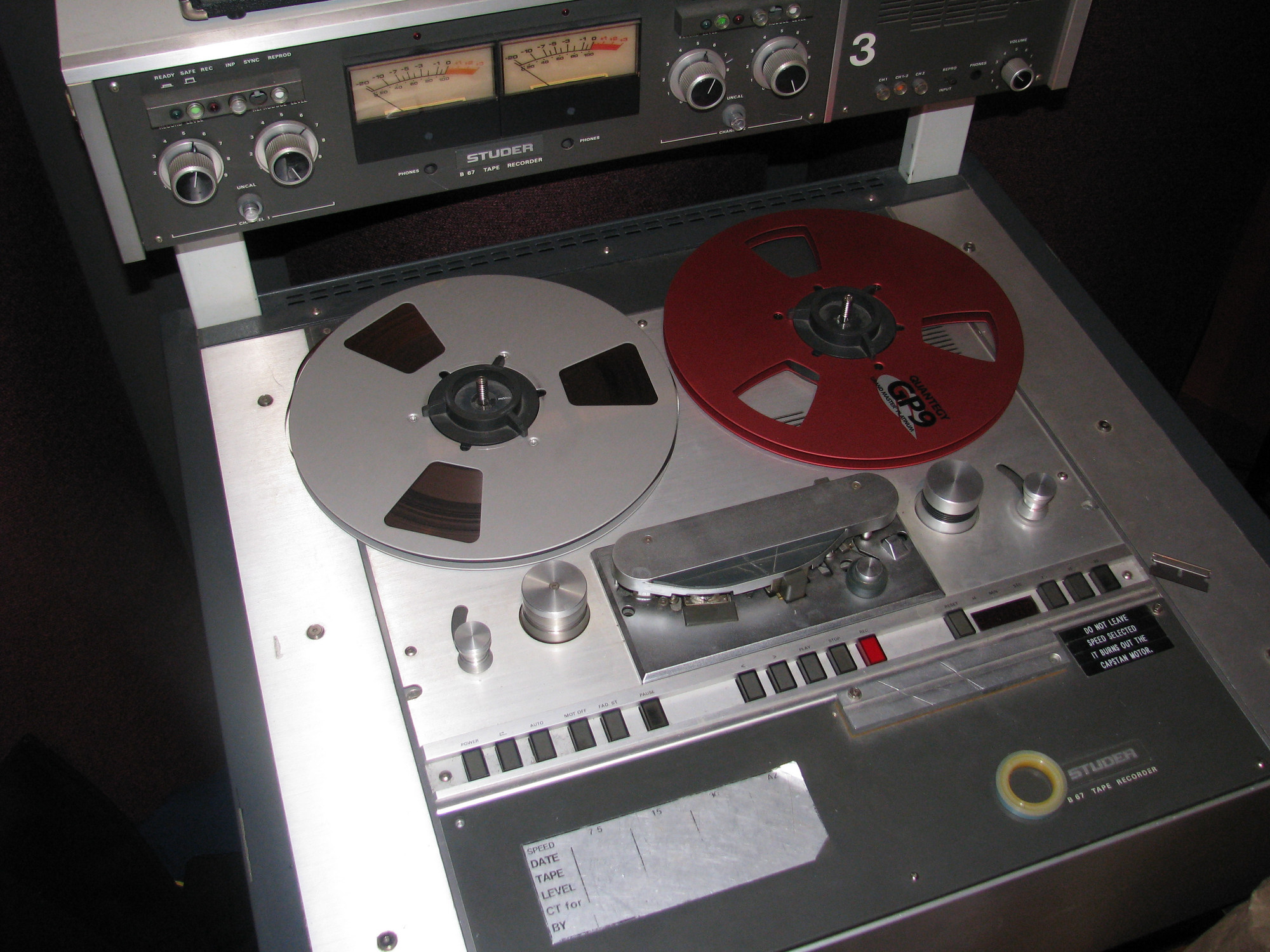
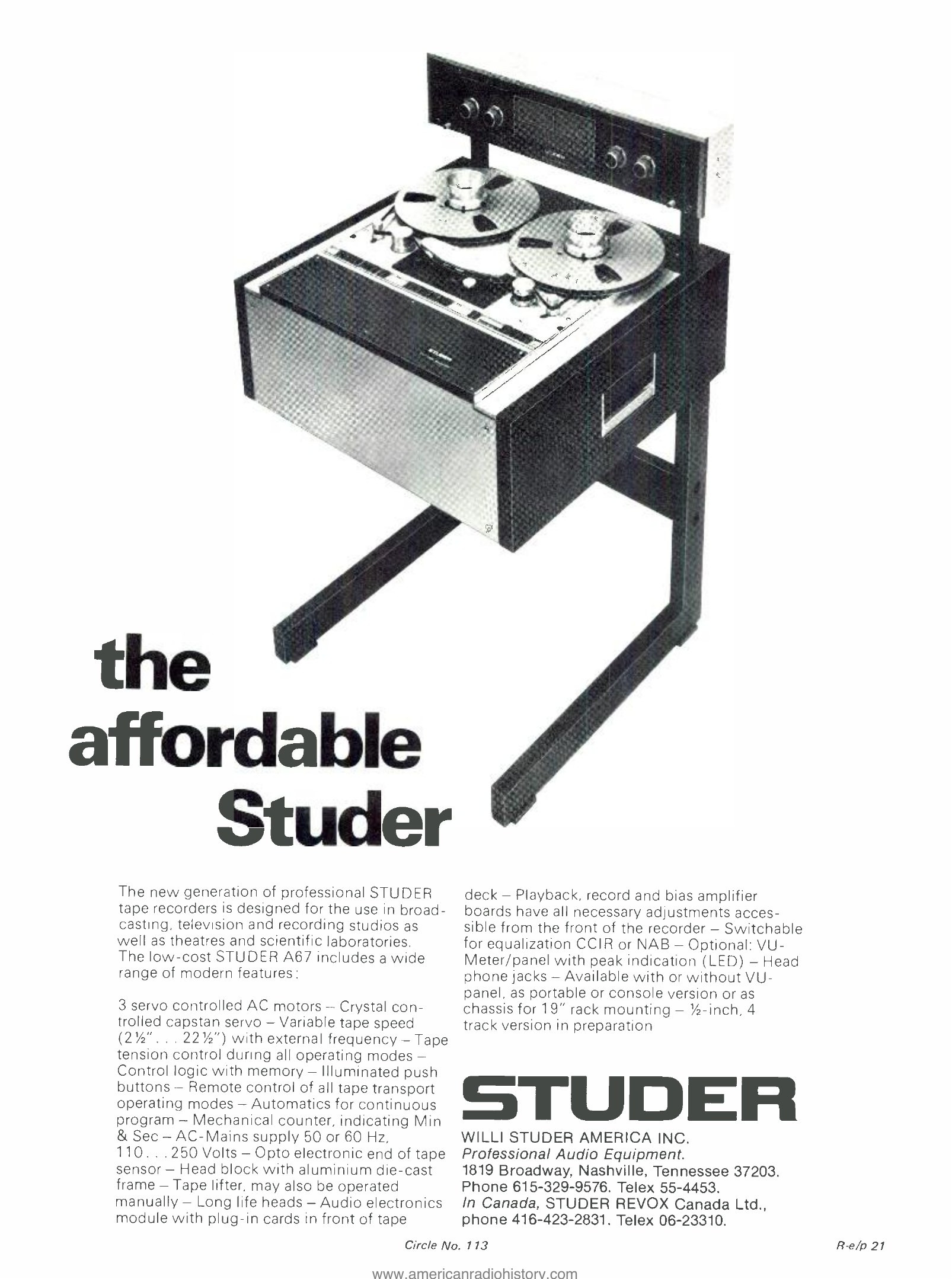
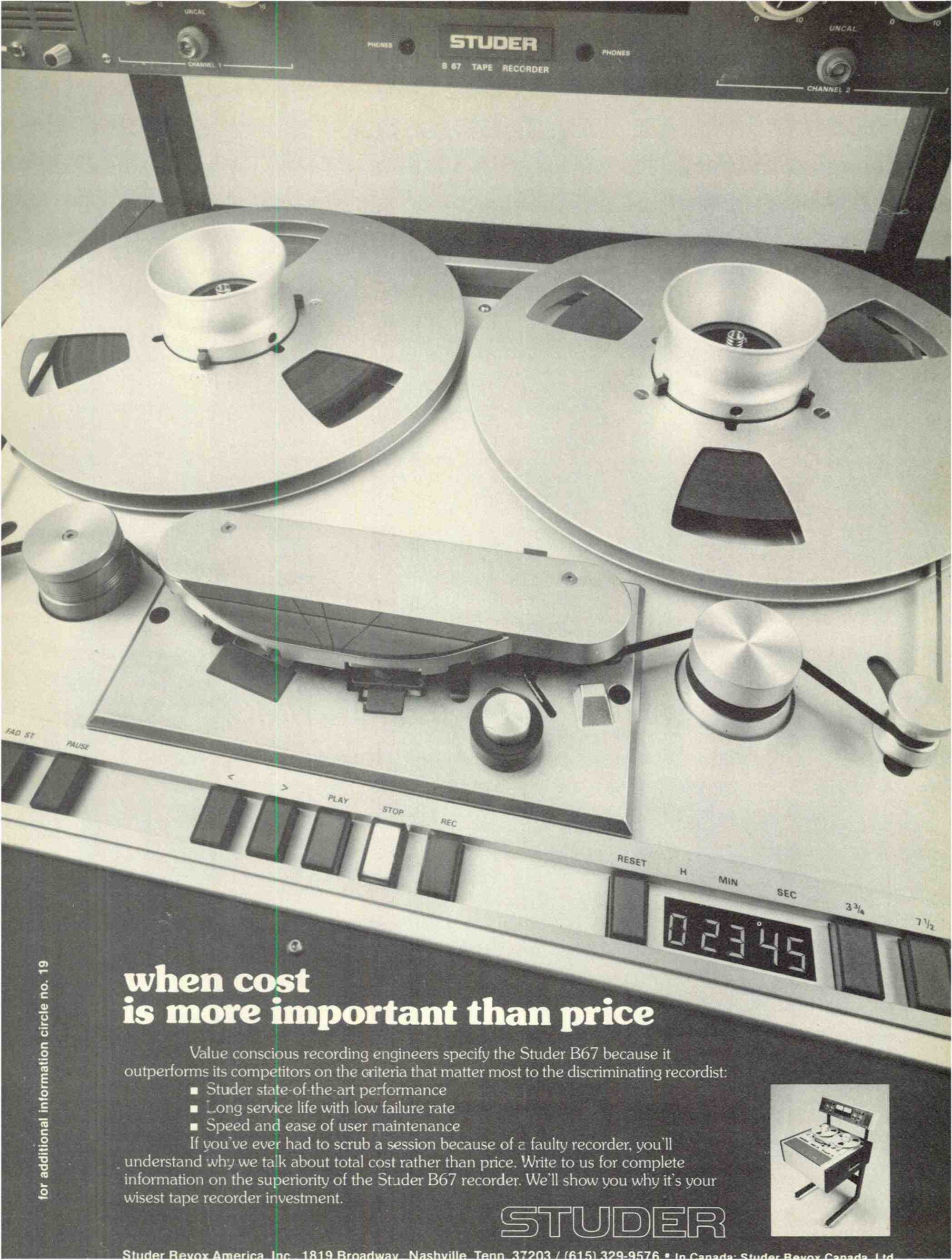
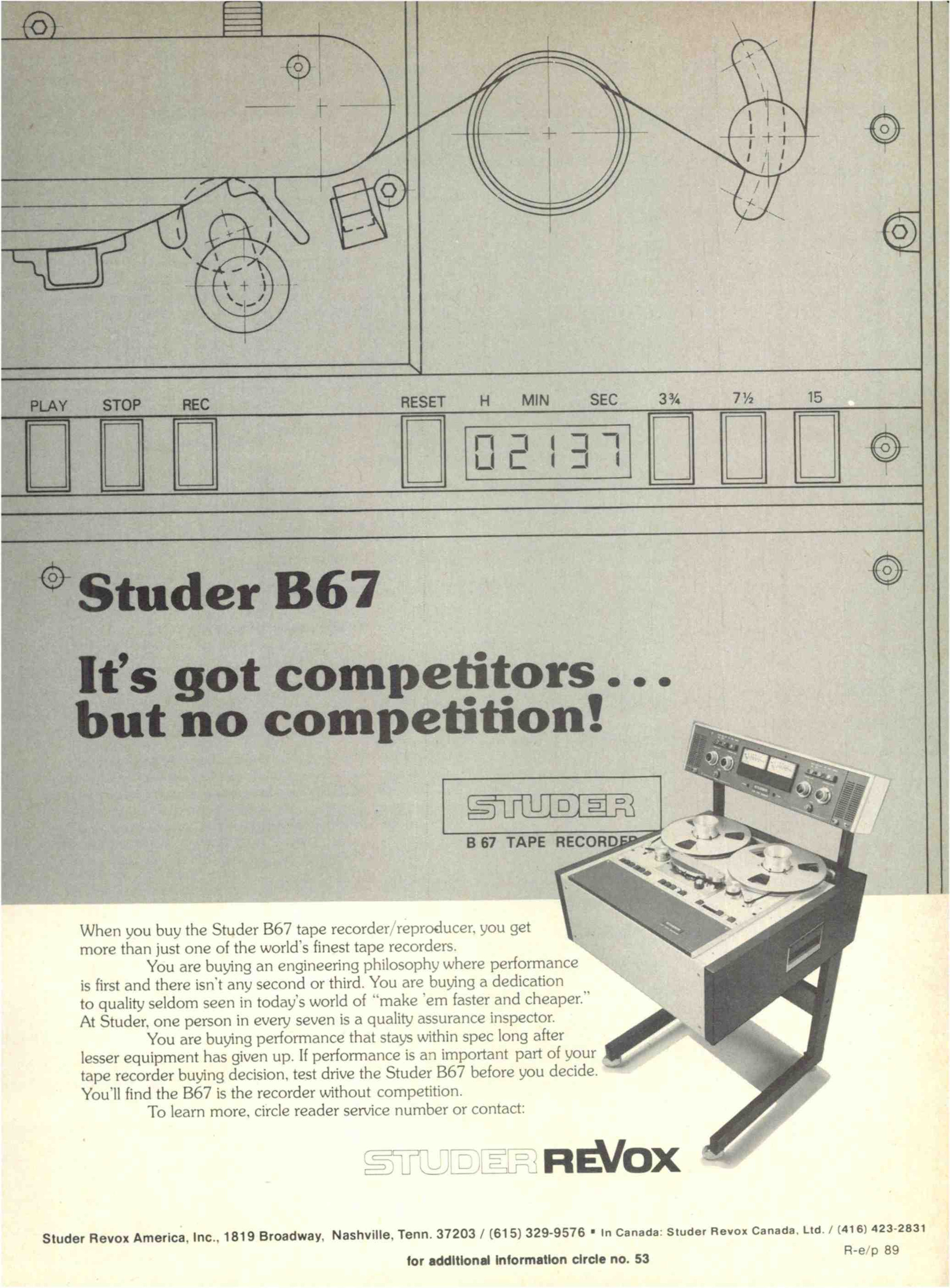
Studer B67

1975 – 1985  ·  2-track portable  ·  ¼ inch (6.35 mm)

Golden Age 3¾ ips 7½ ips 15 ips

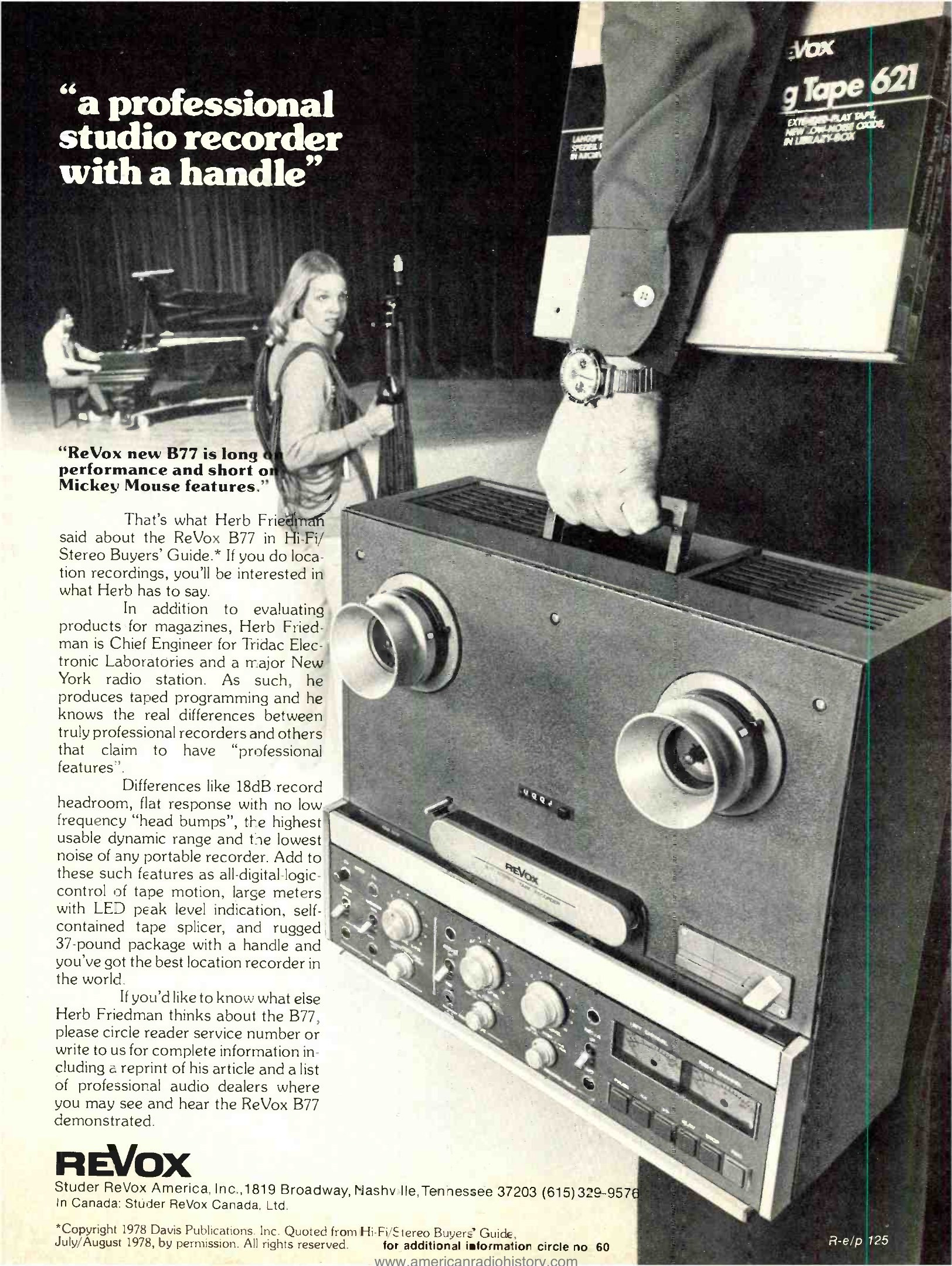
The portable sibling of the A80, the B67 brought Studer quality to location recording and broadcast field work. Battery operation and a rugged 3-motor transport made it the choice of location engineers, film crews, and broadcast journalists who needed A80-class quality outside the studio. Widely used across two decades of field recording, it earned a reputation for surviving conditions that would destroy lesser machines.

Portable design Battery operation 3-motor transport XLR balanced I/O Built-in monitoring

Notable users

Location recording engineers, Broadcast field crews, Film production

Technical specs

Frequency response 30Hz – 18kHz ±3dB at 15 ips
Signal-to-noise >65 dB (A-weighted)
Wow & flutter <0.08%
Speed accuracy ±0.2%
Head config Record / Play / Erase
Motor DC servo

Market value

$3,000 – $8,000

Rarity

Moderate

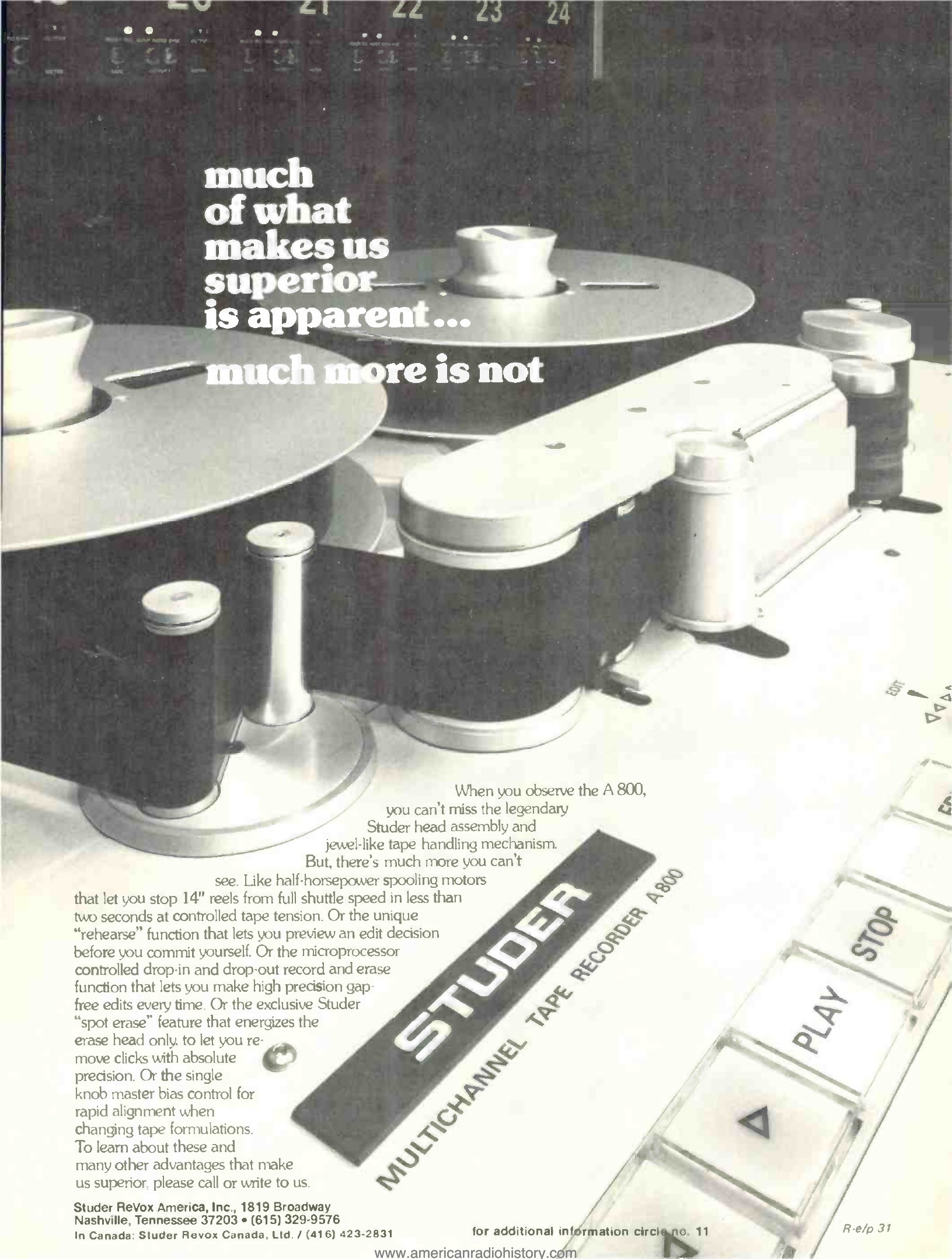
Studer A800

1978 – 1990  ·  24-track  ·  2 inch (50.8 mm)

Transitional 15 ips 30 ips

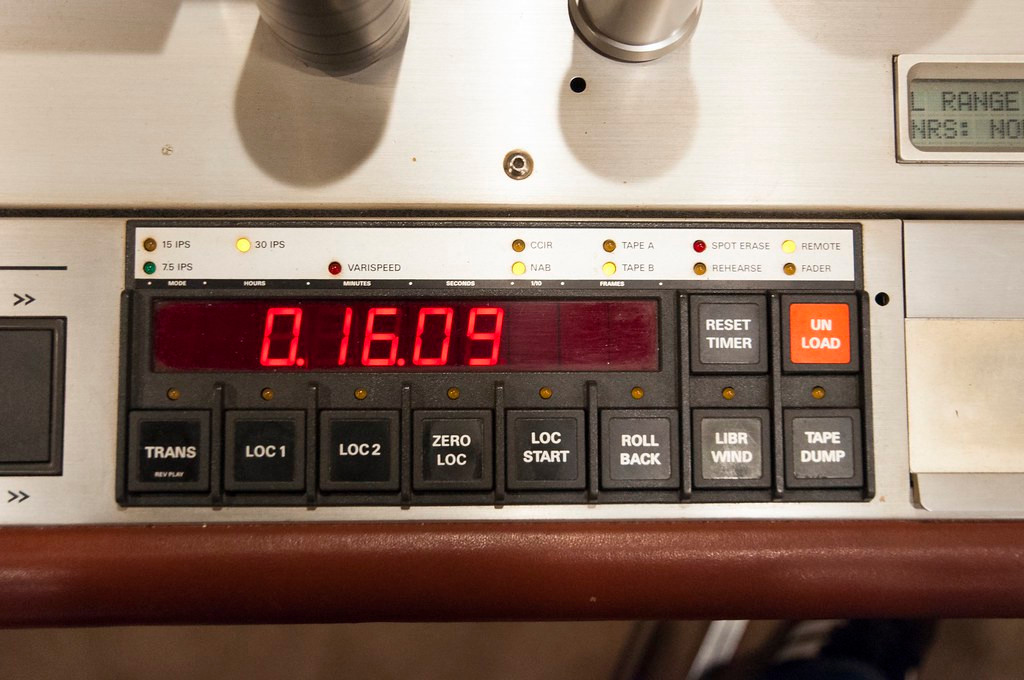
The definitive 24-track analog multitrack recorder of the 1980s. Used on countless hit records at Ocean Way, Record Plant, Sunset Sound, and Air Studios. The A800 combined Studer's legendary audio quality with microprocessor-controlled transport, an autolocator with eight memories, and optional Dolby SR — giving engineers everything they needed in one machine. The A800 MkIII (1985) remained in demand long after the digital era began.

Microprocessor controlled Autolocator (8 memories) Remote control Optional Dolby SR Sync input Electronic tension control

Notable users

Ocean Way Recording, Record Plant, Sunset Sound, Air Studios

Technical specs

Frequency response 30Hz – 20kHz ±2dB
Signal-to-noise >68 dB (A-weighted, no NR)
Wow & flutter <0.06%
Speed accuracy ±0.1%
Head config 24-track record/play
Motor DC servo with quartz PLL

Market value

$15,000 – $40,000

Rarity

Moderate

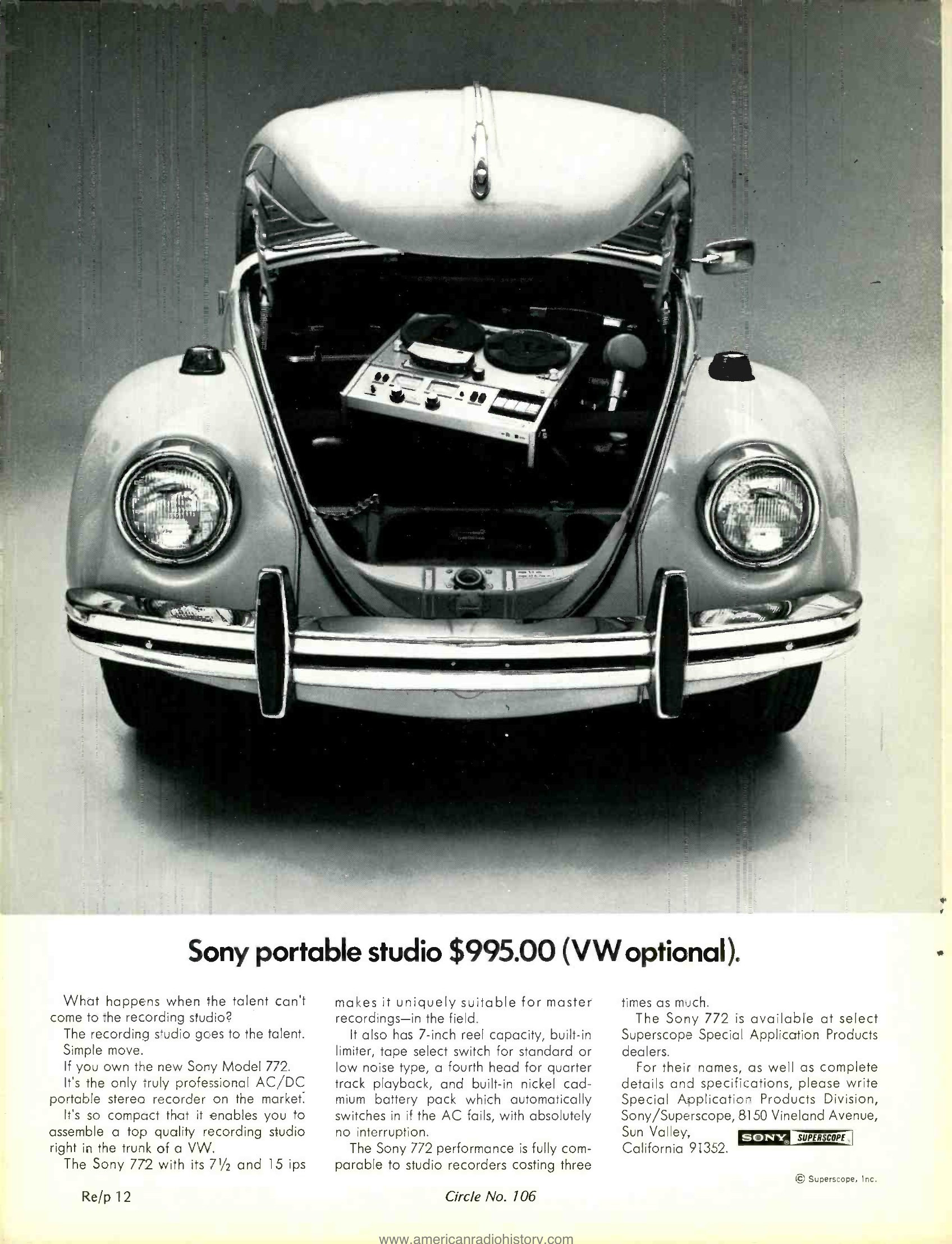
■ 1 vintage ad

Studer A820

1985 – 1995  ·  Multi-format  ·  ¼ inch to 2 inch

Transitional 7½ ips 15 ips 30 ips

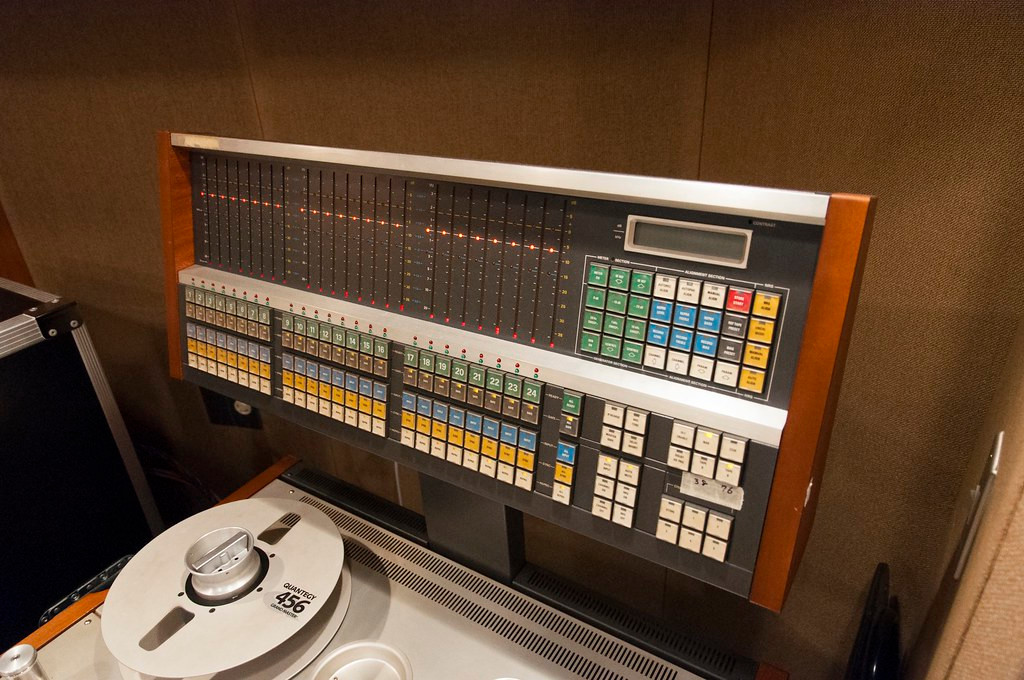
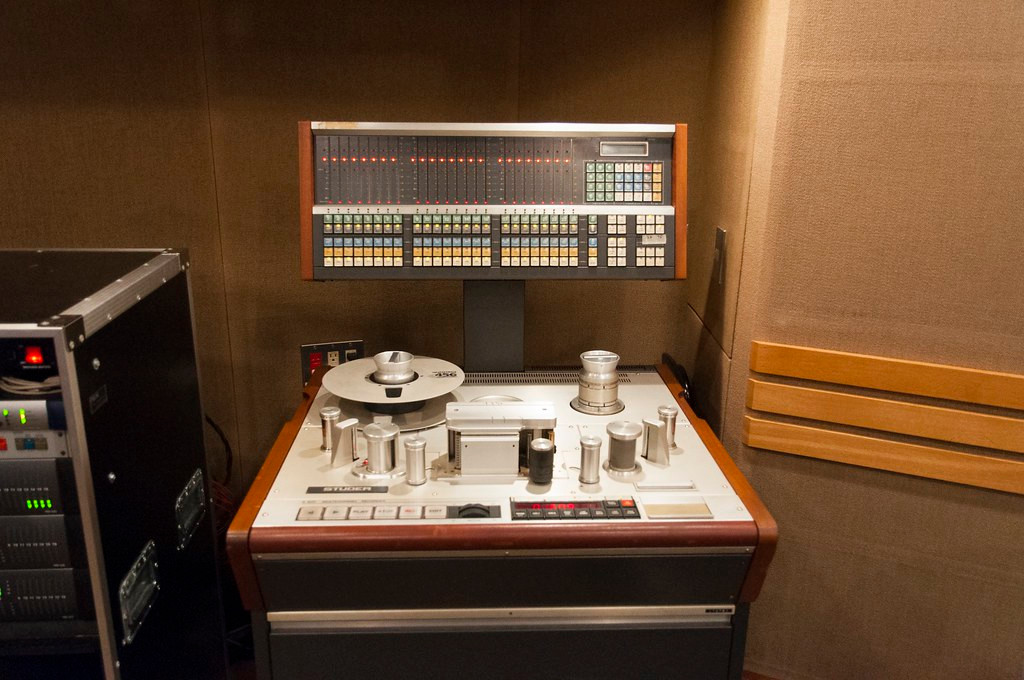
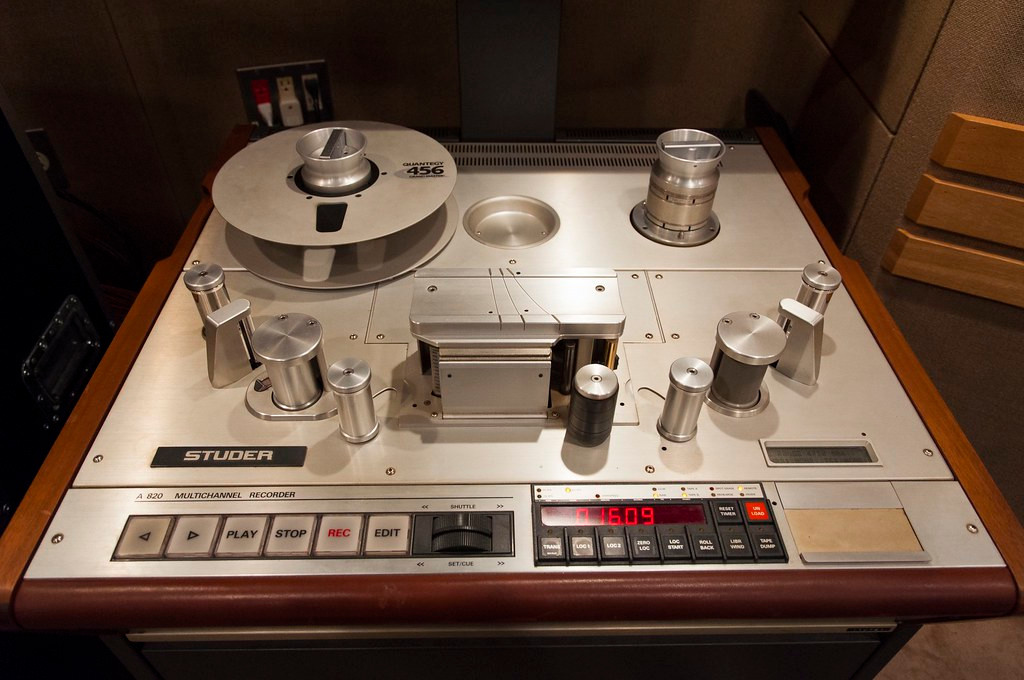
The pinnacle of Studer analog tape technology. The A820 was available in all formats from ¼" 2-track to 2" 24-track, and its 5-motor transport — three DC servo motors plus two synchronous — provided speed stability and tape handling that no competitor could match. Automatic alignment and bargraph metering made it as convenient as it was precise. Mastering studios worldwide consider the A820 the finest analog tape machine ever built.

5-motor transport Microprocessor controlled Bargraph metering Automatic alignment Remote control Dolby SR compatible

Notable users

Mastering studios worldwide, Classical recording facilities, Broadcast stations

Technical specs

Frequency response 30Hz – 20kHz ±2dB
Signal-to-noise >72 dB (A-weighted)
Wow & flutter <0.04%
Speed accuracy ±0.05%
Head config Various configurations
Motor DC servo with separate processor

Market value

$20,000 – $50,000

Rarity

Rare

Studer A827

1990 – 1995  ·  24-track  ·  2 inch (50.8 mm)

Digital Transition 15 ips 30 ips

The final Studer multitrack analog recorder, and a deliberate simplification of the A820. Studer removed the bargraph metering and automatic alignment to give engineers more direct control — a choice professional studios appreciated. Redesigned audio electronics and full external noise reduction support made it as capable as it was flexible. The last of the legendary Studer analog line.

Redesigned A820 audio electronics External noise reduction support Microprocessor controlled Sync input Remote control

Notable users

Major recording studios, Post-production facilities

Technical specs

Frequency response 30Hz – 20kHz ±2dB
Signal-to-noise >70 dB (A-weighted)
Wow & flutter <0.05%
Speed accuracy ±0.05%
Head config 24-track record/play
Motor DC servo

Market value

$18,000 – $45,000

Rarity

Rare

■ Vintage Ads 2 ads

🇨🇭 Revox

Switzerland — est. 1948

Studio Quality for the Rest of Us.

revox.com ↗

Revox was the consumer and prosumer brand of Willi Studer's company, established alongside the professional Studer range in 1948. Where Studer machines were priced for national broadcasters and major commercial studios, Revox brought the same engineering philosophy to home recordists, small studios, and educational institutions.

The A77 and B77 became icons of the home recording world — machines that introduced a generation of musicians and engineers to open-reel tape. The build quality and reliability of Revox machines was so far above the competition that they ended up in small radio stations, schools, and working studios worldwide.

Revox A77

1967 – 1977  ·  2-track / 4-track  ·  ¼ inch (6.35 mm)

Golden Age 3¾ ips 7½ ips 15 ips

One of the first all-transistor open-reel recorders aimed at serious home users, the A77 sold approximately 15,000 units over its ten-year run. The electronically governed capstan motor, 3-motor transport, and 10.5-inch reel capacity gave it a specification closer to professional equipment than the consumer market expected. Radio stations, small studios, and home recordists all relied on the A77, and its legendary reliability means working examples are still common today.

All-transistor design 3-motor transport Electronically governed capstan Electronic speed change 10.5 inch reel capacity

Notable users

Home recording enthusiasts, Small studios, Radio stations

Technical specs

Frequency response 30Hz – 20kHz +2/−3dB at 15 ips
Signal-to-noise 66 dB (2-track), 64 dB (4-track) at 15 ips
Wow & flutter 0.08% at 7.5 ips
Speed accuracy ±0.2%
Head config Record / Play / Erase
Motor AC capstan, DC reel

Market value

$800 – $2,500

Rarity

Common

Revox A700

1974 – 1980  ·  2-track  ·  ¼ inch (6.35 mm)

Golden Age 3¾ ips 7½ ips 15 ips

The premium Revox model of the mid-1970s, positioned between the A77 and B77. Fewer than 3,000 were made, making it the rarest of the mainstream Revox range. Engineers who own working A700s prize them for build quality, advanced tape tension control, and the characteristic Revox sound. Parts are harder to find than for the A77 or B77, but machines in good condition are highly regarded.

3-motor transport Electronic speed control Advanced tape tension 10.5 inch reel capacity

Notable users

Audiophiles, High-end home users

Technical specs

Frequency response 30Hz – 22kHz at 15 ips
Signal-to-noise 65 dB
Wow & flutter 0.06% at 15 ips
Speed accuracy ±0.15%
Head config Record / Play / Erase
Motor DC servo

Market value

$1,200 – $3,500

Rarity

Moderate

Revox B77

1977 – 1985  ·  2-track / 4-track  ·  ¼ inch (6.35 mm)

Golden Age 3¾ ips 7½ ips 15 ips

The successor to the A77 refined the transport and improved speed stability without abandoning what made the original successful. The DC servo capstan gave the B77 better wow and flutter figures than its predecessor, and optional remote control suited semi-professional applications. Educational institutions, small broadcasters, and home studios bought B77s in large numbers throughout its eight-year production run.

Improved 3-motor transport DC servo capstan Electronic speed change 10.5 inch reel capacity Optional remote control

Notable users

Home studios, Educational institutions, Small broadcasters

Technical specs

Frequency response 30Hz – 22kHz +2/−3dB at 15 ips
Signal-to-noise 68 dB at 15 ips
Wow & flutter 0.06% at 15 ips
Speed accuracy ±0.15%
Head config Record / Play / Erase
Motor DC servo capstan

Market value

$1,000 – $3,000

Rarity

Common

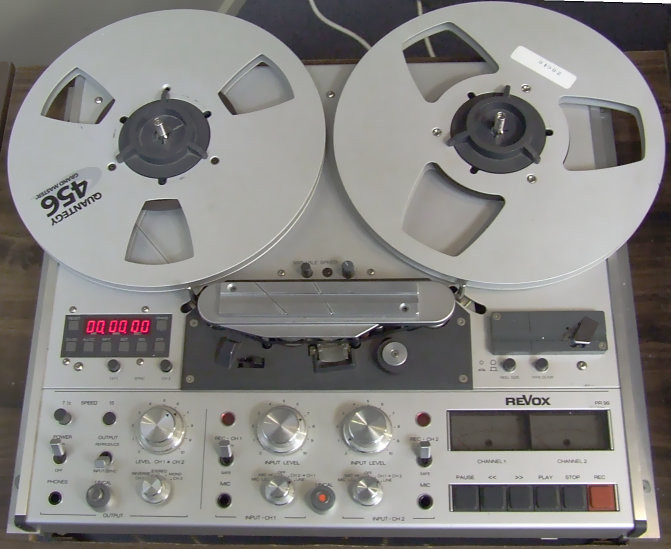
Revox PR99

1980 – 1990  ·  2-track  ·  ¼ inch (6.35 mm)

Transitional 7½ ips 15 ips

Revox's step into semi-professional territory — a machine intended for studios and broadcast facilities that wanted B77 reliability with additional production features. Microprocessor control, a real-time tape counter, and a variable speed range of −30% to +50% made it a practical tool rather than just a quality playback deck. Considered the most capable of the mainstream Revox range.

Electronically regulated 3-motor drive Variable speed −30% to +50% Microprocessor control Real-time tape counter VU meters Optional remote control

Notable users

Semi-professional studios, Broadcast, Educational facilities

Technical specs

Frequency response 30Hz – 20kHz ±2dB at 15 ips
Signal-to-noise >65 dB
Wow & flutter <0.05%
Speed accuracy ±0.1%
Head config Record / Play / Erase
Motor DC servo

Market value

$1,500 – $4,000

Rarity

Moderate

■ Vintage Ads 1 ad

🇨🇭 Nagra

Switzerland — est. 1951

The Sound of Cinema.

nagra.com ↗

Nagra was founded in Lausanne in 1951 by Stefan Kudelski, a Polish-born engineer who had fled Europe after World War II. The name comes from the Polish word for "will record." Kudelski designed the original Nagra I as a portable machine small enough to carry in a briefcase — the first recorder to achieve truly professional audio quality in portable form.

By the 1960s Nagra had become the absolute standard for film production sound recording. Location sound mixers worldwide used Nagra machines on virtually every major film production through the 1970s and 1980s. The combination of exceptional audio quality, rugged Swiss construction, and reliable battery operation made Nagra uniquely suited to field work where failure was not an option.

Nagra SN

1970 – 1980  ·  Miniature mono  ·  0.15 inch (3.81 mm)

Golden Age 1.875 ips

Smaller than a paperback book and lighter than a kilogram, the Nagra SN used a proprietary miniature tape format to achieve remarkable audio quality in an ultra-compact form. Crystal-controlled speed and a built-in microphone made it self-contained. Its primary market was intelligence agencies, law enforcement, and journalists requiring covert or unobtrusive recording — making it one of the most unusual professional audio devices ever built.

Ultra-compact design Proprietary miniature tape Crystal-controlled speed Built-in microphone

Notable users

Intelligence agencies, Law enforcement, Journalists, Researchers

Technical specs

Frequency response 80Hz – 15kHz
Signal-to-noise 60 dB
Wow & flutter 0.1%
Speed accuracy ±0.2%
Head config Record / Play / Erase
Motor DC servo

Market value

$1,500 – $4,000

Rarity

Rare

Nagra IV-S

1971 – 1985  ·  2-track portable  ·  ¼ inch (6.35 mm)

Golden Age 3¾ ips 7½ ips 15 ips

The first stereo Nagra and the machine that defined location sound recording for a generation. Film production sound mixers worldwide used the IV-S on feature films, documentaries, and news productions throughout the 1970s and 1980s. Separate record and playback heads, a built-in monitoring speaker, the distinctive Modulometer metering, and a power supply alarm made it a complete production tool. Its signal-to-noise of 72–74.5 dB at 15 ips was exceptional for a battery-powered portable.

Separate record/playback heads Built-in monitoring speaker External NR support Reference generator Modulometer metering Power supply alarm

Notable users

Film production sound mixers, Location recording engineers, Broadcast journalists, Documentary filmmakers

Technical specs

Frequency response 30Hz – 20kHz at 15 ips
Signal-to-noise 72 – 74.5 dB NAB at 15 ips
Wow & flutter 0.028 – 0.05% at 15 ips
Speed accuracy ±0.1%
Head config Record / Play / Pilot / Erase
Motor DC servo

Market value

$2,000 – $6,000

Rarity

Moderate

Nagra T-Audio

1985 – 1995  ·  2-track portable  ·  ¼ inch (6.35 mm)

Transitional 7½ ips 15 ips

The final generation of analog Nagra recorders, the T-Audio evolved the IV-S with timecode capability, improved electronics, a digital display, and an advanced transport. By the mid-1980s film and broadcast production increasingly required SMPTE timecode synchronisation — the T-Audio delivered it without sacrificing the audio quality that Nagra users depended upon. It marked the end of the analog Nagra line.

Timecode capability Improved electronics Digital display Advanced transport

Notable users

Film production, Broadcast, Professional location recording

Technical specs

Frequency response 30Hz – 20kHz
Signal-to-noise >72 dB
Wow & flutter <0.05%
Speed accuracy ±0.1%
Head config Record / Play / Erase
Motor DC servo

Market value

$2,500 – $7,000

Rarity

Rare

🇺🇸 Ampex

United States — est. 1944

The Original Professional Standard.

ampex.com ↗

Ampex was founded in San Carlos, California in 1944 by Alexander Poniatoff. The company's technology had a direct lineage from wartime Germany: after the fall of Nazi Germany, US Army Signal Corps officer Jack Mullin discovered AEG Magnetophon tape recorders — then the most advanced in the world — in a Frankfurt radio studio and brought two machines and 50 reels of tape back to the US. His 1946 demonstrations to American engineers sparked enormous interest. Bing Crosby hired Mullin to record his radio shows, and Ampex subsequently developed the Model 200 — its design informed by the Magnetophon technology Mullin had uncovered. The first Model 200 was delivered to Crosby in 1948, introducing professional tape recording to American broadcasting.

Through the 1950s, 60s and 70s Ampex was the dominant force in American studio recording. Motown, Stax, Atlantic, Columbia — virtually every significant American recording was made on Ampex machines. The 440 series became the workhorse of US studios; the ATR-100 redefined mastering quality.

Ampex 350

1953 – 1967  ·  2-track  ·  ¼ inch (6.35 mm)

Golden Age 7½ ips 15 ips

An early Ampex professional recorder that helped establish the company in the studio market of the 1950s and early 1960s. Tube-based electronics gave it the warm character that engineers of the era valued, and the three-motor transport and rack-mount design made it a practical studio installation. Major recording studios and broadcast stations across America used the 350. Today a working example in good condition is a direct connection to the earliest days of professional tape recording.

Tube electronics Three-motor transport Professional design Rack-mount configuration

Notable users

Early recording studios, Broadcast stations, Major labels

Technical specs

Frequency response 50Hz – 15kHz at 15 ips
Signal-to-noise >55 dB
Wow & flutter <0.15%
Speed accuracy ±0.3%
Head config Record / Play / Erase
Motor AC induction

Market value

$2,000 – $6,000

Rarity

Rare

Ampex 440

1967 – 1976  ·  2-track / 4-track  ·  ¼ inch (6.35 mm)

Golden Age 7½ ips 15 ips 30 ips

The American classic. The 440 series was the workhorse of American recording studios from the late 1960s through the mid-1970s — Motown, Stax, Atlantic, and Columbia all built their sounds around it. Engineers prized the 440 for reliability and its characteristic sound: slightly warmer and more coloured than a Studer, but very musical. The three-motor transport and vacuum capstan became the template for decades of US professional machines.

Three-motor transport Vacuum capstan Tape tension arm XLR connectors Remote control Optional 4-track version

Notable users

Motown Records, Stax Records, Atlantic Records, Columbia Records

Technical specs

Frequency response 40Hz – 18kHz ±3dB at 15 ips
Signal-to-noise >65 dB
Wow & flutter <0.08%
Speed accuracy ±0.2%
Head config Record / Play / Erase
Motor AC induction with capstan servo

Market value

$4,000 – $12,000

Rarity

Common

Ampex AG-440

1967 – 1975  ·  2-track / 4-track  ·  ¼ inch (6.35 mm)

Golden Age 3¾ ips 7½ ips 15 ips

The solid-state successor to the tube-based 440 series, the AG-440 brought the Ampex sound into the transistor era. Rack-mount design and professional XLR I/O made it ideal for broadcast stations and studio installations. Over 6,000 units were produced, making it one of the most widely distributed Ampex machines. Known for dependability and the same characteristic Ampex tonal quality as its predecessor.

Solid-state electronics Three-motor transport Professional XLR I/O Remote control capability Rack-mount design

Notable users

Recording studios, Broadcast stations, Educational institutions

Technical specs

Frequency response 30Hz – 18kHz at 15 ips
Signal-to-noise 64 dB
Wow & flutter 0.08% at 15 ips
Speed accuracy ±0.2%
Head config Record / Play / Erase
Motor AC/DC hybrid

Market value

$3,000 – $8,000

Rarity

Common

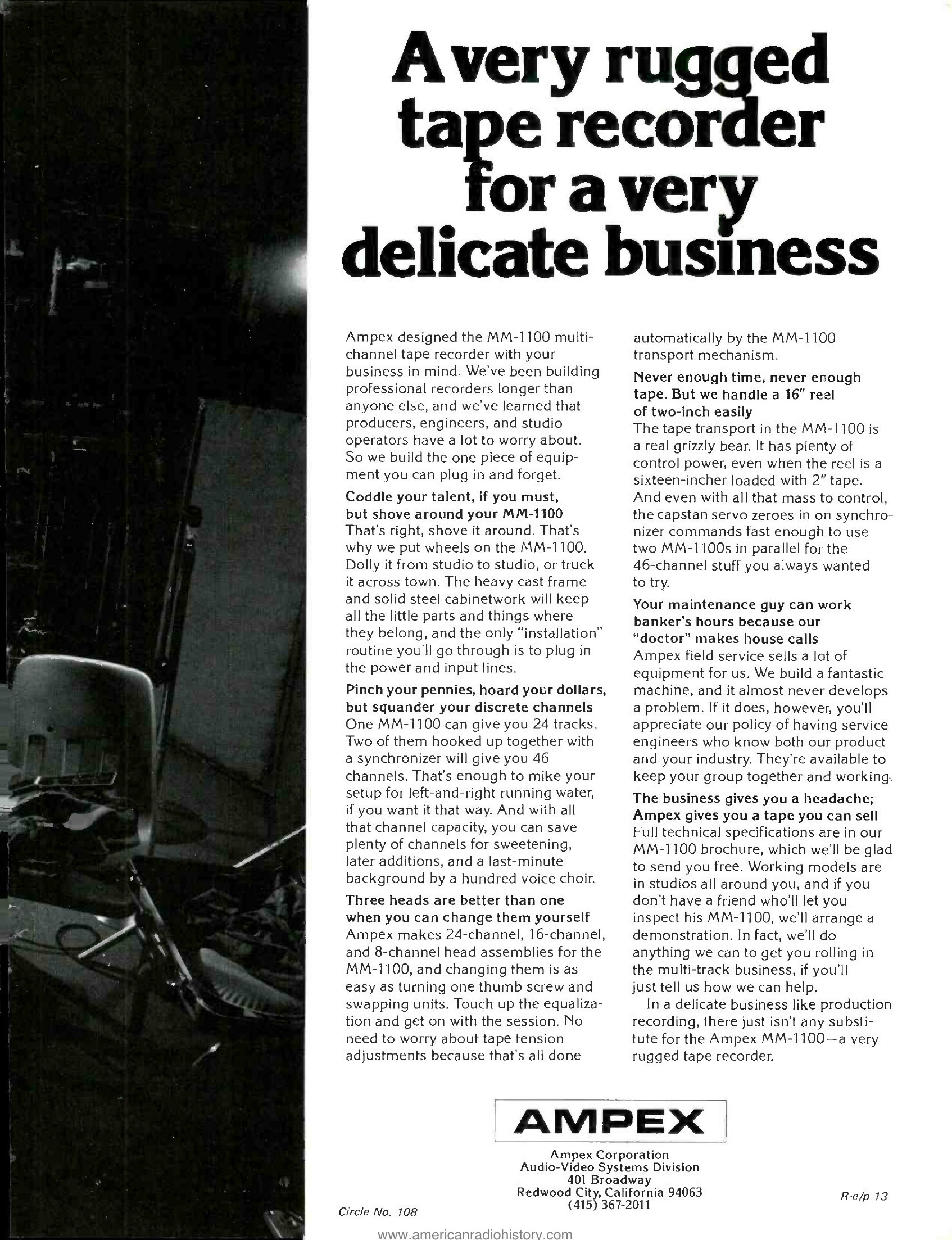
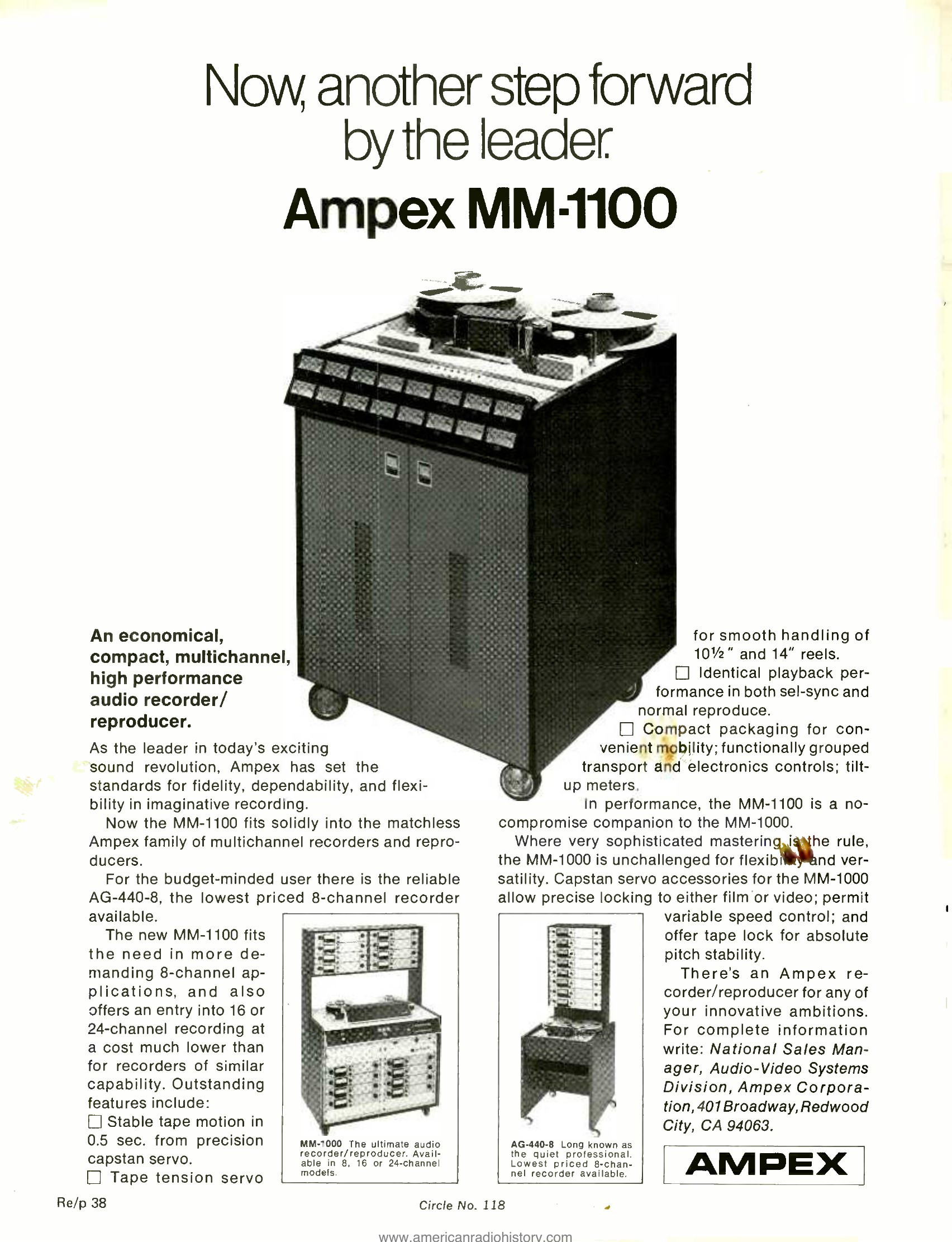
Ampex MM-1000

1968 – 1978  ·  16-track  ·  2 inch (50.8 mm)

Golden Age 15 ips

Ampex's entry into the studio multitrack market, the MM-1000 brought 16-track recording to American studios and competed directly with 3M and Scully for the emerging multitrack market of the late 1960s and 1970s. Electronic transport control, remote control, and sync capability made it a complete production tool. It laid the groundwork for multitrack recording at many of the studios that had already standardised on Ampex 2-track equipment.

16-track recording Electronic transport control Remote control Sync capability

Notable users

Major recording studios, Rock and pop producers

Technical specs

Frequency response 40Hz – 16kHz
Signal-to-noise >60 dB
Wow & flutter <0.1%
Speed accuracy ±0.2%
Head config 16-track
Motor DC servo

Market value

$5,000 – $15,000

Rarity

Rare
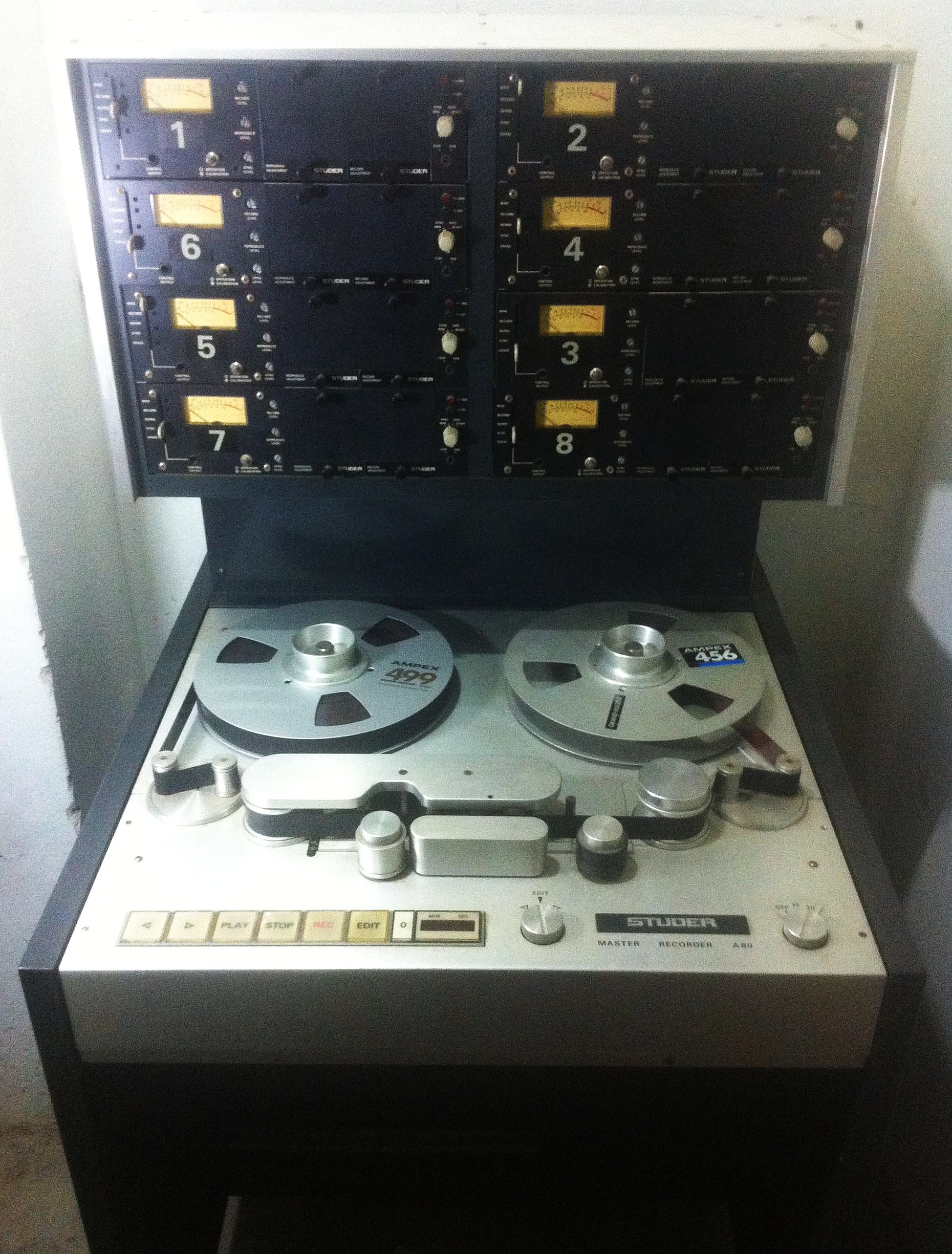
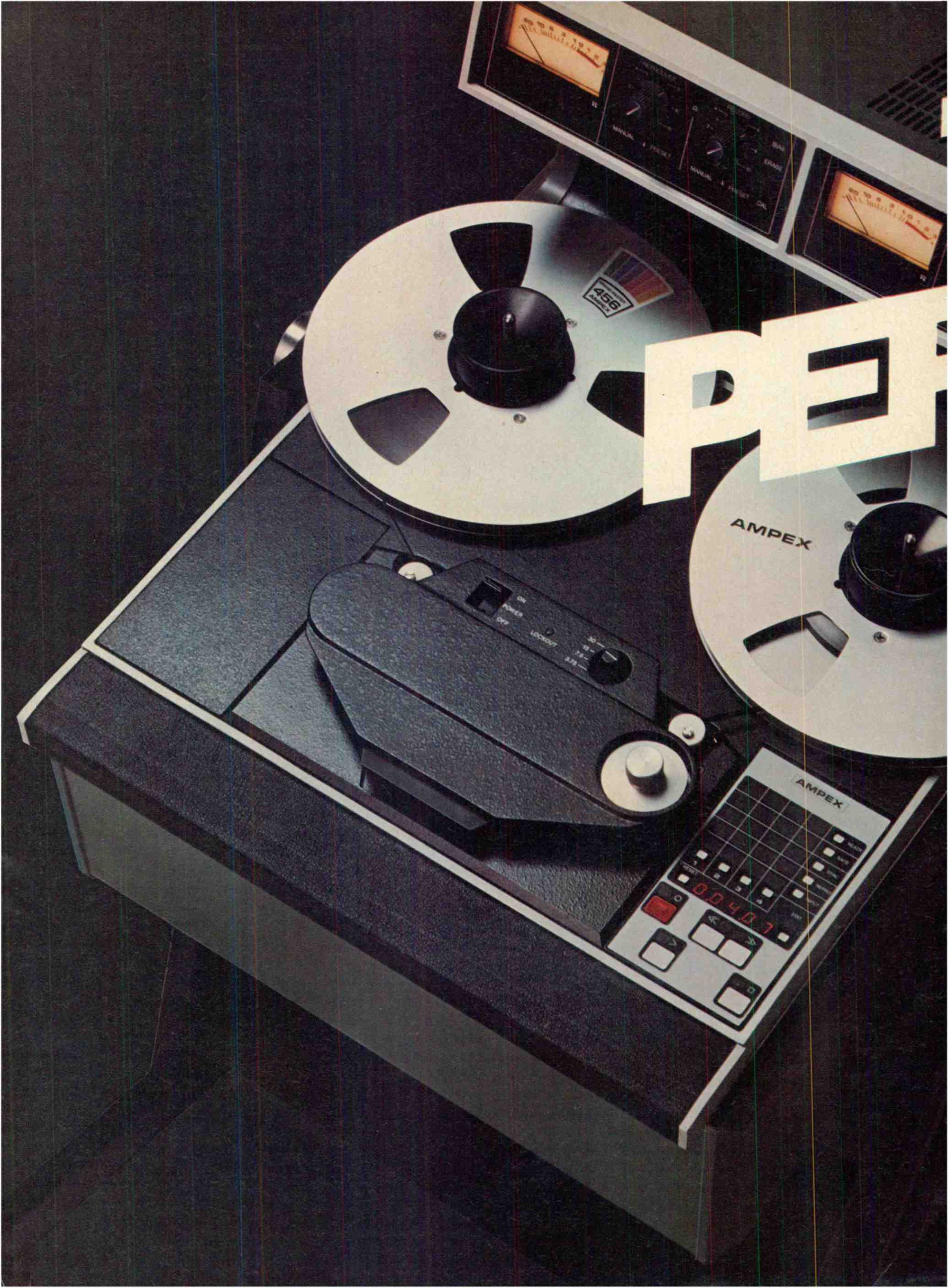
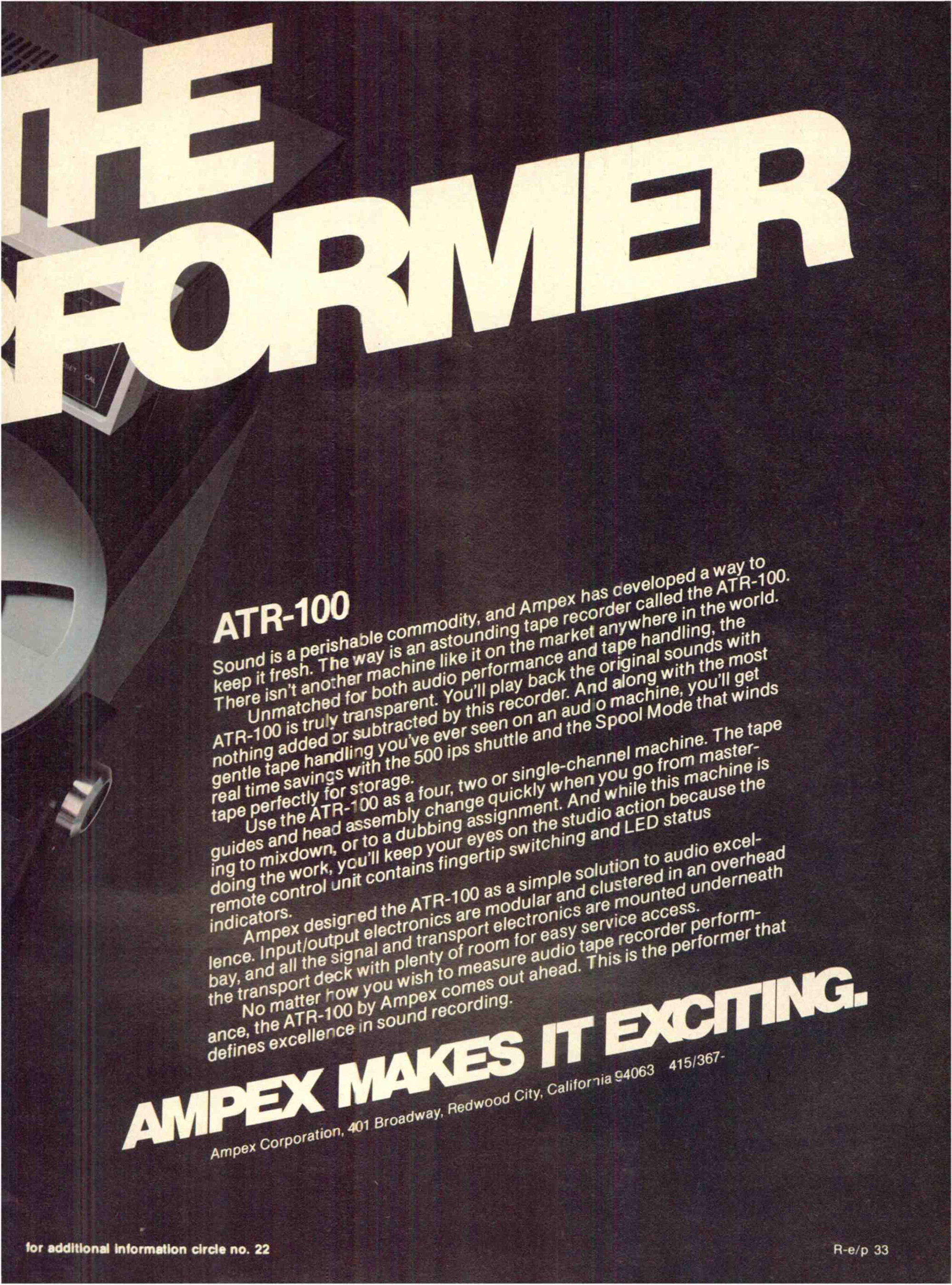
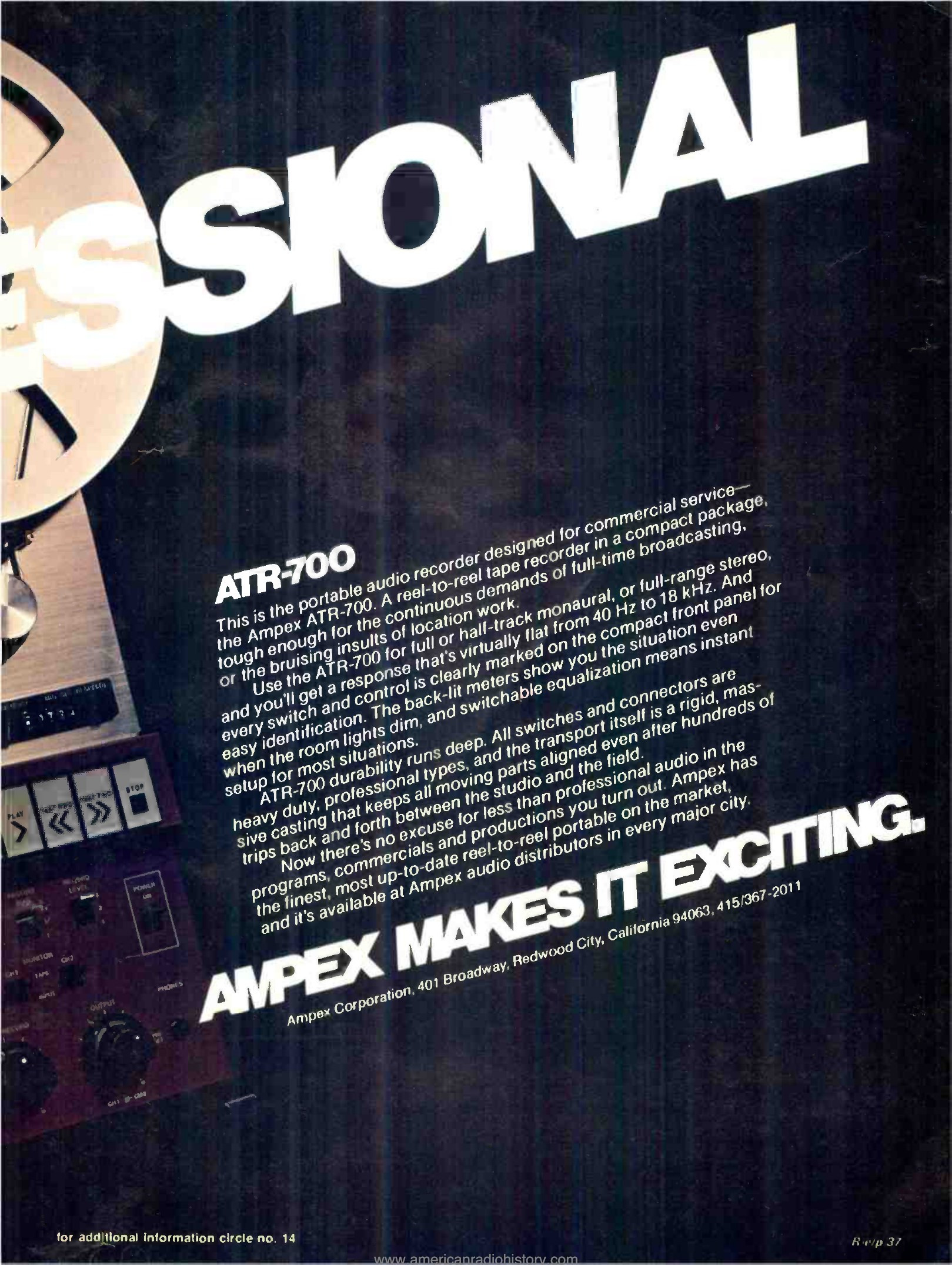
Ampex ATR-100

1976 – 1985  ·  2-track mastering  ·  ¼ inch / ½ inch (6.35 / 12.7 mm)

Transitional 7½ ips 15 ips 30 ips

Designed specifically for mastering — and it shows. The ATR-100's Isoloop tape path provided exceptional transport stability, and the DC servo direct-drive motors gave it speed accuracy that still impresses. Sterling Sound, Bernie Grundman Mastering, and The Mastering Lab all used ATR-100s as their primary decks. Many engineers consider it the finest mastering machine ever built, rivalling the Studer A80 for the top spot.

Isoloop tape path Single capstan Electronic tension Microprocessor control Autolocator Optional ½ inch version

Notable users

Sterling Sound, Bernie Grundman Mastering, The Mastering Lab, Mastering labs worldwide

Technical specs

Frequency response 25Hz – 22kHz ±2dB at 30 ips
Signal-to-noise >72 dB (A-weighted)
Wow & flutter <0.03%
Speed accuracy ±0.05%
Head config Record / Play / Erase
Motor DC servo direct drive

Market value

$12,000 – $30,000

Rarity

Rare

🇯🇵 Otari

Japan — est. 1961

Professional Performance. Accessible Price.

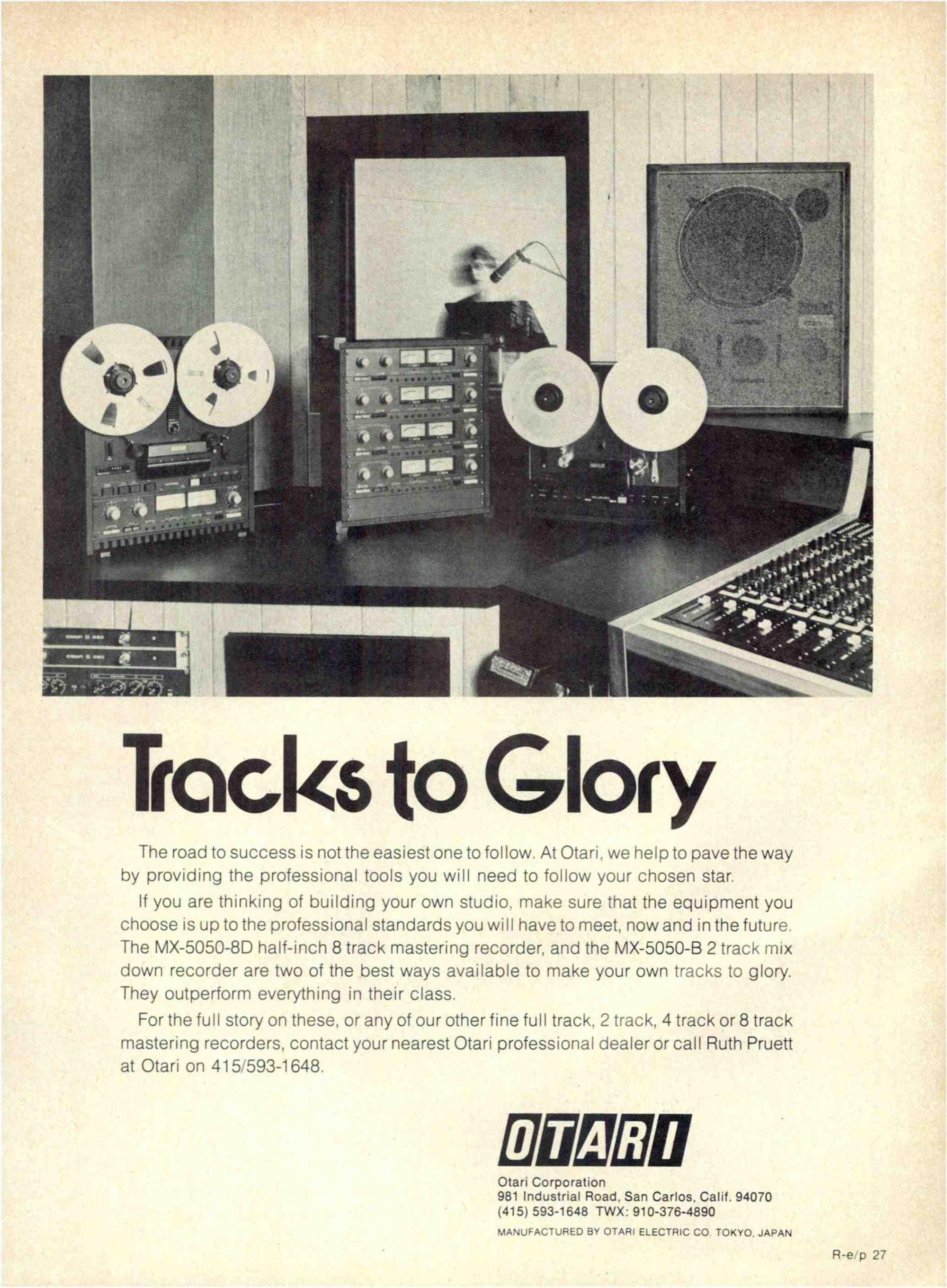
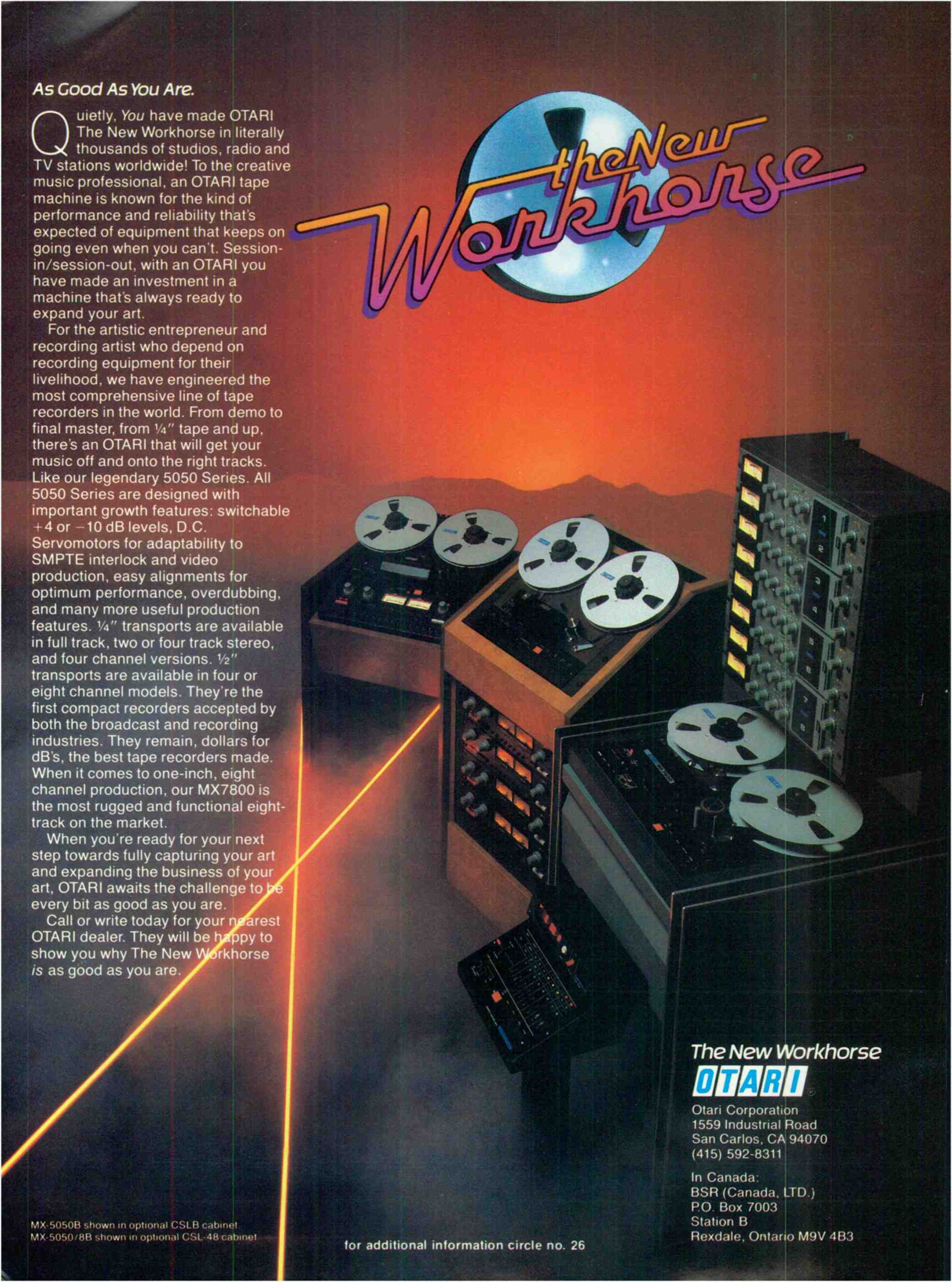
Otari Corporation was founded in Tokyo in 1961 and grew into the leading Japanese manufacturer of professional tape equipment. While Studer owned the top end of the market, Otari found its place by offering genuinely professional performance at substantially lower prices — opening 24-track recording to a generation of project studios and smaller commercial facilities.

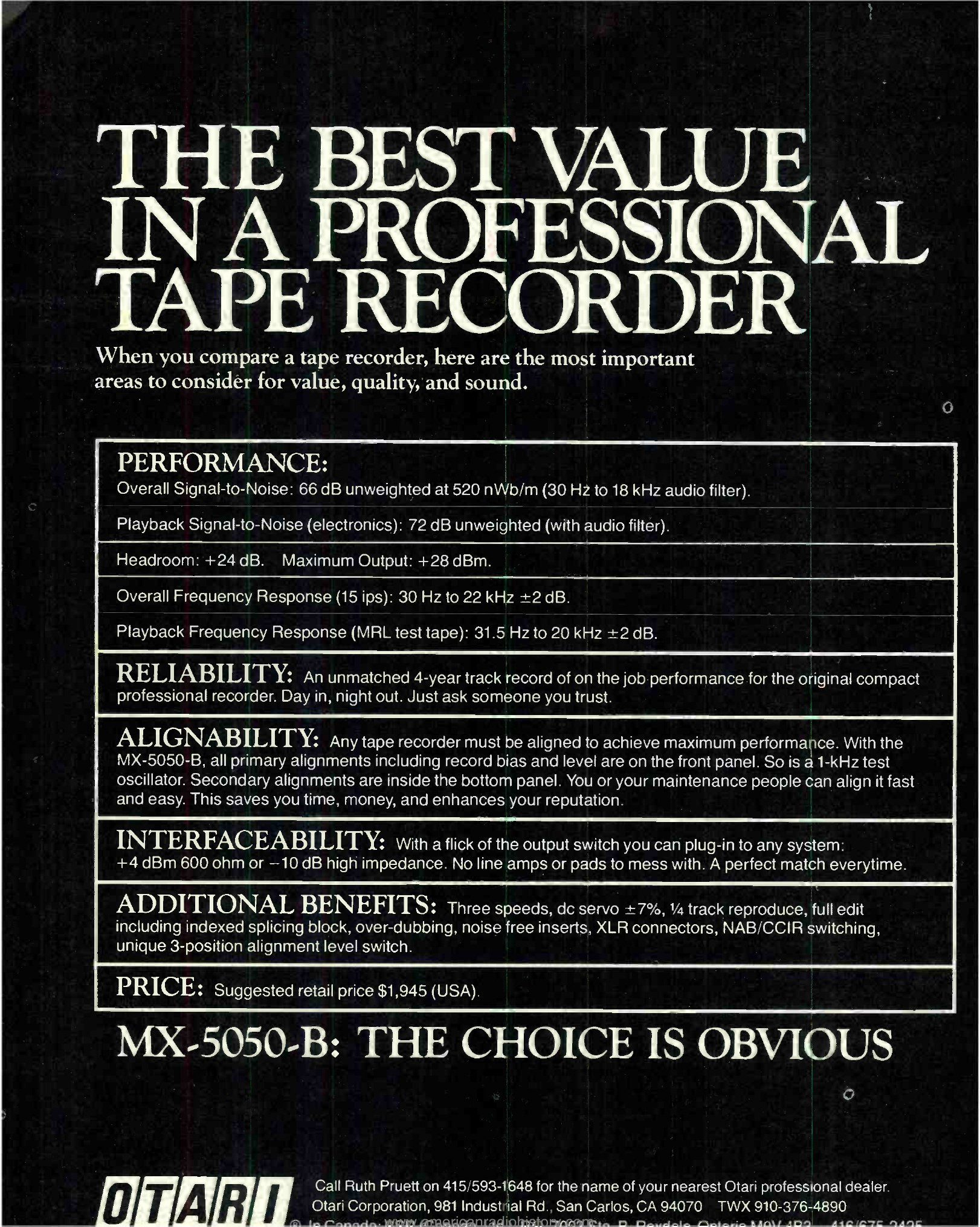
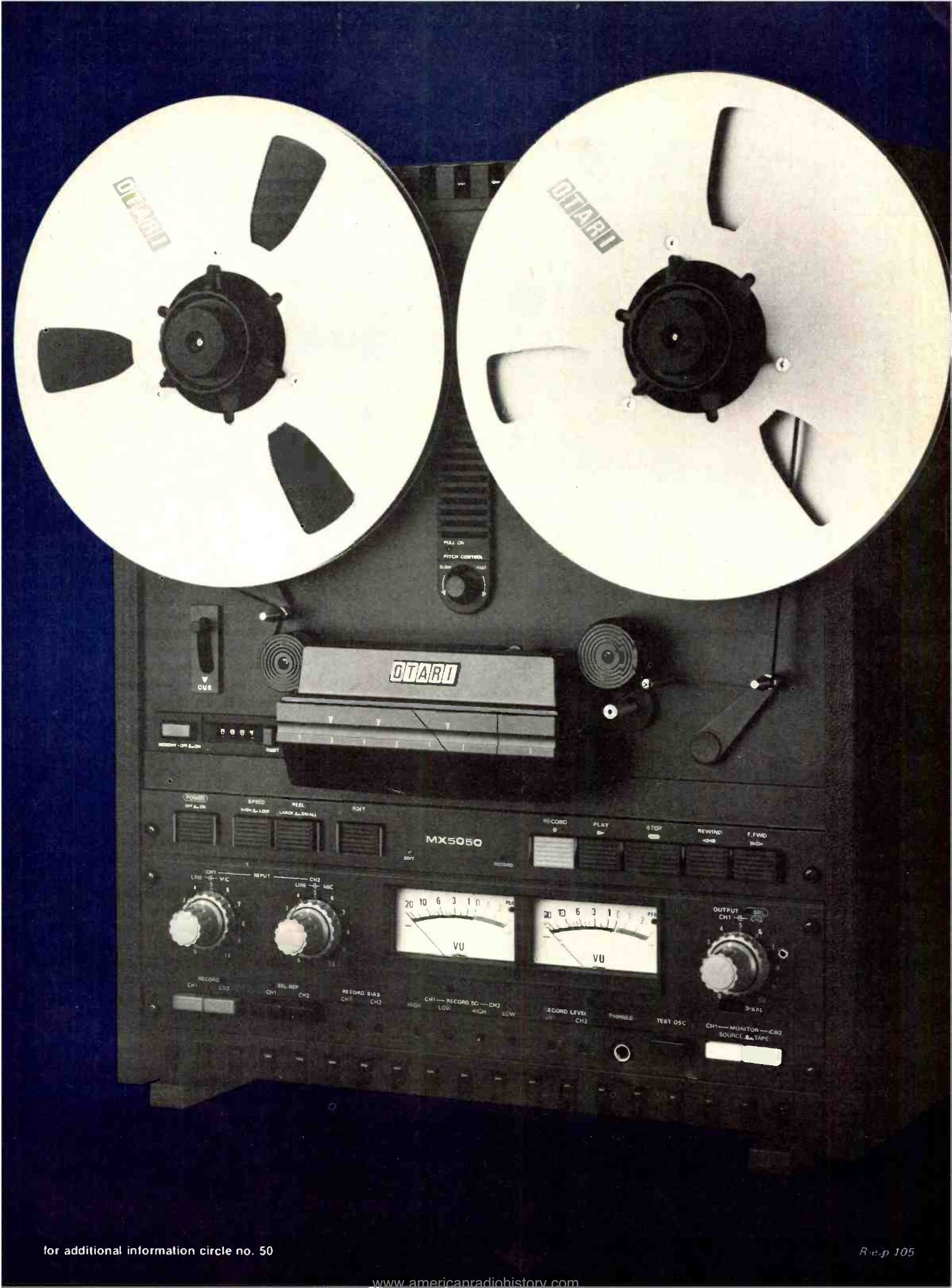
Otari MX-5050

1974 – 1990  ·  2-track / 4-track  ·  ¼ inch (6.35 mm)

Transitional 7½ ips 15 ips

The workhorse of the project studio revolution. The MX-5050 made genuinely professional-quality recording affordable for smaller studios and home recordists who couldn't justify the cost of an Ampex or Studer. Selective reproduction, motion sensing, edit and cueing controls, a test oscillator, and front-panel adjustments made it a complete studio tool. Over 8,000 units were produced, and it remains one of the most common quality open-reel machines in the vintage market.

Selective reproduction Motion sensing Edit control Cueing control Test oscillator Digital timer Front panel adjustments

Notable users

Home studios, Small commercial studios, Broadcast, Educational facilities

Technical specs

Frequency response 35Hz – 22kHz at 15 ips
Signal-to-noise 62 dB (unweighted)
Wow & flutter <0.05%
Speed accuracy ±0.15%
Head config Record / Play / Erase
Motor DC servo

Market value

$1,500 – $4,000

Rarity

Common

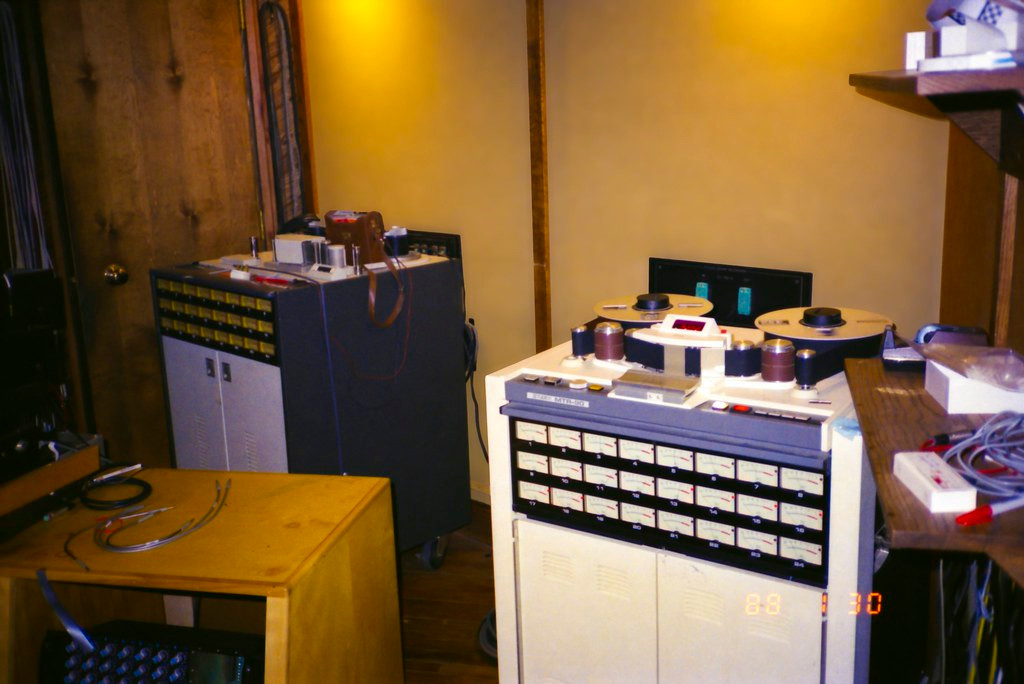
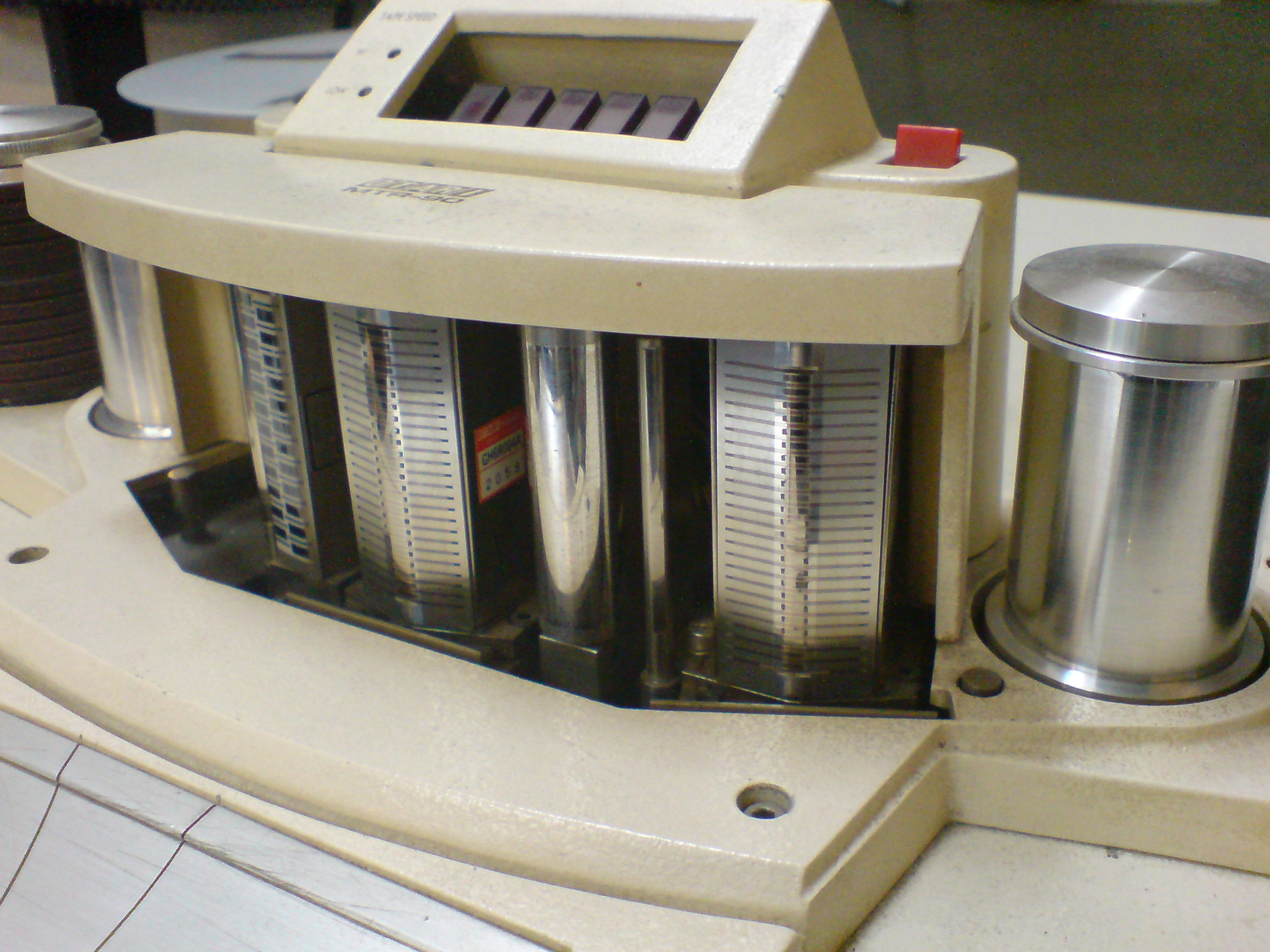
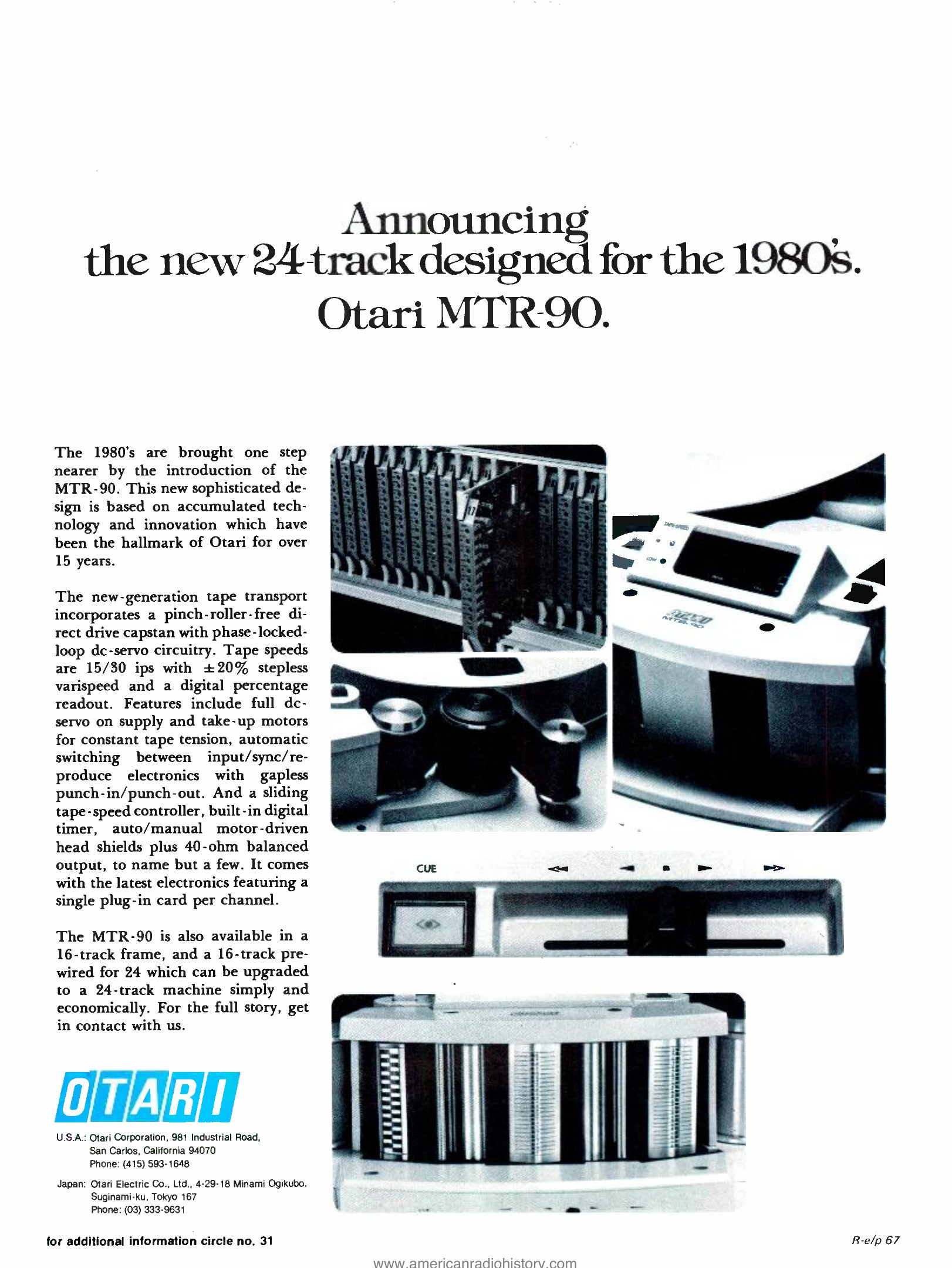
Otari MTR-90

1982 – 1995  ·  24-track  ·  2 inch (50.8 mm)

Transitional 15 ips 30 ips

The MTR-90 brought 24-track recording to studios that couldn't afford a Studer A800. More affordable while maintaining genuine professional quality — the MTR-90 was ubiquitous in project studios and smaller commercial facilities throughout the 1980s and 1990s. Its microprocessor-controlled transport, autolocator, and Dolby SR compatibility made it a complete production tool. The MTR-90 II variant improved on the original with refined electronics.

Microprocessor controlled Autolocator Remote control Dolby SR ready Sync input Electronic tension

Notable users

Project studios worldwide, Smaller commercial studios, Educational institutions, Independent recording facilities

Technical specs

Frequency response 30Hz – 20kHz ±3dB
Signal-to-noise >65 dB (A-weighted)
Wow & flutter <0.06%
Speed accuracy ±0.1%
Head config 24-track
Motor DC servo

Market value

$8,000 – $20,000

Rarity

Moderate

■ 1 vintage ad

Otari MTR-10

1984 – 1995  ·  2-track / 4-track  ·  ¼ inch / ½ inch

Transitional 15 ips 30 ips

Otari's professional mastering and production 2-track, optimised for audio and video post-production applications. An 8080A microprocessor-based control system provided advanced features for the era, and a plug-in CPU board made servicing and upgrades straightforward. Post-production studios, broadcast facilities, and mastering suites adopted it as a reliable professional alternative to Studer 2-track machines.

8080A microprocessor control Plug-in CPU board Post-production optimised Professional mastering

Notable users

Post-production studios, Broadcast, Mastering facilities

Technical specs

Frequency response 30Hz – 20kHz
Signal-to-noise >68 dB
Wow & flutter <0.05%
Speed accuracy ±0.1%
Head config Record / Play / Erase
Motor DC servo

Market value

$2,000 – $6,000

Rarity

Moderate

Otari MTR-12

1984 – 1995  ·  2-track  ·  ¼ inch (6.35 mm)

Transitional 7½ ips 15 ips 30 ips

A variant of the MTR-10 with additional features oriented toward professional mastering. Signal-to-noise above 70 dB and wow and flutter below 0.04% put it in mastering-grade territory. A popular choice for mastering studios and post-production facilities seeking high performance at a practical cost.

Enhanced mastering features Professional electronics High-speed capability

Notable users

Mastering studios, Post-production

Technical specs

Frequency response 30Hz – 22kHz
Signal-to-noise >70 dB
Wow & flutter <0.04%
Speed accuracy ±0.1%
Head config Record / Play / Erase
Motor DC servo

Market value

$2,500 – $7,000

Rarity

Moderate

Otari MTR-20

1986 – 1995  ·  24-track  ·  2 inch (50.8 mm)

Digital Transition 15 ips 30 ips

The MTR-20 represented Otari's late-analog 24-track offering, combining advanced microprocessor control with Dolby SR noise reduction and full SMPTE timecode integration. By the late 1980s studios required seamless synchronisation with video and digital audio systems — the MTR-20 delivered it. Fewer than 1,000 were made, making it the rarest of the Otari multitrack range.

Advanced microprocessor control Autolocator Dolby SR Timecode

Notable users

Professional studios, Post-production

Technical specs

Frequency response 30Hz – 20kHz
Signal-to-noise >68 dB
Wow & flutter <0.05%
Speed accuracy ±0.1%
Head config 24-track
Motor DC servo

Market value

$10,000 – $25,000

Rarity

Rare

🇺🇸 MCI

United States — est. 1967

Modular. Flexible. Built to Work.

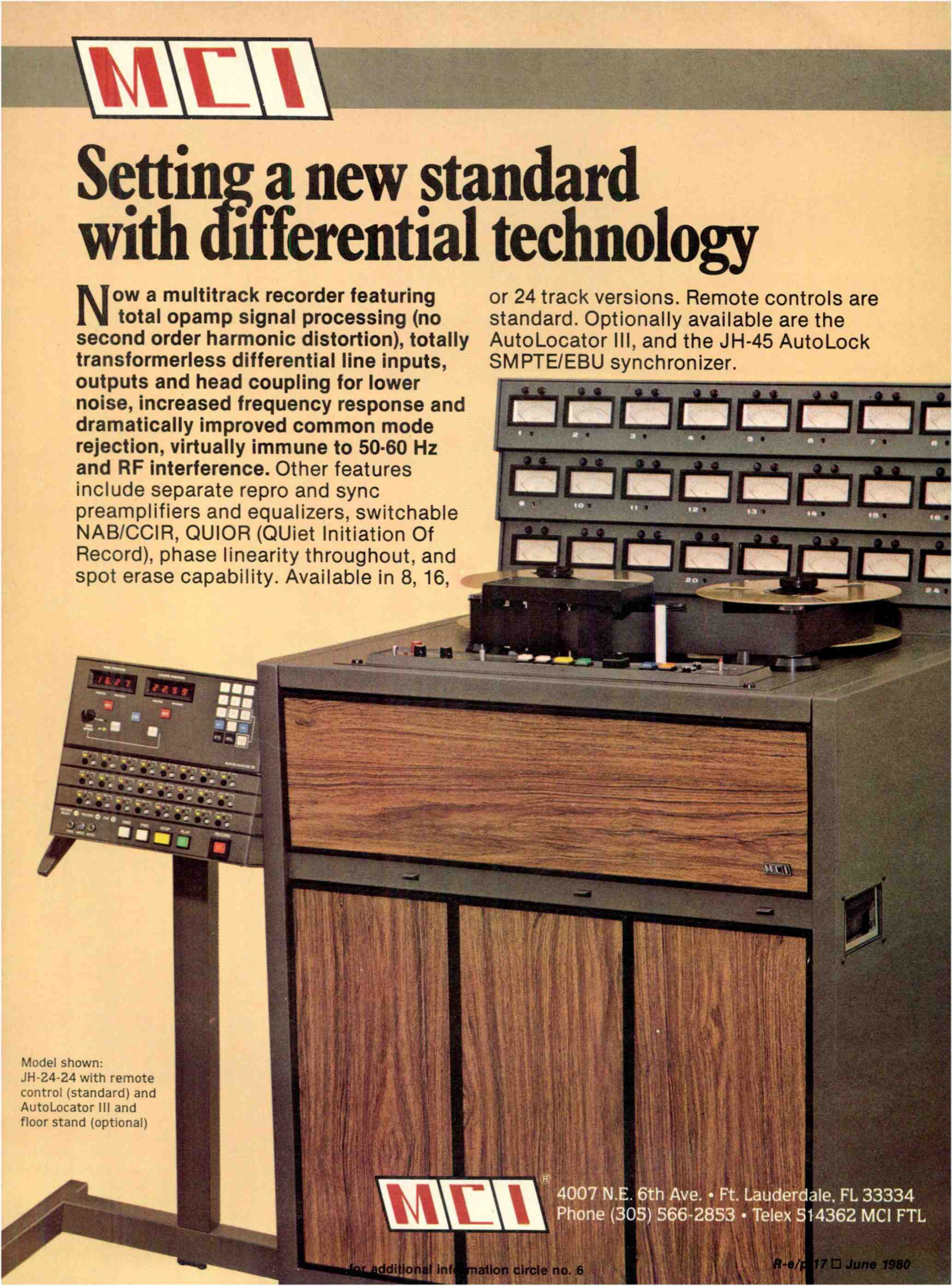
MCI (Media/Communications Industries) was founded in Fort Lauderdale, Florida in 1967 by Jeep Harned. The company distinguished itself from Studer and Ampex by emphasising modular design — MCI machines were built to be expanded, upgraded, and serviced in the field. Transformerless audio electronics, precise servo-controlled tape motion, and comprehensive remote control made MCI a practical choice for commercial studios.

MCI machines were widely adopted across the United States through the 1970s and early 1980s, particularly in facilities that valued service accessibility and system expandability. The JH-24 became one of the most common 24-track machines in American commercial studios.

In 1982 Sony acquired MCI. The Fort Lauderdale plant continued to produce JH-24 and JH-110 machines under Sony ownership for several years — often branded "Sony/MCI" on the badge — before Sony developed its own in-house high-end analog line, the APR-5000 series (see Sony brand entry above). The JH-24 itself remained in production into the mid-1980s and survives in working studios today as one of the most successful American multitracks ever built.

MCI JH-16

1971 – 1979  ·  16-track / 24-track  ·  2 inch (50.8 mm)

Golden Age 15 ips

MCI's first serious multitrack offering, the JH-16 appeared in various transport configurations across its production life — the JH-10, JH-100, and JH-114 transports were all used in JH-16 machines. Modular electronics and remote control made it a flexible studio tool. The JH-16 established MCI's reputation in the multitrack market and laid the groundwork for the more capable JH-24.

Various transport options (JH-10, JH-100, JH-114) Modular electronics Remote control

Notable users

Recording studios, Production facilities

Technical specs

Frequency response 30Hz – 18kHz
Signal-to-noise >60 dB
Wow & flutter <0.08%
Speed accuracy ±0.2%
Head config 16/24-track
Motor AC/DC depending on transport

Market value

$4,000 – $12,000

Rarity

Moderate

MCI JH-110

1975 – 1985  ·  2-track / 4-track  ·  ¼ inch / ½ inch

Transitional 7½ ips 15 ips 30 ips

MCI's professional 2-track and 4-track recorder, available in multiple configurations for mastering, production, and sync applications. Reliable DC servo drive, sync capability, and remote control made it a practical studio companion to the JH-24 multitrack. Known for good sound at a price accessible to commercial studios already invested in MCI multitrack equipment.

Professional 2-track Multiple configurations Remote control Sync capability

Notable users

Recording studios, Mastering facilities

Technical specs

Frequency response 30Hz – 20kHz
Signal-to-noise >65 dB
Wow & flutter <0.06%
Speed accuracy ±0.1%
Head config Record / Play / Erase
Motor DC servo

Market value

$3,000 – $8,000

Rarity

Moderate

MCI JH-114

1975 – 1980  ·  24-track  ·  2 inch (50.8 mm)

Transitional 15 ips

The transport mechanism at the heart of the JH-24 and JH-16, the JH-114 was also produced as a standalone 24-track machine. All DC servo motors and the option of transformer-coupled channels made it a versatile platform. The transformer version is highly regarded for its audio character — transformers add a subtle harmonic quality that many engineers find musical. The Autolocator II remote gave it the automation capabilities commercial studios demanded.

All DC motors Transformer-coupled channels Autolocator II Remote control

Notable users

Major recording studios

Technical specs

Frequency response 30Hz – 18kHz
Signal-to-noise >64 dB
Wow & flutter <0.07%
Speed accuracy ±0.15%
Head config 24-track
Motor All DC servo

Market value

$5,000 – $15,000

Rarity

Moderate

MCI JH-24

1975 – 1985  ·  8-track / 16-track / 24-track  ·  1 inch / 2 inch

Transitional 15 ips 30 ips

The definitive MCI machine and one of the most successful American 24-track recorders of the 1970s and 1980s. The JH-24 combined modular expandability, transformerless audio electronics, precise servo-controlled tape motion, and comprehensive remote control in a package that commercial studios could maintain and upgrade themselves. Widely adopted across the United States, it is the MCI machine most likely to appear in a working studio today.

JH-114 tape transport Modular expandable design Remote control unit System upgrading capability Multiple tape formats

Notable users

Recording studios, Post-production facilities, Educational institutions

Technical specs

Frequency response 30Hz – 18kHz
Signal-to-noise >62 dB
Wow & flutter <0.08%
Speed accuracy ±0.15%
Head config 8/16/24-track
Motor DC servo

Market value

$6,000 – $18,000

Rarity

Moderate

🇯🇵 Sony

Japan — est. 1946

Pioneers of Professional Digital.

Sony Corporation was founded in Tokyo in 1946 as Tokyo Tsushin Kogyo. By the late 1970s Sony's professional audio division had developed the PCM-1600 — the first professional 2-channel digital recorder — opening the era of digital mastering and laying the technical foundation for the Compact Disc.

Sony's approach to 2-track digital mastering was to use existing videotape infrastructure (U-matic VCRs) as storage for digital audio data, dramatically reducing cost compared to custom digital tape systems. The PCM-1600 / PCM-1610 / PCM-1630 lineage became the industry standard for CD mastering throughout the 1980s.

For multitrack, Sony developed an entirely separate format: DASH (Digital Audio Stationary Head), introduced in 1984. Where the PCM-1600 mastering line used rotary video-style heads, DASH used stationary heads on ½-inch tape and offered editable digital multitrack with comparatively easy razor-blade-style editing. The PCM-3324 (24-track) and PCM-3348 (48-track) became the digital multitrack standard at major studios worldwide — competing directly with Mitsubishi's ProDigi format. The PCM-3348HR added 24-bit resolution in the mid-1990s and held position until hard-disk-recording finally displaced it.

In 1982 Sony acquired MCI of Fort Lauderdale, Florida — bringing the JH-24 + JH-110 analog tape machines into the Sony catalogue. Sony continued producing MCI-branded machines (sometimes "Sony/MCI") through the early 1980s, then developed its own analog mastering line — the APR-5000 series (APR-5003 2-track + APR-5008 8-track + later variants) — as Sony's in-house high-end analog offering through the late 1980s and 1990s.

Sony PCM-1600

1978 – 1985  ·  2-track digital  ·  U-matic video

Transitional Digital standard

The machine that started digital mastering. The PCM-1600 encoded 16-bit, 44.1kHz digital audio as a video signal stored on standard U-matic VCRs, making professional digital recording possible without expensive custom formats. Mastering studios and major record labels adopted it for the first wave of CD masters. Many of the earliest CDs were mastered directly from PCM-1600 recordings.

16-bit digital recording 44.1kHz sampling rate U-matic VCR interface CD mastering

Notable users

Mastering studios, Major record labels, CD mastering facilities

Technical specs

Frequency response 2Hz – 20kHz
Dynamic range 90 dB
Sampling rate 44.1kHz
Bit depth 16-bit
Wow & flutter N/A (digital)

Market value

$2,000 – $6,000

Rarity

Rare

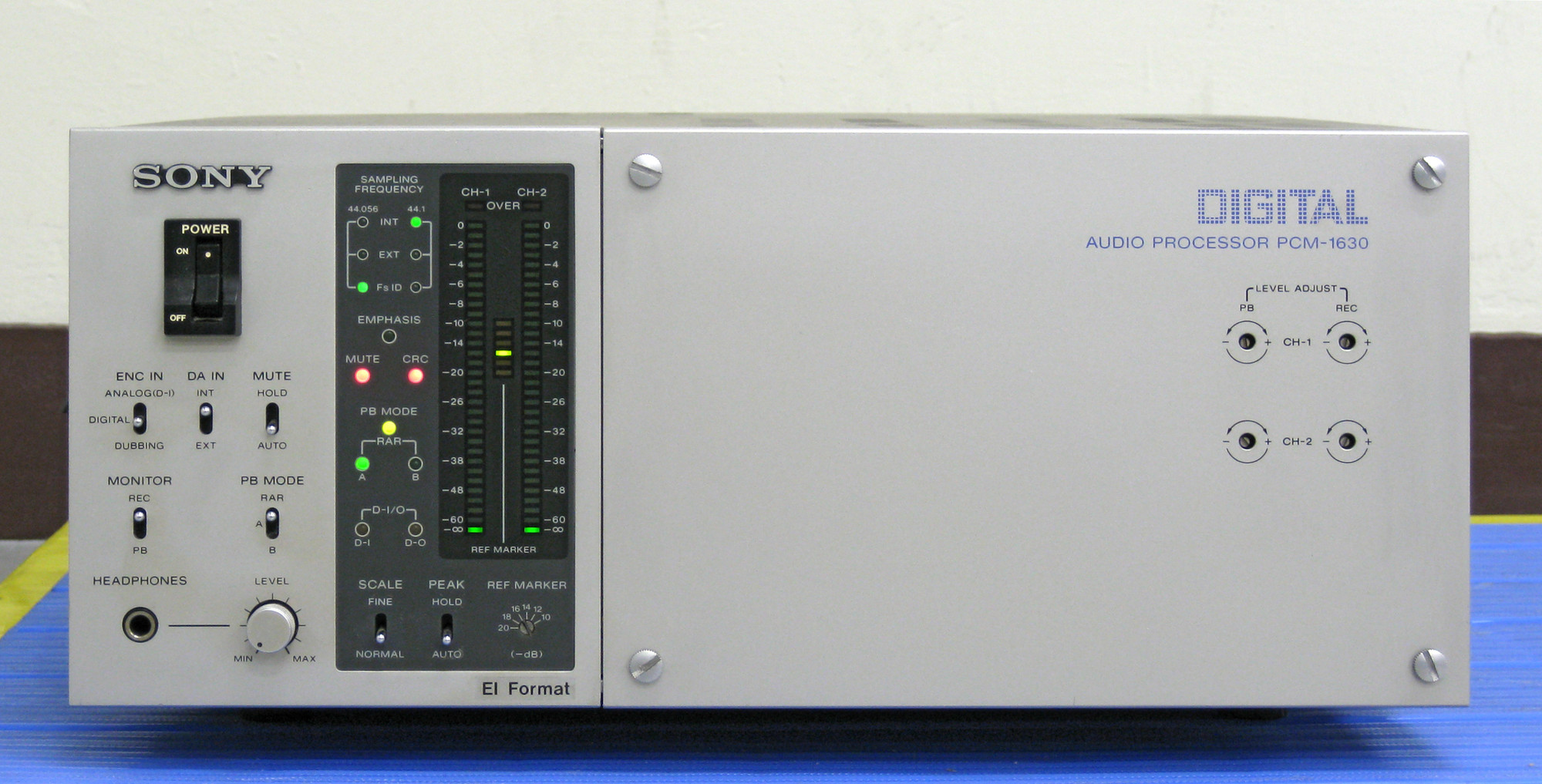
Sony PCM-1630

1980 – 1990  ·  2-track digital processor  ·  U-matic / Betacam

Transitional Digital standard

The third generation of the PCM-1600 system and the machine that became the absolute standard for CD mastering through the 1980s. So widely adopted was the PCM-1630 that the CD manufacturing industry effectively required masters to be submitted in this format. Virtually every CD produced in the 1980s and into the 1990s passed through a PCM-1630 at some point in its production chain.

Third generation PCM system U-matic / Betacam compatible CD mastering standard Improved over PCM-1600

Notable users

Mastering labs, CD manufacturing

Technical specs

Frequency response 2Hz – 20kHz
Dynamic range 90 dB
Sampling rate 44.1kHz
Bit depth 16-bit
Wow & flutter N/A (digital)

Market value

$1,000 – $3,000

Rarity

Rare

Sony PCM-2500

1989 – 1995  ·  2-track DAT  ·  DAT cassette

Digital Transition Digital standard

As DAT emerged in the late 1980s, the PCM-2500 brought professional-grade features to the compact format. AES/EBU digital I/O, multiple sampling rates (48, 44.1, and 32kHz), and Skip ID made it suitable for professional studio, broadcast, and location recording. The PCM-2500 represented the transition from bulky U-matic-based digital recording to the portable DAT format that would dominate professional location recording through the 1990s.

DAT recording 48 / 44.1 / 32kHz sampling Skip ID AES/EBU digital interface Professional features

Notable users

Professional studios, Broadcast, Location recording

Technical specs

Frequency response 2Hz – 22kHz
Dynamic range 90 dB
Sampling rate 48 / 44.1 / 32kHz
Bit depth 16-bit
THD 0.05%

Market value

$1,500 – $4,000

Rarity

Rare

Sony PCM-3324

1984 – early 1990s  ·  24-track digital (DASH)  ·  ½ inch (12.7 mm) DASH format

Digital Transition 30 ips

Sony's first DASH multitrack and the machine that brought professional digital multitrack into reach of top-tier studios. DASH (Digital Audio Stationary Head) used stationary heads on ½-inch tape — a fundamentally different approach to Mitsubishi's rotary-head ProDigi format that was its main competitor. The PCM-3324 ran 24 channels at 16-bit / 48 kHz with editing comparable to analog tape (razor-blade-style splicing was possible on DASH). Major studios that installed it through the late 1980s and early 1990s used it for projects where digital cleanliness was a requirement rather than a stylistic choice.

24-track digital DASH format (½-inch tape, stationary heads) 16-bit / 48 kHz sampling Razor-blade editing possible Studio-grade transport

Notable users

Sony Music Studios, NYC, A&M Studios, LA, Onkio Haus, Tokyo, Major mastering + post-production facilities worldwide

Technical specs

Format DASH (Digital Audio Stationary Head)
Tape width ½ inch
Sampling rate 48 kHz
Bit depth 16-bit
Tracks 24
Editing Razor-blade-style splice editing (DASH advantage over rotary)

Market value

$8,000 – $25,000 (est., complete working unit + remote)

Rarity

Rare

Sony PCM-3348

1988 – late 1990s  ·  48-track digital (DASH)  ·  ½ inch (12.7 mm) DASH format

Digital Transition 30 ips

The 48-track sibling of the PCM-3324 — Sony's digital multitrack flagship and the de-facto top-tier DASH machine through the late 1980s and 1990s. Double the channel count for projects that needed it; the same razor-blade-style editing that distinguished DASH from rotary-head formats. The later PCM-3348HR added 24-bit resolution in the mid-1990s and stayed in service at major studios until hard-disk recording finally displaced it.

48-track digital DASH format (½-inch tape, stationary heads) 16-bit / 48 kHz (PCM-3348) → 24-bit (3348HR) Razor-blade editing Locked multitrack standard for digital sessions

Notable users

Top-tier mastering + tracking facilities worldwide, Film score recording stages, Major-label projects requiring digital cleanliness through the 90s

Technical specs

Format DASH (Digital Audio Stationary Head)
Tape width ½ inch
Sampling rate 48 kHz
Bit depth 16-bit (PCM-3348) / 24-bit (PCM-3348HR, mid-90s+)
Tracks 48
Variants PCM-3348 (1988) → PCM-3348HR (24-bit, mid-1990s)

Market value

$15,000 – $45,000 (est., 3348HR commands premium)

Rarity

Rare (Holy Grail among DASH machines)

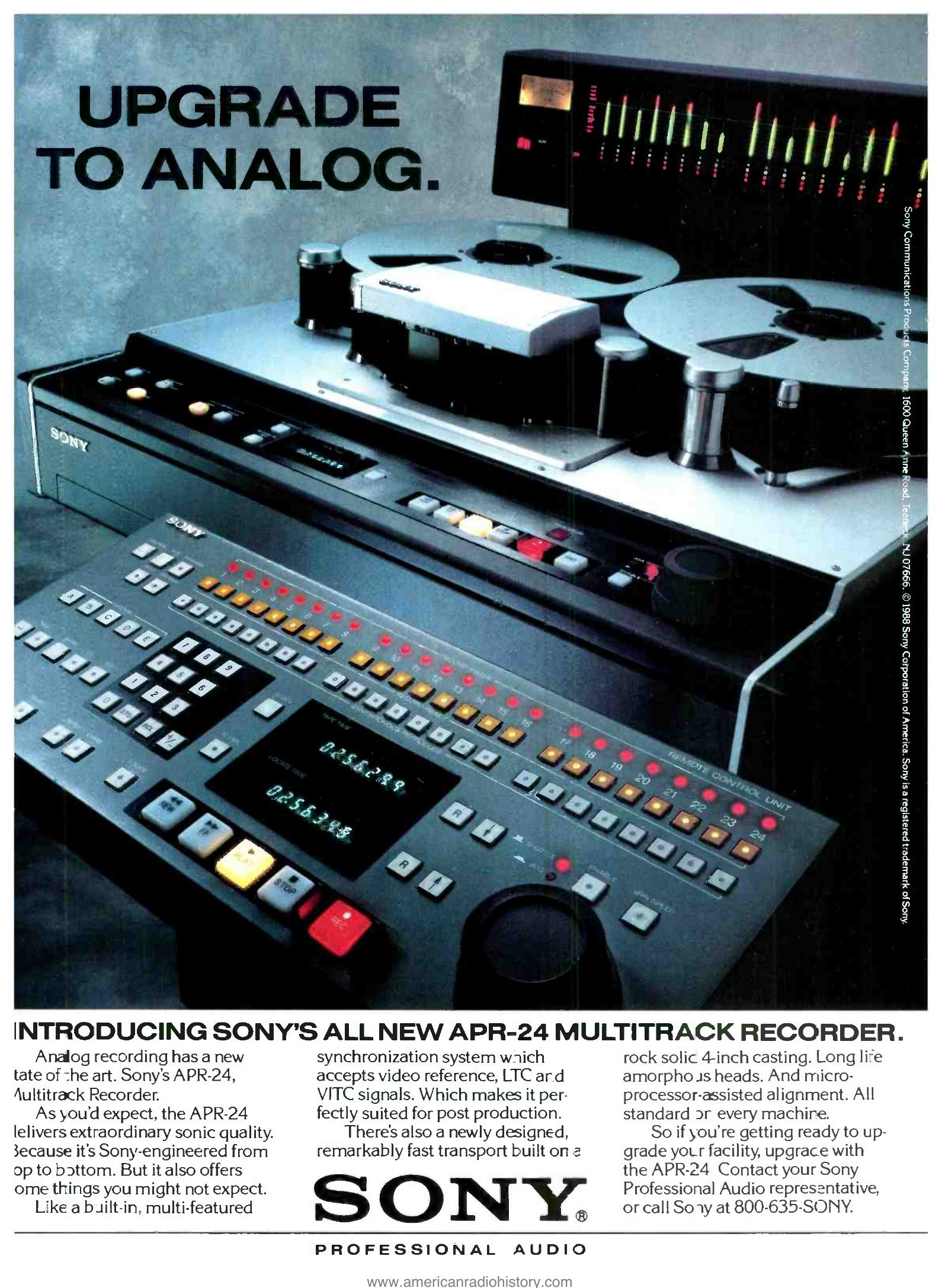
Sony APR-5003 / APR-5000 Series

~1988 – mid 1990s  ·  2-track / 8-track analog mastering  ·  ¼ inch (5003) / 1 inch (5008)

Digital Transition 7½ ips 15 ips 30 ips

Sony's in-house high-end analog mastering line, developed after the company exhausted its post-MCI inventory. The APR-5003 was the 2-track flagship — quartz-PLL servo capstan, electronic tape tension control, ±15% varispeed, balanced XLR I/O — positioned to compete with Studer A820 and Otari MTR-12 in the high-end mastering / classical recording market. The APR-5008 8-track followed for facilities that wanted a Sony-branded multitrack outside the DASH digital line. Sony's post-acquisition relationship to MCI is part of the story here: from 1982 onwards Sony also kept producing JH-24 + JH-110 machines as "Sony/MCI" — see the MCI brand entry below for the JH lineage Sony continued.

Quartz-PLL servo capstan Electronic tape tension control Varispeed ±15% Balanced XLR I/O Optional noise reduction Remote control

Notable users

Mastering facilities seeking Sony-branded alternative to Studer A820, Japanese broadcast + classical recording

Technical specs

Frequency response 30Hz – 22kHz ±2dB at 15 ips
Signal-to-noise >72 dB (A-weighted)
Wow & flutter <0.05% (DIN weighted)
Speed accuracy ±0.05%
Variants APR-5003 (2-track), APR-5008 (8-track), later refinements

Market value

$3,000 – $9,000 (est., 5003); $6,000 – $14,000 (est., 5008)

Rarity

Moderate

■ Vintage Ads 2 ads

🇯🇵 Mitsubishi

Japan — est. 1870

ProDigi — the stationary-head alternative.

Mitsubishi Electric entered professional audio with its ProDigi format in the early 1980s — a stationary-head digital recording system that competed directly with Sony's DASH standard. Both used fixed heads on linear tape (contrasting with rotating-head consumer digital formats), enabling razor-blade editing and low tape noise.

The X-86 32-track multitrack became Mitsubishi's flagship professional machine, installed at major facilities alongside or instead of Sony's PCM-3324. The X-86HS ("High Sampling") extended the format to 96kHz sampling, an extraordinary specification for the late 1980s that positioned it as an early high-resolution recording platform. Conway Recording Studios, A&M Studios, and several Tokyo-based facilities ran X-86 machines.

Mitsubishi's ProDigi format ultimately lost the standard-setting race to Sony DASH, which had broader adoption and longer manufacturer support. By the mid-1990s hard-disk-based recording was displacing all tape-based digital formats, making the X-86 lineage collectible as one of the earliest 96kHz-capable professional recorders.

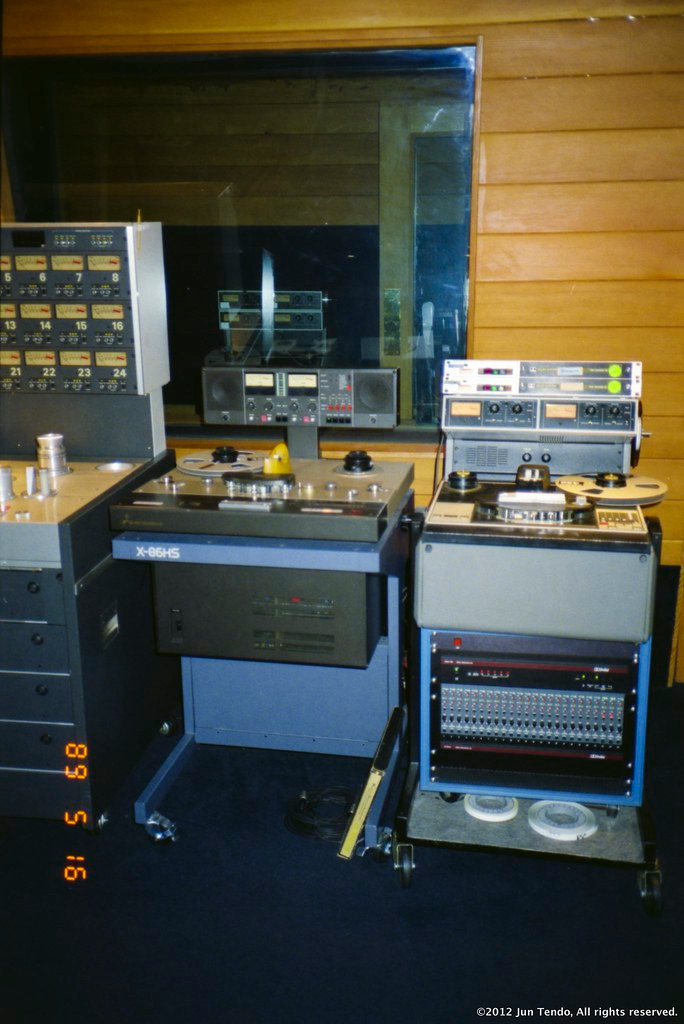
Mitsubishi X-86HS

1988 – 1995  ·  32-track digital  ·  1 inch

Digital Transition 30 ips

The professional-grade 32-track machine from Mitsubishi's ProDigi format lineup. The HS suffix denotes High Sampling — the X-86HS supported 96kHz sampling rate, making it one of the earliest high-resolution multitrack recorders available to commercial studios. Stationary-head design allowed razor-blade editing and comparatively simple tape handling. Conway Recording Studios Studio B carried an X-86HS in 1989.

32-track digital 96kHz sampling (HS) ProDigi stationary-head Razor-blade editable

Notable users

Conway Recording Studios, Los Angeles, Major Tokyo facilities

Technical specs

Tracks 32
Sampling rate Up to 96kHz (HS variant)
Bit depth 20-bit
Format ProDigi (stationary head)
Tape width 1 inch
Wow & flutter N/A (digital)

Market value

$3,000 – $8,000 (est.)

Rarity

Very rare

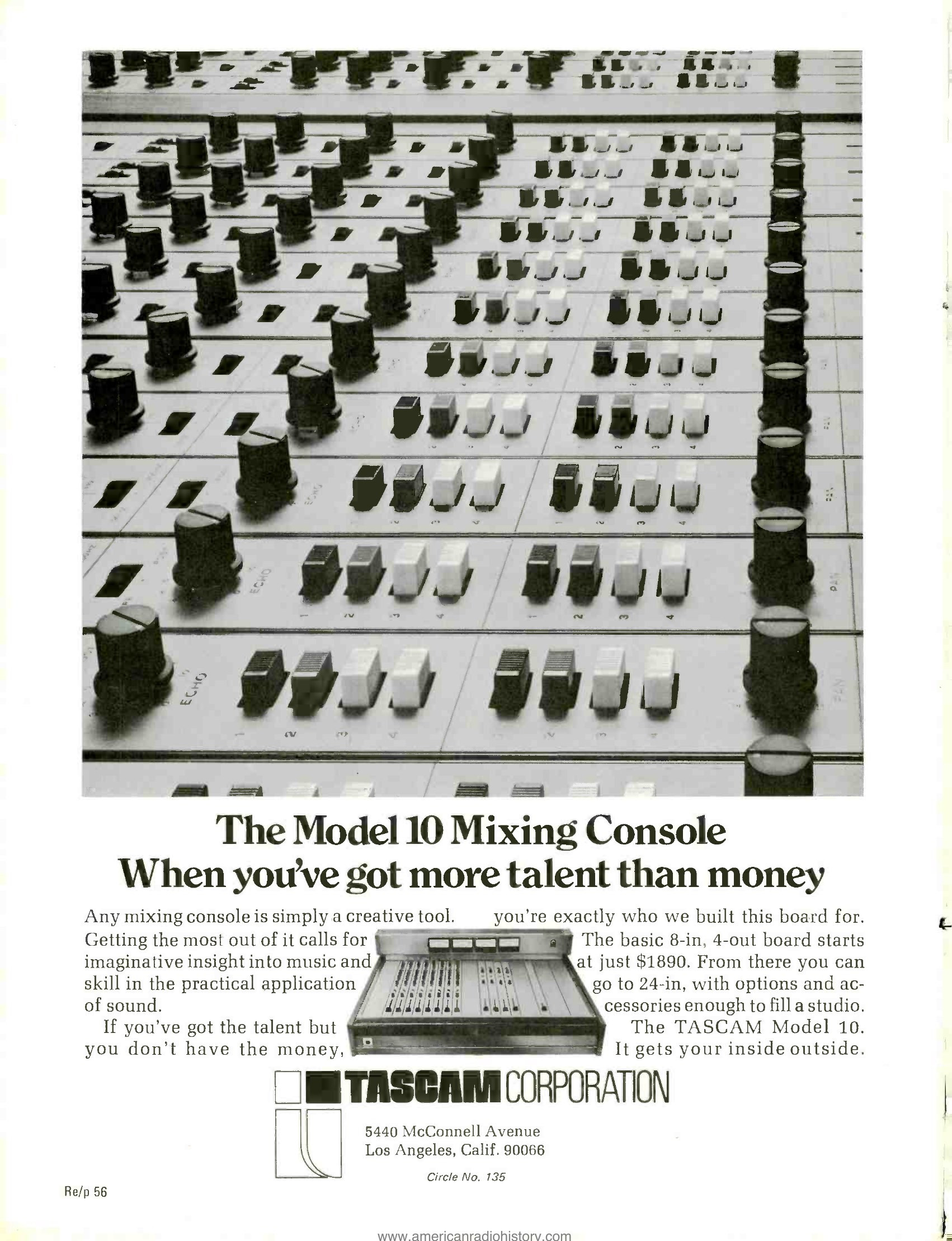
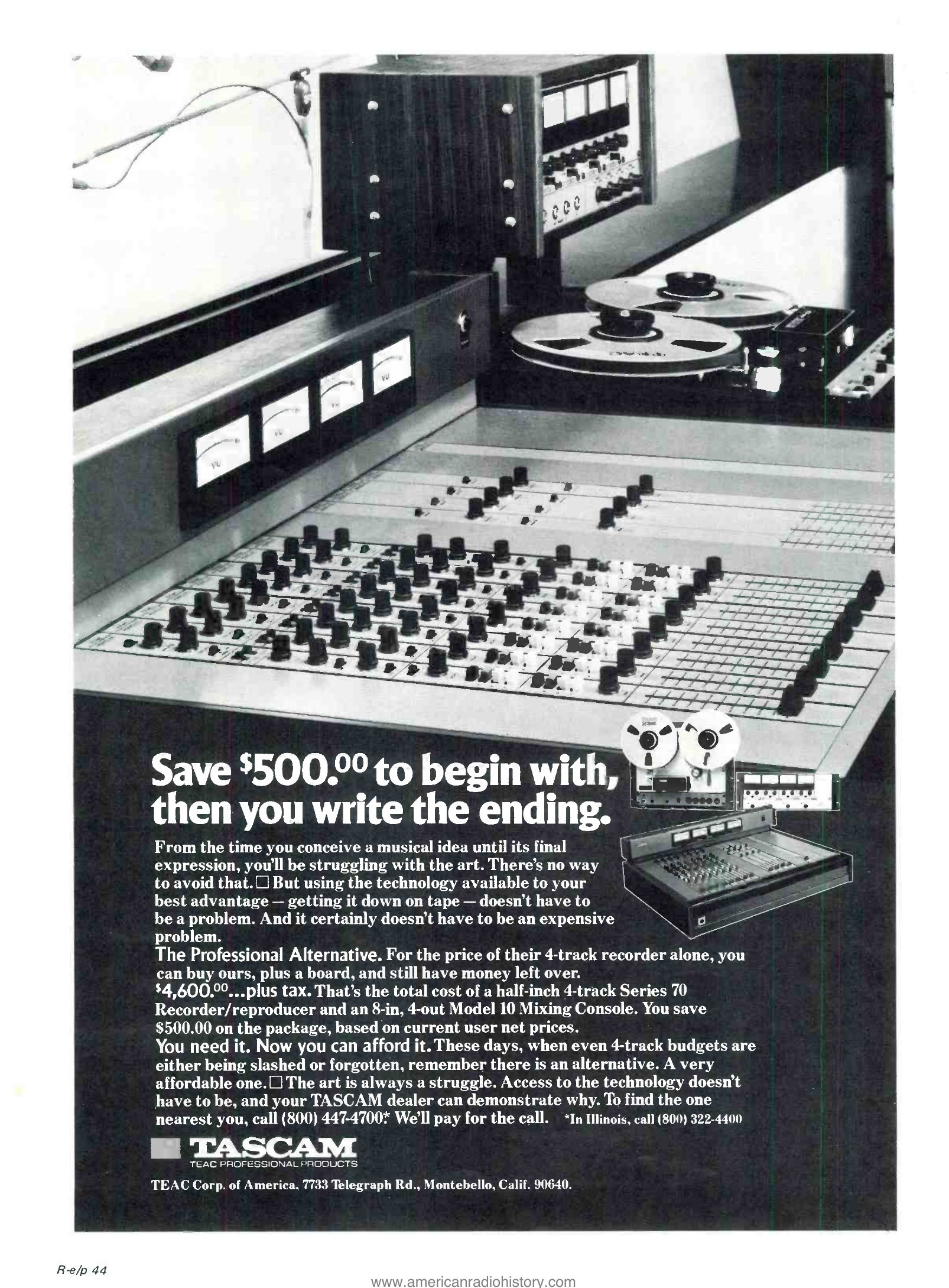
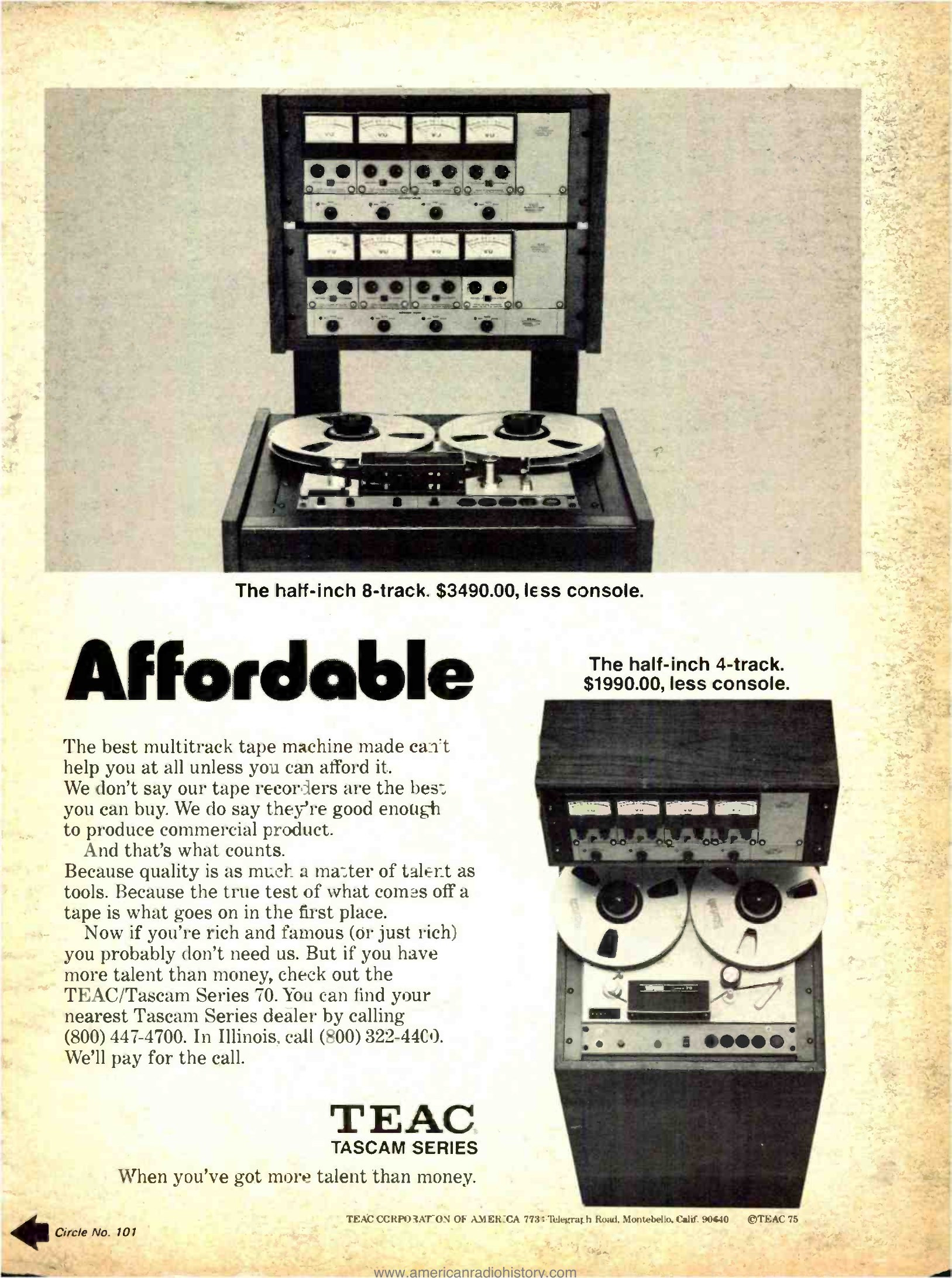
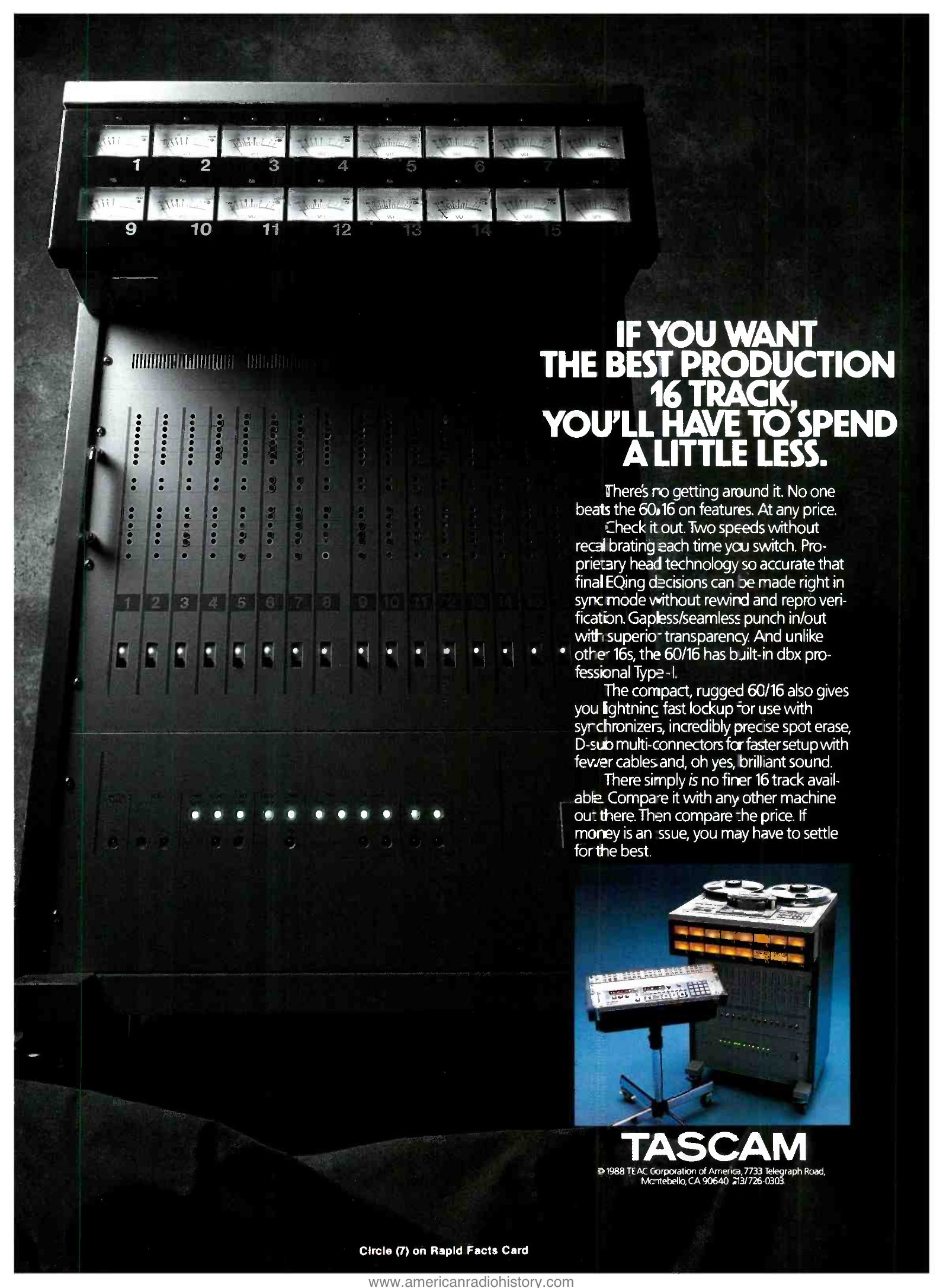
🇯🇵 TEAC

Japan — est. 1953

The Home Studio Revolution Starts Here.

teac.com ↗

TEAC (Tokyo Electro-Acoustic Company) was founded in 1953 and grew into one of Japan's leading consumer electronics manufacturers. The company changed home recording in 1972 when it released the A-3340 — an affordable 4-track open-reel recorder that put multitrack recording in reach of individual musicians for the first time.

Before TEAC, multitrack recording required a professional studio. After the A-3340, musicians could record overdubs, build arrangements, and experiment with production techniques at home. TEAC's machines seeded a generation of self-produced recordings and established the consumer multitrack market that Tascam later developed into the cassette-based Portastudio.

TEAC A-3340

1972 – 1980  ·  4-track  ·  ¼ inch (6.35 mm)

Golden Age 7½ ips 15 ips

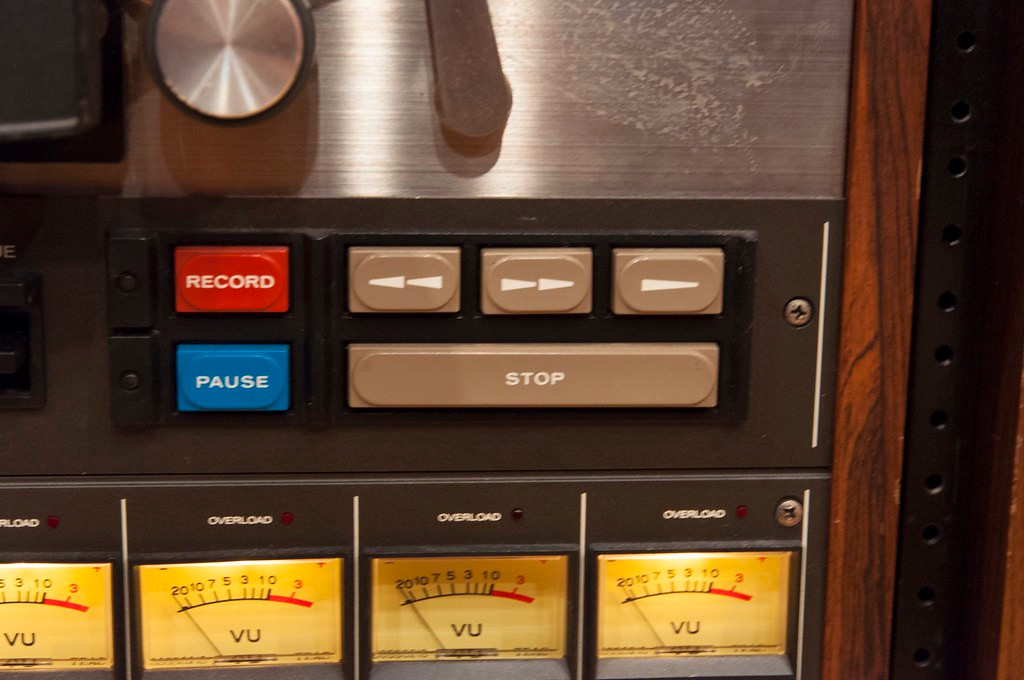
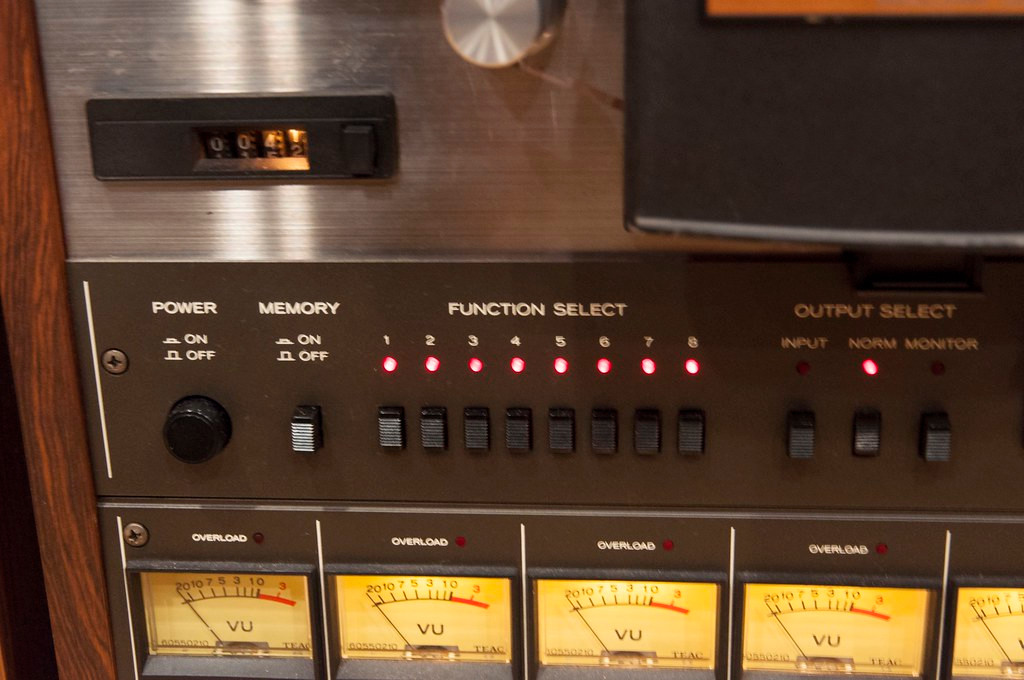
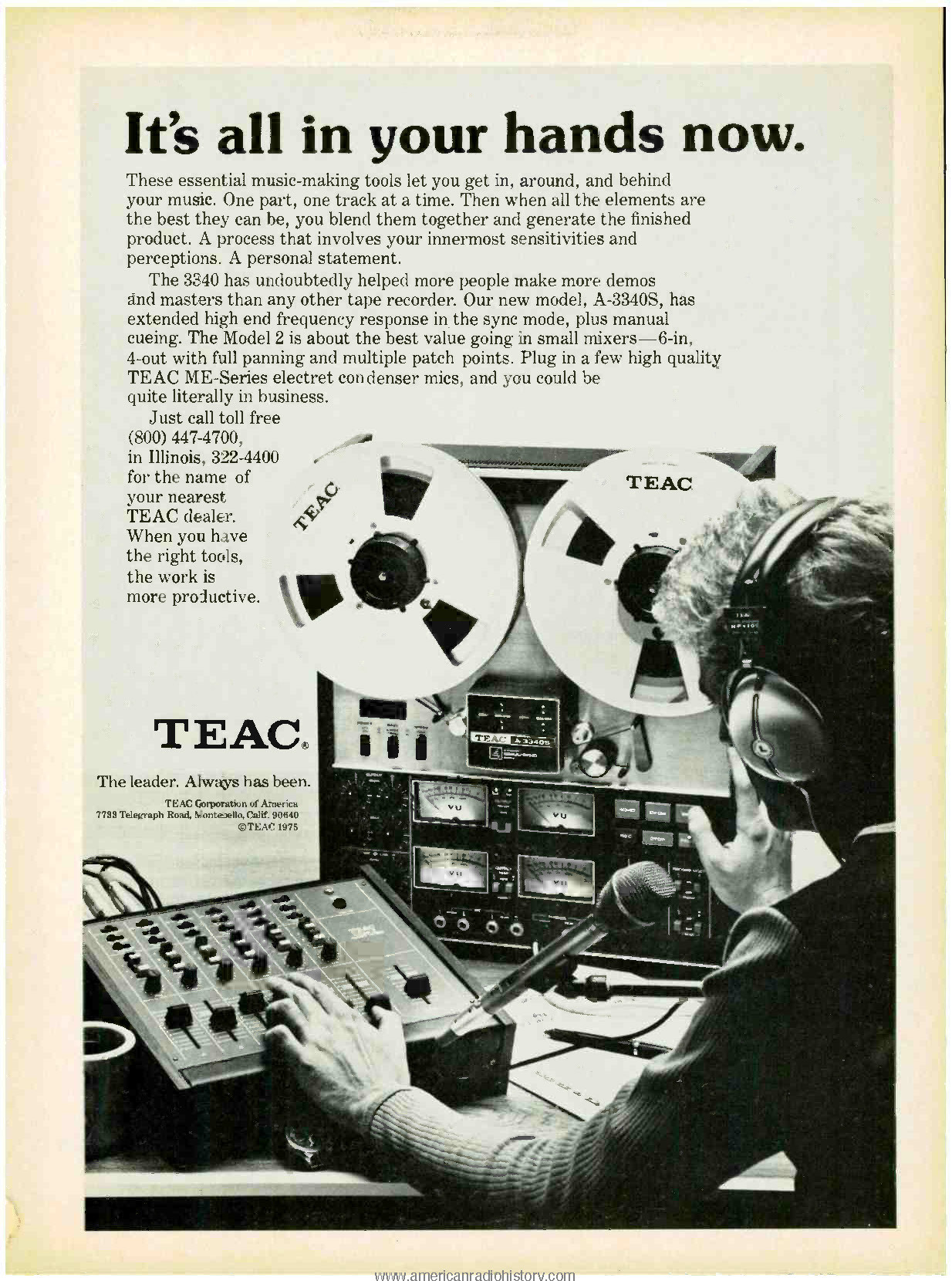
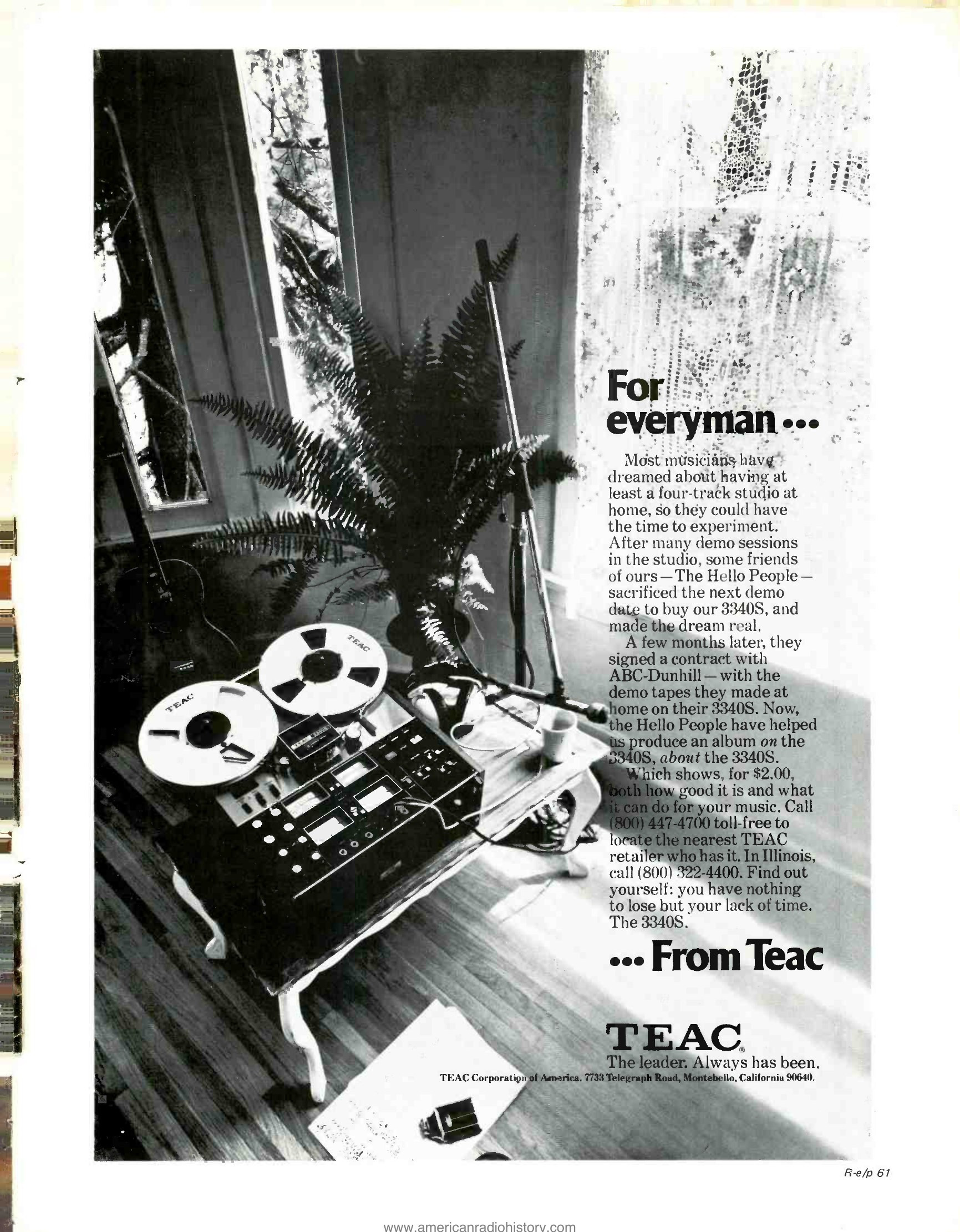
The machine that started the home multitrack revolution. At a time when 4-track recording required a professional studio booking, the A-3340 put it in the hands of individual musicians. Simul-sync — recording to one track while monitoring previously recorded tracks through the record head — meant overdubbing was possible with correct timing. Artists including Stevie Wonder and Todd Rundgren used home multitrack setups to create self-produced recordings that redefined solo production.

4-track recording 3-head design 10.5 inch reel capacity Simul-sync Home studio oriented

Notable users

Home recording enthusiasts, Demo studios, Songwriters

Technical specs

Frequency response 30Hz – 22kHz at 15 ips
Signal-to-noise 50 dB
Wow & flutter 0.08% at 15 ips
Speed accuracy ±0.2%
Head config Record / Play / Erase
Motor AC/DC

Market value

$600 – $1,500

Rarity

Common

TEAC A-3440

1975 – 1985  ·  4-track  ·  ¼ inch (6.35 mm)

Golden Age 7½ ips 15 ips

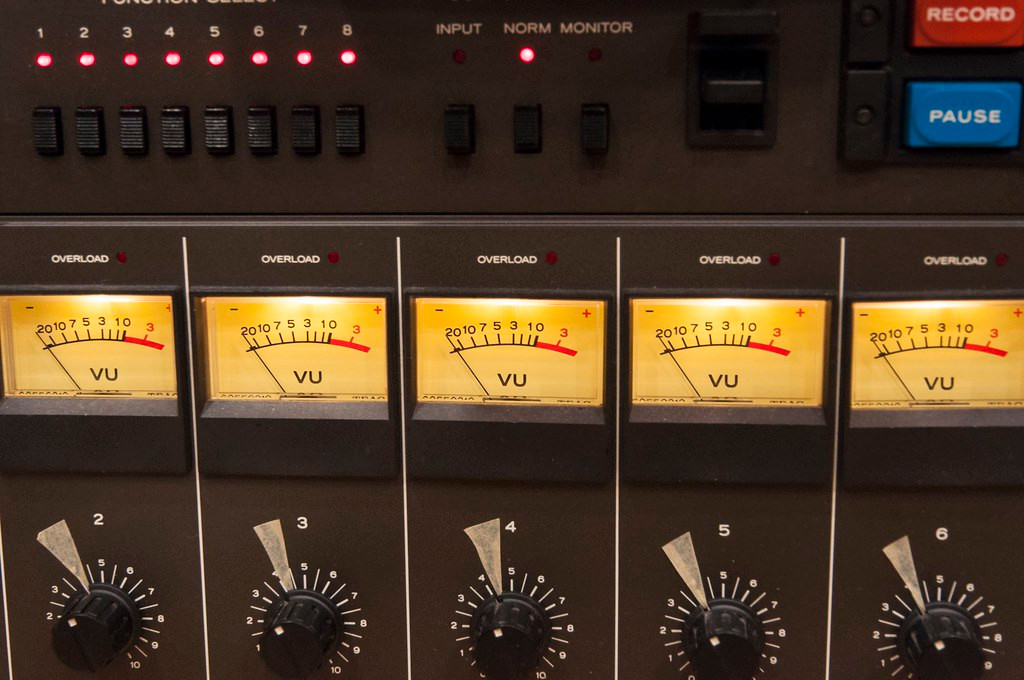
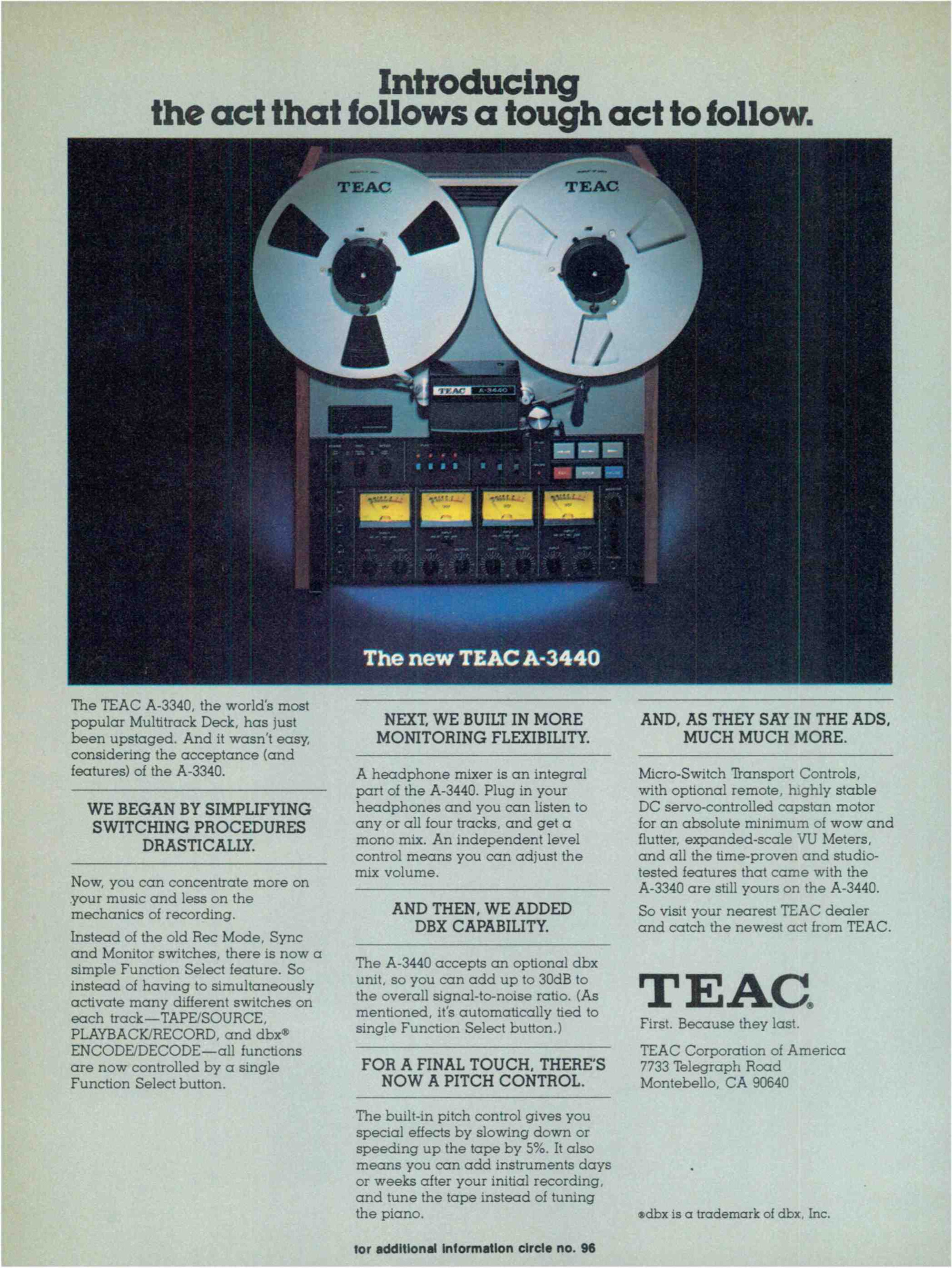
The successor to the pioneering A-3340, the A-3440 refined the formula with a DC servo capstan motor for better speed stability and significantly improved wow and flutter figures. The extended frequency response at 15 ips made it more capable for musical recording. The A-3440 continued its predecessor's role as the standard home multitrack machine through the late 1970s and into the 1980s.

Improved 4-track DC servo capstan Better specs than A-3340 Simul-sync

Notable users

Home studios, Small commercial studios

Technical specs

Frequency response 25Hz – 24kHz at 15 ips
Signal-to-noise 55 dB
Wow & flutter 0.04% at 15 ips
Speed accuracy ±0.15%
Head config Record / Play / Erase
Motor DC servo

Market value

$800 – $2,000

Rarity

Common

TEAC X-1000R

1987 – 1995  ·  2-track  ·  ¼ inch (6.35 mm)

Digital Transition 3¾ ips 7½ ips

TEAC's high-end consumer 2-track of the late 1980s, aimed at audiophiles rather than recording enthusiasts. Auto-reverse, Permalloy heads, EE tape support, and optional dbx noise reduction positioned it as a high-fidelity playback and mastering deck for home use. The 3-motor transport provided the mechanical quality associated with TEAC's better machines.

Auto reverse 3-motor transport Permalloy heads EE tape support dbx noise reduction

Notable users

Audiophiles, Home recording enthusiasts

Technical specs

Frequency response 40Hz – 26kHz at 7.5 ips
Signal-to-noise 50 – 52 dB
Wow & flutter 0.10% at 7.5 ips
Speed accuracy ±0.15%
Head config Record / Play / Erase
Motor DC servo

Market value

$800 – $2,000

Rarity

Moderate

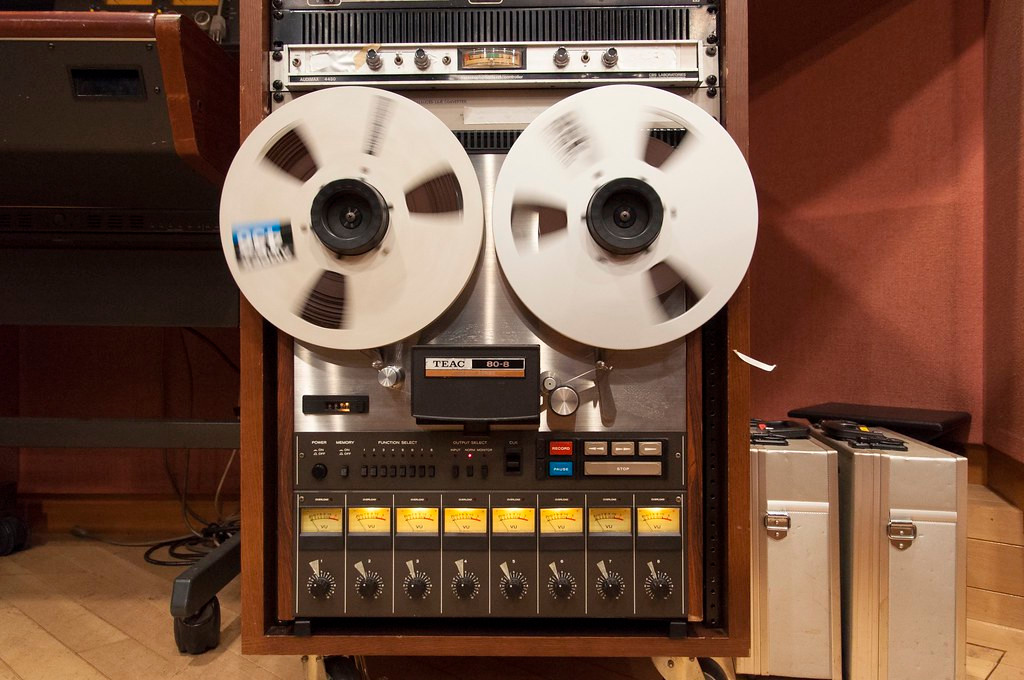
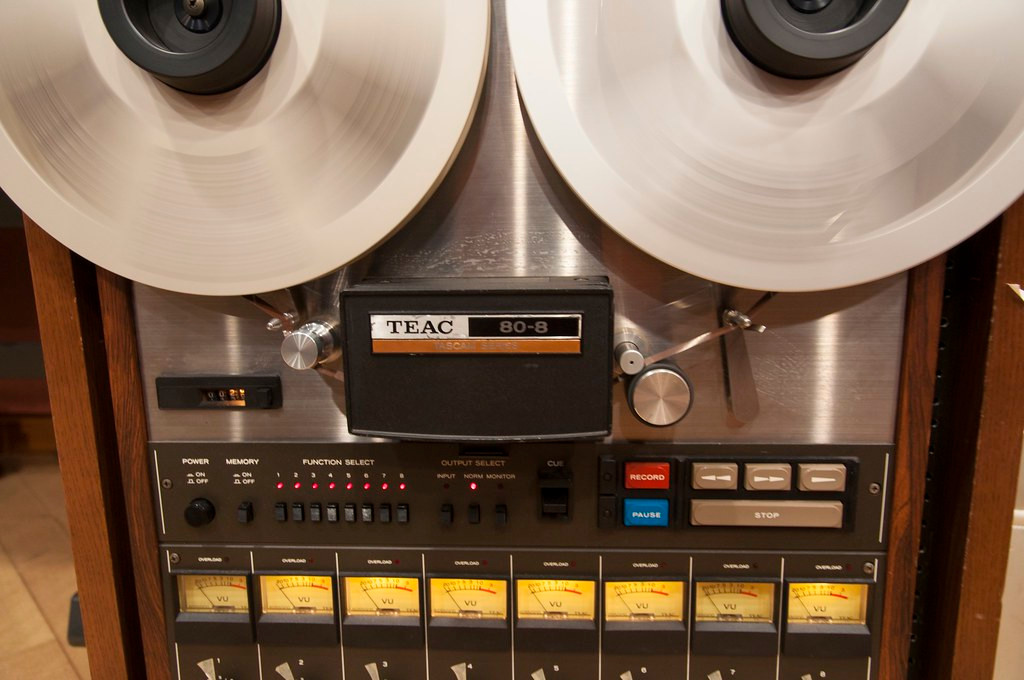
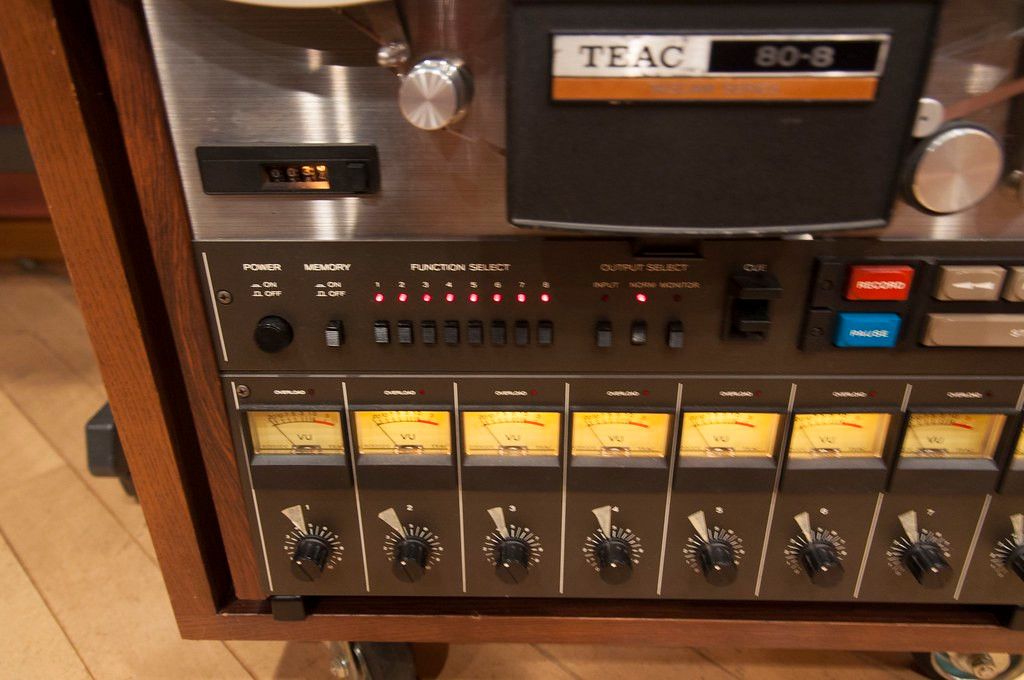
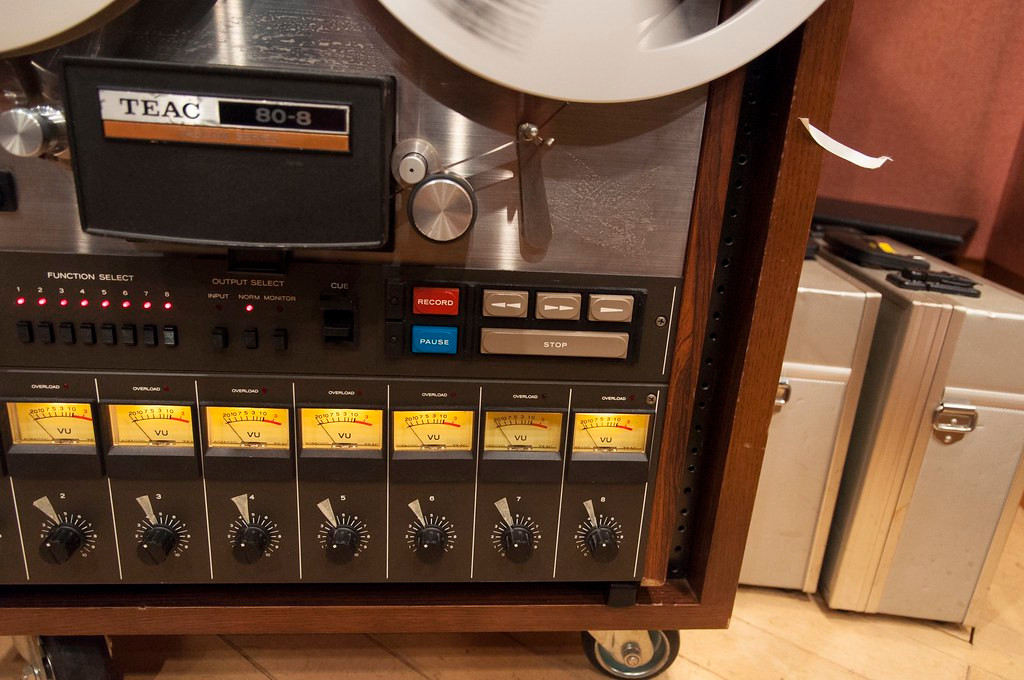
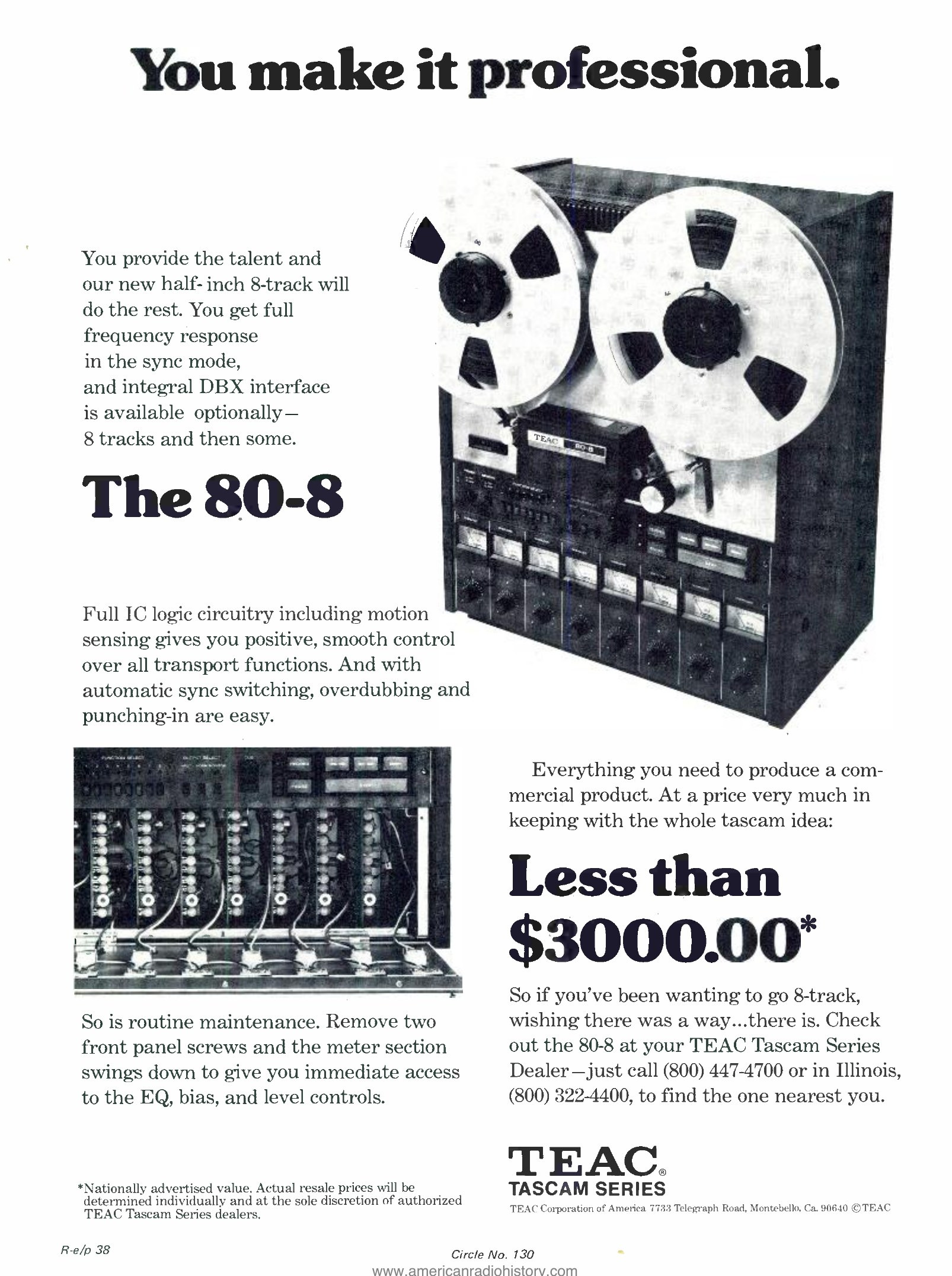
TEAC 80-8

1976 – 1985  ·  8-track  ·  ½ inch (12.7 mm)

Transitional 15 ips

TEAC's entry-level 8-track on ½-inch tape — the machine that put pro-grade multitrack recording into reach of project studios and serious home setups in the late 1970s. Built before TEAC split off its professional line as Tascam, the 80-8 was sold as TEAC-branded; later production runs carried the Tascam logo. Eight tracks across ½ inch of tape gave each track 50 thou of width — narrower than a 1-inch 8-track, but generous enough (when paired with dbx noise reduction) for serious work. The transport was a true 3-motor design with logic-controlled solenoid braking, far above what consumer machines offered. Demo studios, jingle houses and a generation of small commercial facilities ran 80-8s well into the 1980s. JacoTen documents one still working at Studio Green Bird in Tokyo.

8-track on ½ inch 3-motor logic-controlled transport Optional dbx noise reduction TEAC/Tascam branded variants

Notable users

Project studios worldwide, Demo and jingle houses, Studio Green Bird, Tokyo (JacoTen)

Technical specs

Frequency response 40Hz – 22kHz ±3dB at 15 ips
Signal-to-noise 64 dB (no NR), 90+ dB (with dbx)
Wow & flutter 0.04% (DIN weighted)
Speed accuracy ±0.2%
Head config 8-track record/play
Motor 3-motor (capstan + 2 reel)

Market value

$1,500 – $4,500

Rarity

Moderate

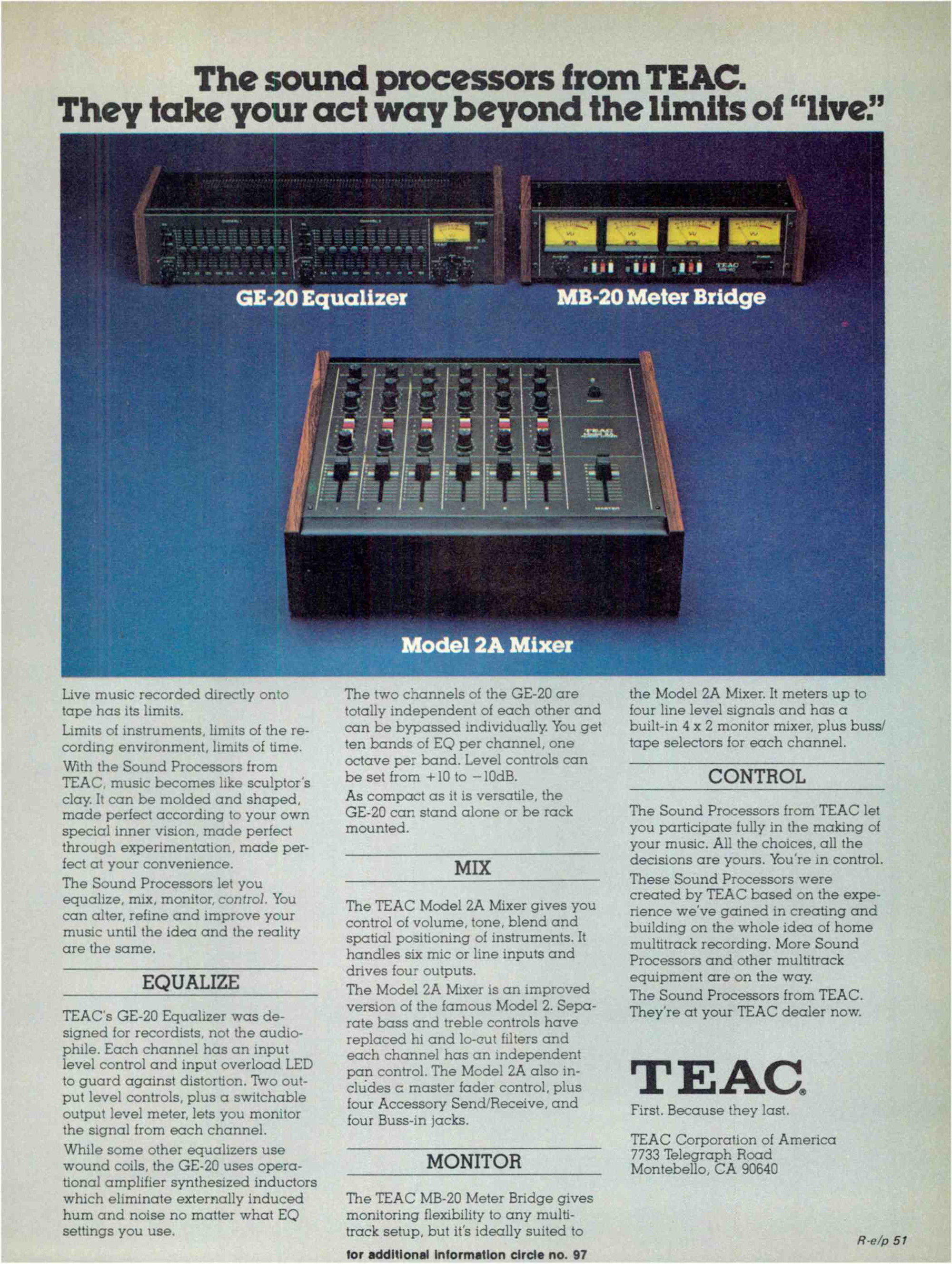
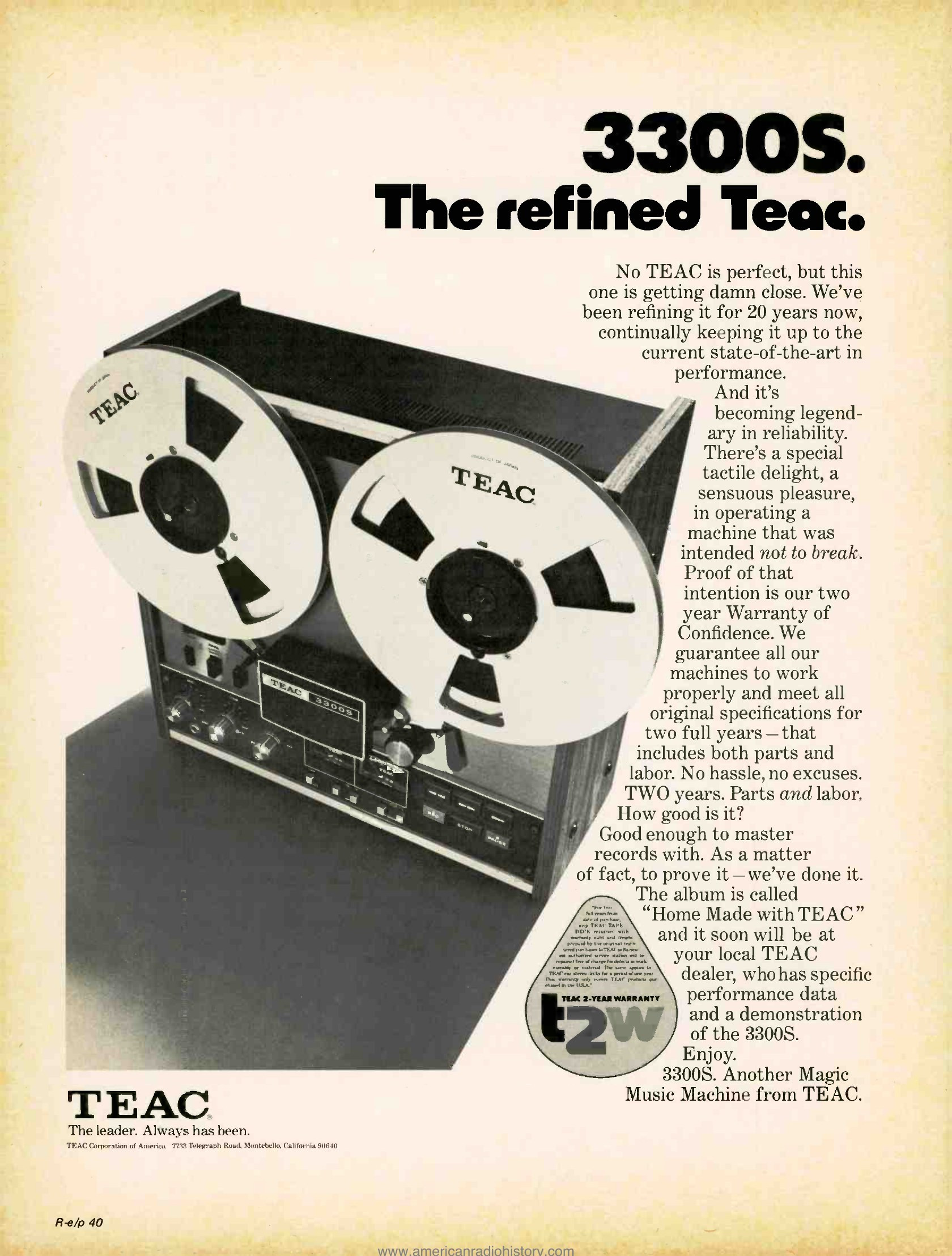
■ Vintage Ads 2 ads

🇯🇵 Fostex

Japan — est. 1973

More Tracks. Less Cost.

fostex.jp ↗

Fostex was established in 1973 as a division of Foster Electric and became one of the most important suppliers of project studio equipment through the 1980s and 1990s. The company specialised in pushing track counts higher while keeping prices accessible — making 8-track and 16-track recording available to studios and individuals who could not justify the cost of professional open-reel machines.

Fostex R8

1988 – 1995  ·  8-track  ·  ¼ inch (6.35 mm)

Digital Transition 15 ips

Eight tracks on quarter-inch tape — that was the engineering achievement that made the R8 attractive to project studios on limited budgets. dbx noise reduction boosted signal-to-noise to 78 dB, compensating for the narrow track width. Compact dimensions and 7-inch reel capacity kept the footprint small. For home studios and project facilities in the late 1980s and early 1990s, the R8 represented an accessible path into genuine multitrack production.

8-track on ¼ inch Compact design 7 inch reel capacity dbx noise reduction Project studio oriented

Notable users

Home studios, Project studios, Songwriters

Technical specs

Frequency response 45Hz – 18kHz at 15 ips
Signal-to-noise 78 dB (with dbx)
Wow & flutter 0.08% at 15 ips
Speed accuracy ±0.15%
Head config Record / Play / Erase
Motor DC servo

Market value

$600 – $1,500

Rarity

Common

Fostex E-16

1985 – 1992  ·  16-track  ·  ½ inch (12.7 mm)

Digital Transition 15 ips

The E-16 achieved something that would have seemed impossible a decade earlier: 16-track recording on ½-inch tape. By using dbx noise reduction and tight track spacing, Fostex extracted usable multitrack performance from a format normally associated with 2-track mastering. Pitch control added flexibility for post-production work. For project studios that needed 16 tracks but couldn't afford two-inch multitrack costs, the E-16 was a practical solution.

16-track on ½ inch Compact design dbx noise reduction Pitch control

Notable users

Project studios, Small commercial studios

Technical specs

Frequency response 40Hz – 18kHz
Signal-to-noise 75 dB (with dbx)
Wow & flutter 0.08%
Speed accuracy ±0.15%
Head config 16-track
Motor DC servo

Market value

$1,000 – $2,500

Rarity

Moderate

Fostex G16S

1990 – 1998  ·  16-track  ·  ½ inch (12.7 mm)

Digital Transition 15 ips

The G16S improved on the E-16 with a better transport, enhanced electronics, and an improved signal-to-noise ratio of 80 dB weighted — a meaningful step forward. Through the 1990s, as digital recording began displacing analog for project studio work, the G16S offered a cost-effective analog alternative for studios that wanted the warmth of tape without committing to expensive professional formats. Its production run to 1998 made it one of the later analog multitracks still sold new.

Improved transport Enhanced electronics dbx noise reduction

Notable users

Project studios, Home studios

Technical specs

Frequency response 40Hz – 18kHz ±3dB
Signal-to-noise 80 dB (weighted), 60 dB (unweighted)
Wow & flutter ±0.05%
Speed accuracy ±0.1%
Head config 16-track
Motor DC servo

Market value

$1,200 – $3,000

Rarity

Moderate

🇯🇵 Tascam

Japan — est. 1971

Tascam. For the Record.

tascam.com ↗

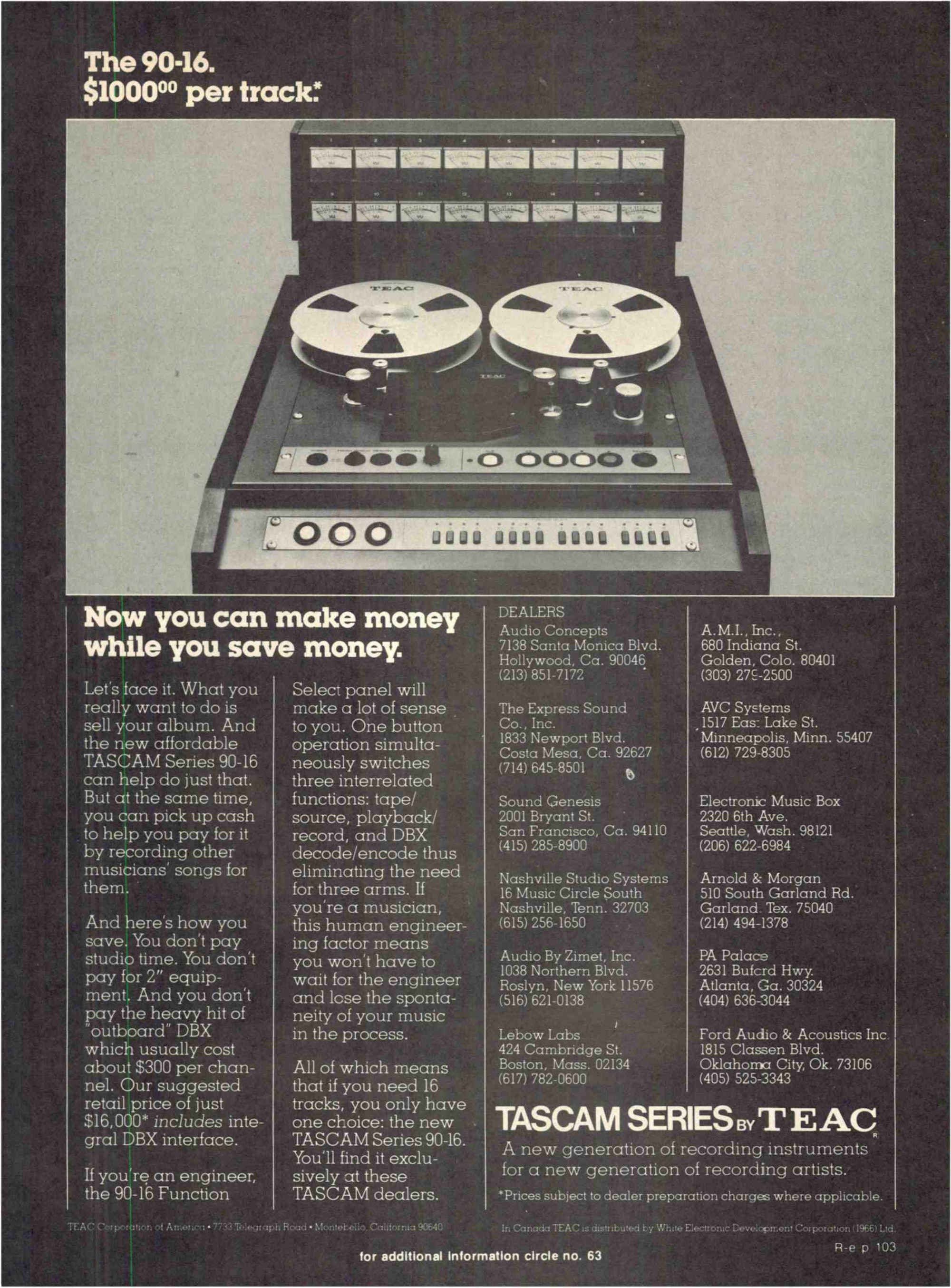
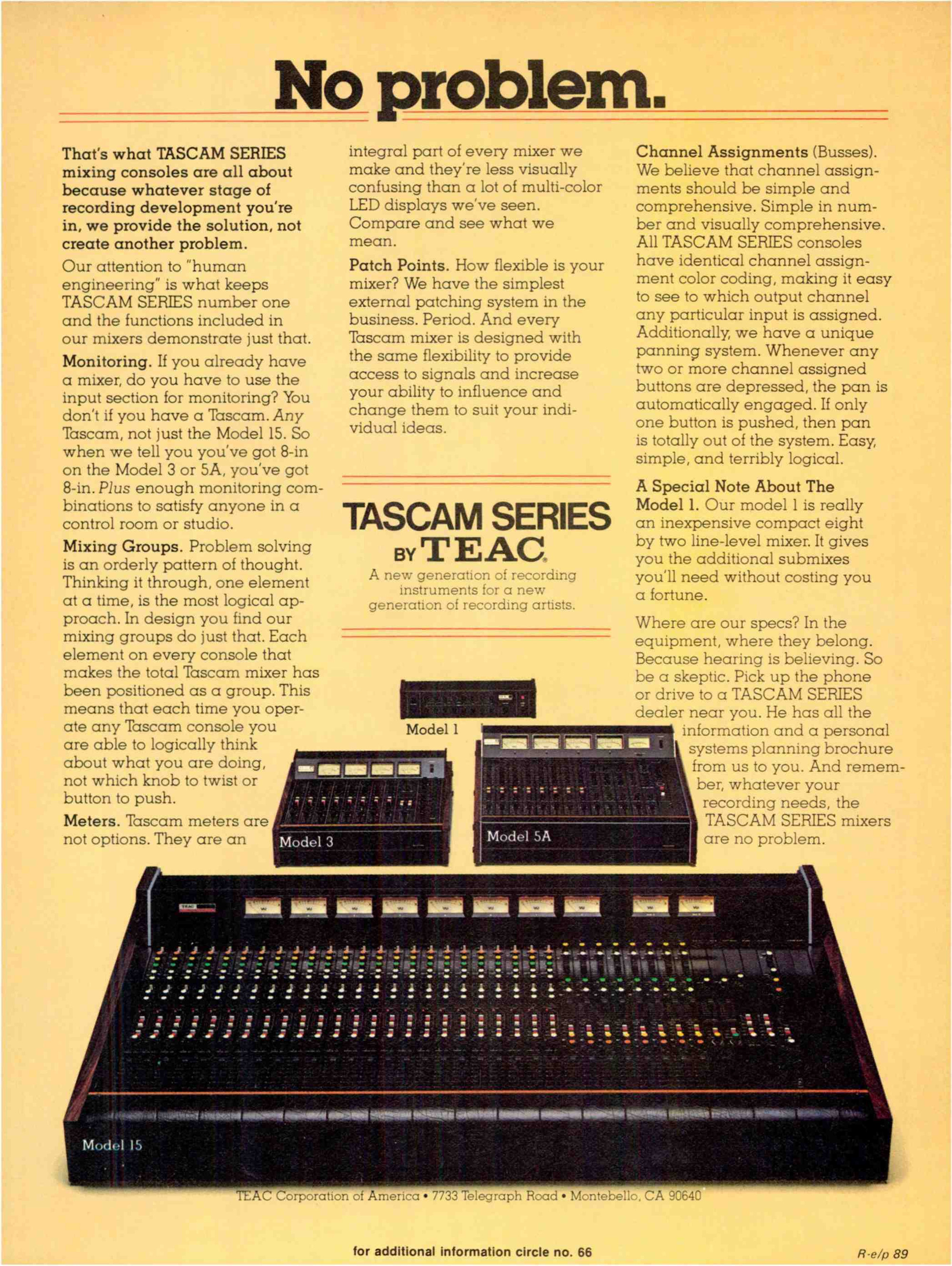
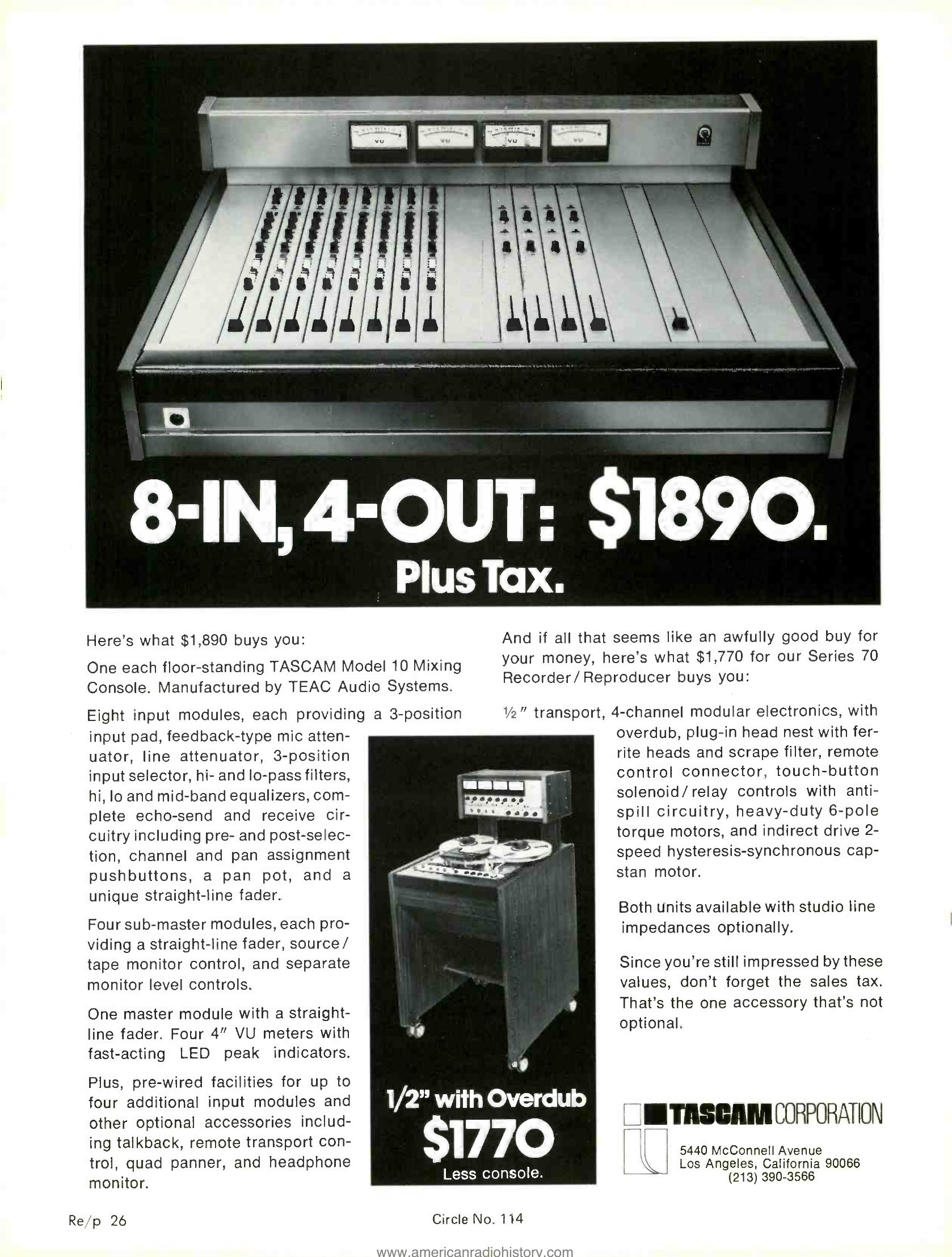
Tascam was established in 1971 as the professional audio division of TEAC Corporation. Where TEAC targeted consumers, Tascam aimed at working musicians, project studios, and small commercial facilities — users who needed professional features at a price point below the established professional brands.

Tascam's most famous product was the Portastudio cassette multitrack of 1979, which brought 4-track recording to cassette tape. But Tascam also produced a range of serious open-reel machines — the 38 and MSR-16 in particular — that gave project studios genuine multitrack capability on formats far more affordable than two-inch tape.

Tascam 34

1980 – 1988  ·  4-track  ·  ¼ inch (6.35 mm)

Transitional 7½ ips 15 ips

An affordable 4-track recorder with full frequency response in sync mode — a technical achievement that mattered for overdubbing quality. The Tascam 34 was aimed at home studios and demo production, providing simul-sync overdubbing at a price point accessible to individual musicians. It filled the same role in the Tascam lineup as the TEAC A-3340 had in its parent company's range: the entry point to multitrack home recording.

4-track with full sync frequency response Inexpensive multitrack Simul-sync

Notable users

Home studios, Demo production

Technical specs

Frequency response 30Hz – 18kHz
Signal-to-noise 58 dB
Wow & flutter 0.08%
Speed accuracy ±0.2%
Head config Record / Play / Erase
Motor AC/DC

Market value

$600 – $1,500

Rarity

Common

Tascam 38

1980 – 1990  ·  8-track  ·  ½ inch (12.7 mm)

Transitional 7½ ips 15 ips

The Tascam 38 filled the niche between consumer and professional 8-track equipment. On ½-inch tape it could deliver frequency response and signal-to-noise figures usable for serious production work, while remaining affordable for smaller studios and serious home recordists. Simul-sync, dbx noise reduction, and 10.5-inch reel capacity gave it the features of a working studio machine at a project studio price.

8-track on ½ inch 10.5 inch reel capacity Simul-sync dbx noise reduction Professional features

Notable users

Project studios, Small commercial studios, Home recording

Technical specs

Frequency response 40Hz – 20kHz at 15 ips
Signal-to-noise 62 dB
Wow & flutter 0.06% at 15 ips
Speed accuracy ±0.15%
Head config Record / Play / Erase
Motor DC servo

Market value

$800 – $2,000

Rarity

Common

Tascam MSR-16

1988 – 1995  ·  16-track  ·  ½ inch (12.7 mm)

Digital Transition 15 ips 30 ips

The MSR-16 made 16-track recording accessible when it previously required expensive two-inch tape and machines costing many times more. On ½-inch tape at 30 ips it delivered 30Hz–20kHz frequency response with signal-to-noise above 65 dB — genuine production quality. Dolby SR ready and highly reliable, the MSR-16 was widely adopted by project studios in the late 1980s and early 1990s as digital recording began challenging analog's dominance.

16-track on ½ inch High reliability Dolby SR ready Professional performance

Notable users

Project studios, Small commercial studios

Technical specs

Frequency response 30Hz – 20kHz at 30 ips
Signal-to-noise >65 dB
Wow & flutter <0.08%
Speed accuracy ±0.1%
Head config 16-track
Motor DC servo

Market value

$1,500 – $4,000

Rarity

Moderate

🇺🇸 3M

United States — est. 1902

The Isoloop Difference.

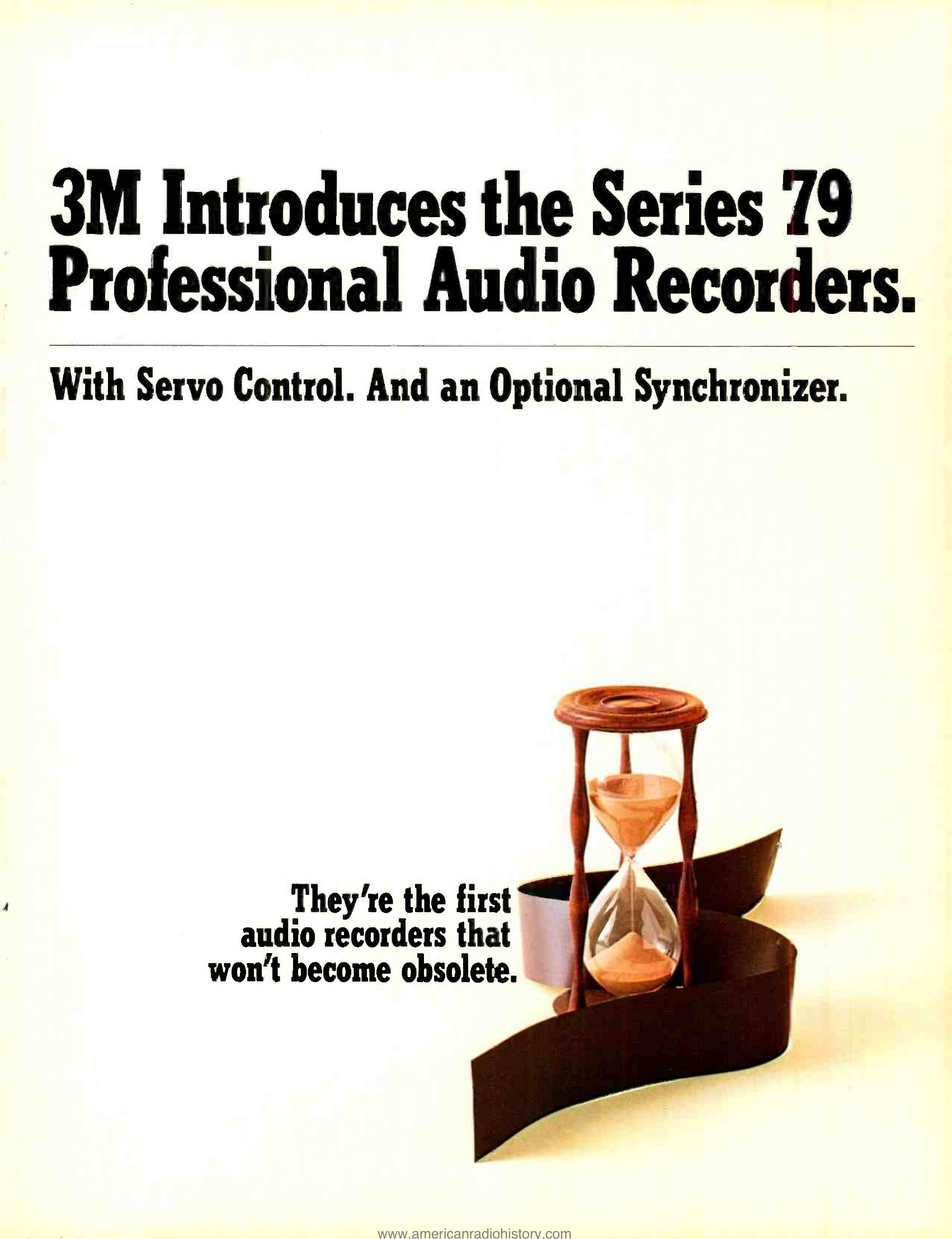
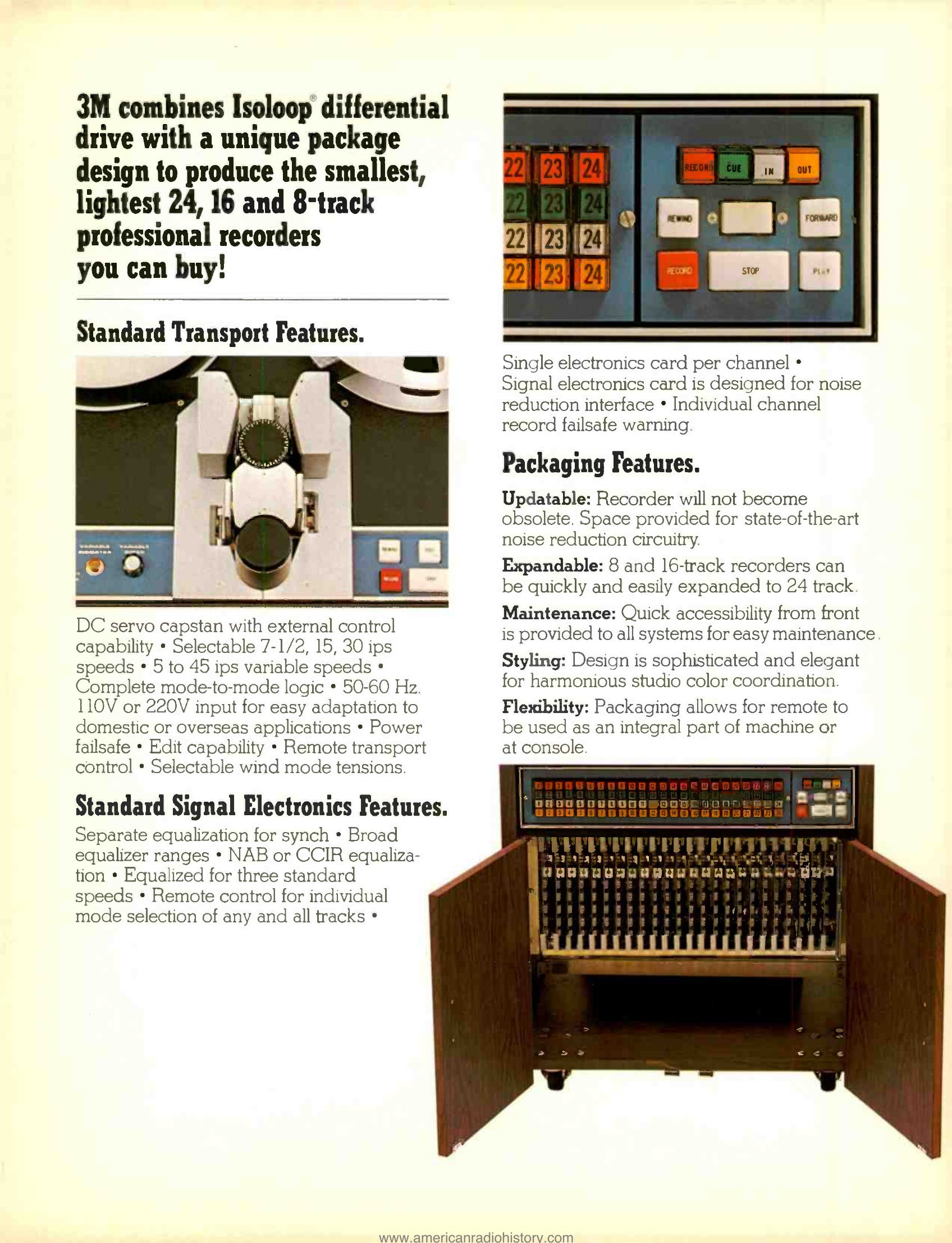
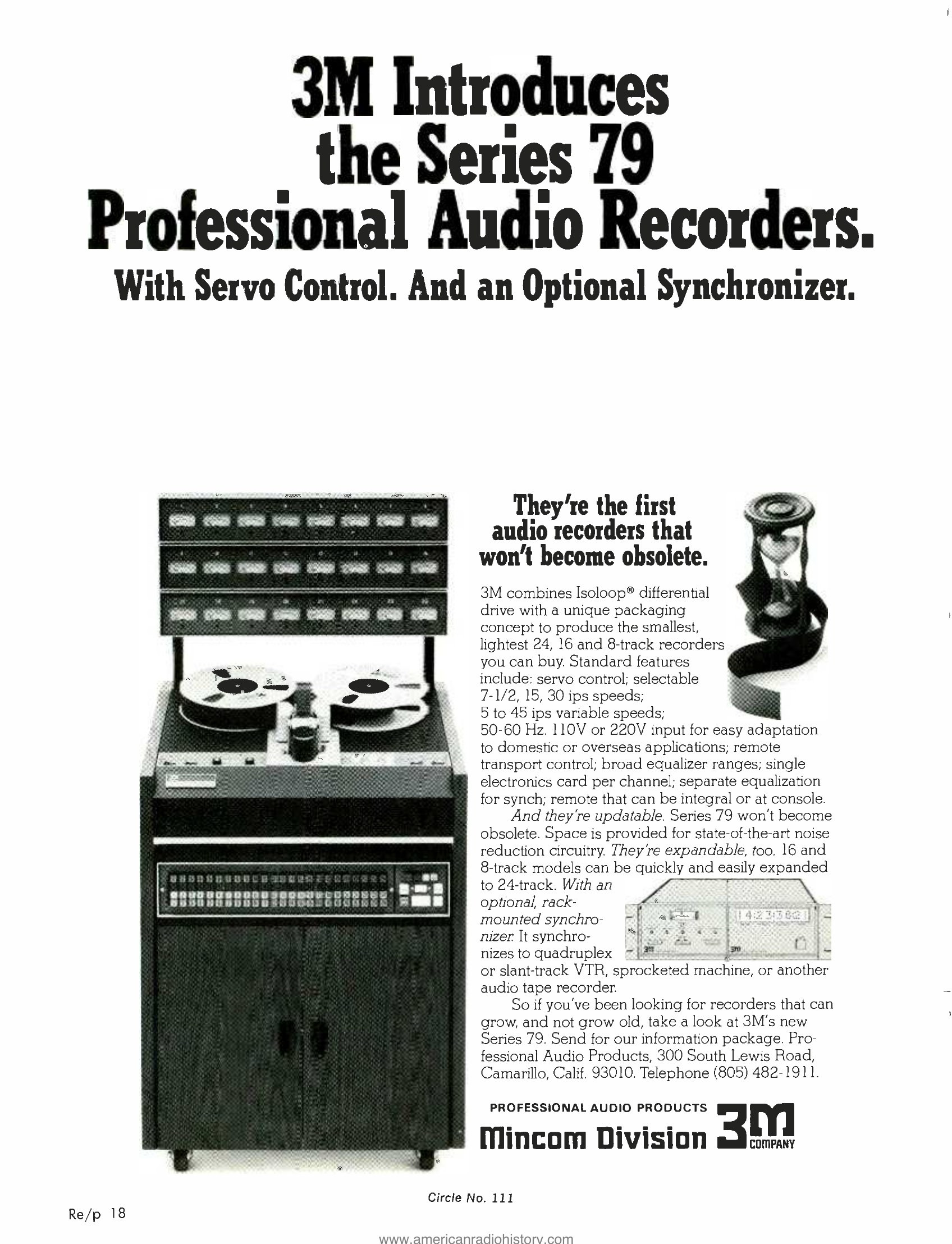
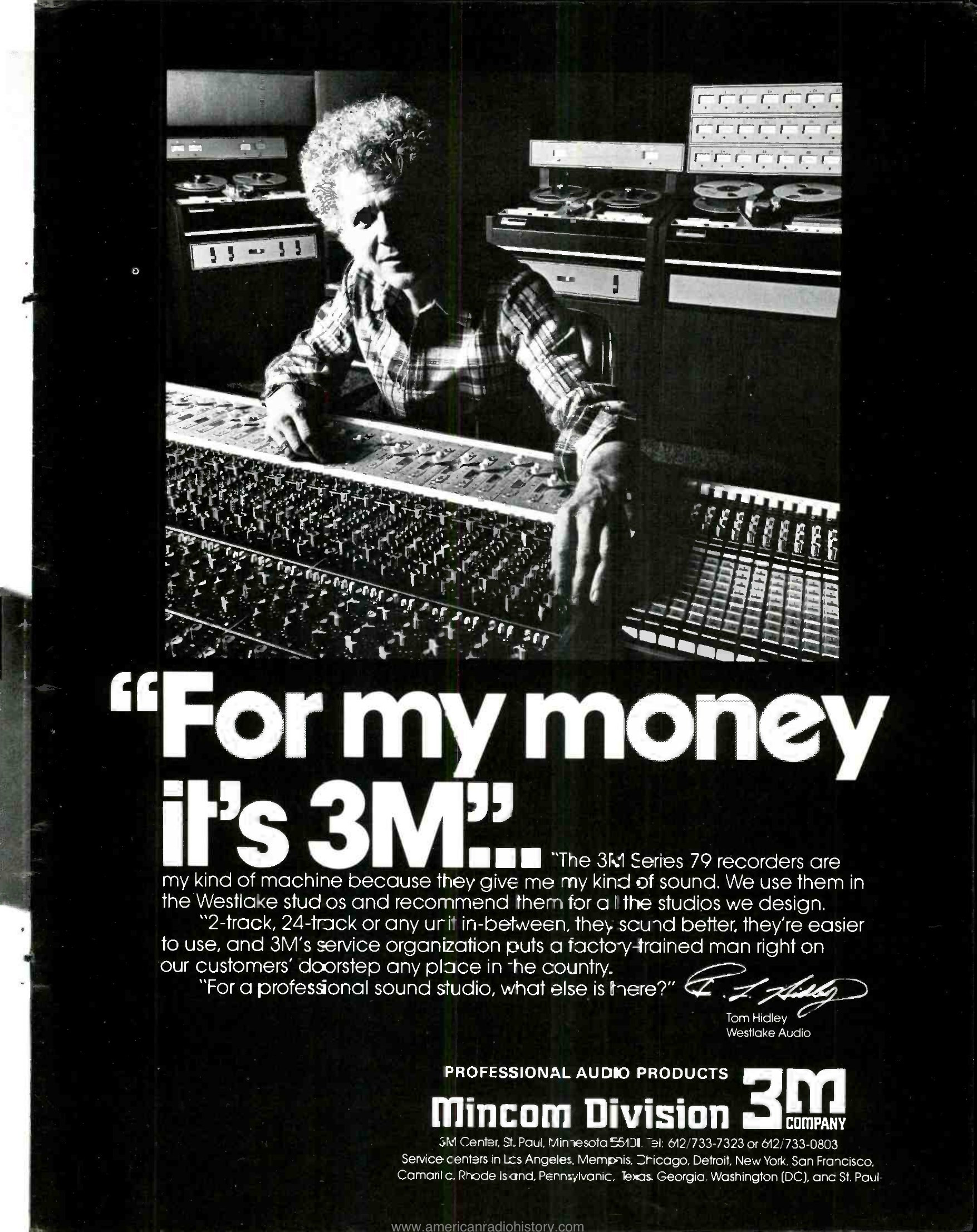
3M (Minnesota Mining and Manufacturing) is primarily known as the world's leading manufacturer of magnetic recording tape — the Scotch brand was a 3M product. But through the 1960s and 1970s, 3M also produced a small range of professional tape recorders featuring their proprietary Isoloop tape path technology.

The Isoloop design — 3M's proprietary tape path development — created a loop of unsupported tape between the supply and takeup sides of the transport, isolating the head block from mechanical disturbances. The result was exceptional speed stability and head-to-tape contact, making 3M machines highly regarded in studios where accuracy was paramount.

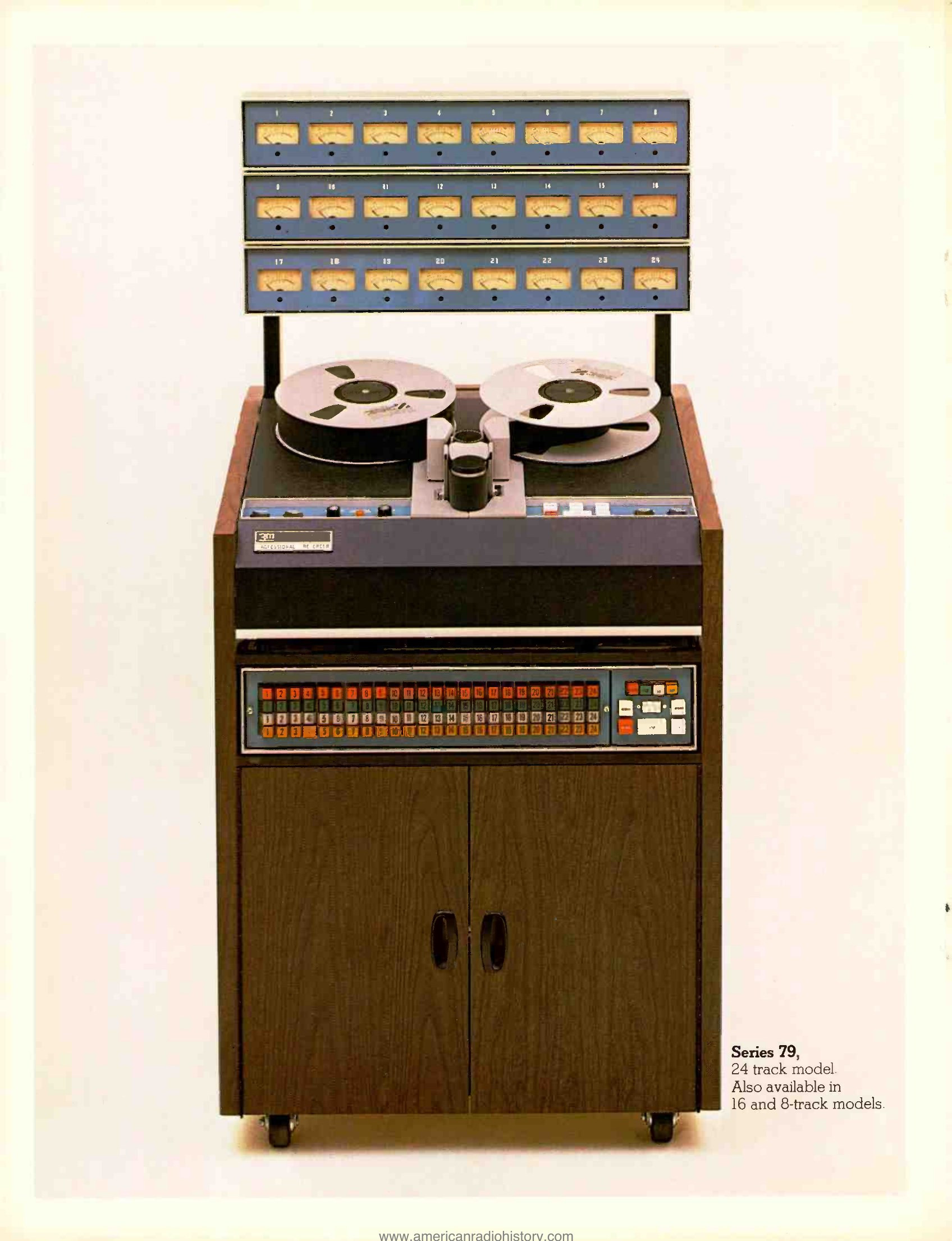
3M M79

1970 – 1980  ·  16-track / 24-track  ·  2 inch (50.8 mm)

Golden Age 15 ips 30 ips

The M79 brought 3M's Isoloop differential capstan technology to the studio multitrack market. The 3.5-inch unsupported tape length in the Isoloop design gave it speed stability and head-to-tape contact that competitors envied. Major recording studios and film scoring stages adopted it, competing directly with Ampex and Studer at the high end. With fewer than 1,500 units produced, the M79 is one of the rarer studio multitracks from the golden era.

Isoloop differential capstan drive 3.5 inch unsupported tape length Low wow and flutter Full remote control Synchronous cue

Notable users

Major recording studios, Film scoring stages, Major labels

Technical specs

Frequency response 30Hz – 18kHz
Signal-to-noise >65 dB
Wow & flutter <0.05%
Speed accuracy ±0.1%
Head config 16/24-track
Motor DC servo Isoloop

Market value

$8,000 – $20,000

Rarity

Rare

🇩🇪 Telefunken

Germany — est. 1903

German Engineering. Broadcast Standard.

Telefunken was founded in 1903 in Berlin as a joint venture between Siemens and AEG, and became one of Germany's most important electronics companies. Through the mid-20th century, Telefunken equipment — both microphones and tape recorders — set the standard for German broadcasting and recording.

The M15 series machines were the tape recorders of choice for German and wider European broadcasting facilities through the 1970s and into the 1980s. Where Studer dominated the Swiss, British, and American markets, Telefunken held equivalent status in Germany — known for mechanical precision and a sound character that European engineers favoured for classical and orchestral recording.

Telefunken M15

1971 – 1977  ·  2-track  ·  ¼ inch (6.35 mm)

Golden Age 7½ ips 15 ips

Introduced at the Hanover Fair in 1971, the M15 used electronic circuits inherited from the M10A predecessor but featured an entirely new mechanical design. Large-format 12.5-inch reel capacity and discrete transistorised circuits made it a capable professional machine. European broadcasters and German recording studios adopted it as the home-grown alternative to Swiss and American machines, and its wow and flutter of 0.03% was among the best of the era.

Discrete transistorised circuits New mechanical control system Professional studio design 12.5 inch reel capacity

Notable users

European broadcasters, German recording studios, Classical recording facilities

Technical specs

Frequency response 30Hz – 16kHz
Signal-to-noise 65 dB
Wow & flutter 0.03%
Speed accuracy ±0.1%
Head config Record / Play / Erase
Motor DC servo

Market value

$3,000 – $8,000

Rarity

Rare

Telefunken M15A

1977 – 1985  ·  2-track  ·  ¼ inch (6.35 mm)

Golden Age 7½ ips 15 ips

The M15A evolved the M15 with improved electronics, an enhanced transport, and variable flux level capability — allowing optimisation for different tape formulations. Frequency response improved to 30Hz–18kHz and signal-to-noise rose to 68 dB, while maintaining the exceptional 0.03% wow and flutter of the original. The machine of choice for German broadcasters and European classical recording facilities through the early 1980s.

Improved electronics Enhanced transport Variable flux levels Improved frequency response

Notable users

European studios, Broadcast facilities

Technical specs

Frequency response 30Hz – 18kHz
Signal-to-noise 68 dB
Wow & flutter 0.03%
Speed accuracy ±0.1%
Head config Record / Play / Erase
Motor DC servo

Market value

$3,500 – $9,000

Rarity

Rare

🇺🇸 Telex / Magnecord

USA — est. 1936

Broadcast Reliability. Magnecord Heritage.

telex.com ↗

Telex Communications was founded in 1936 in Minneapolis as a manufacturer of hearing aids; in 1957 the company acquired the Magnecord tape recorder line and became one of America's leading suppliers of broadcast and industrial tape equipment through the 1960s and 1970s.

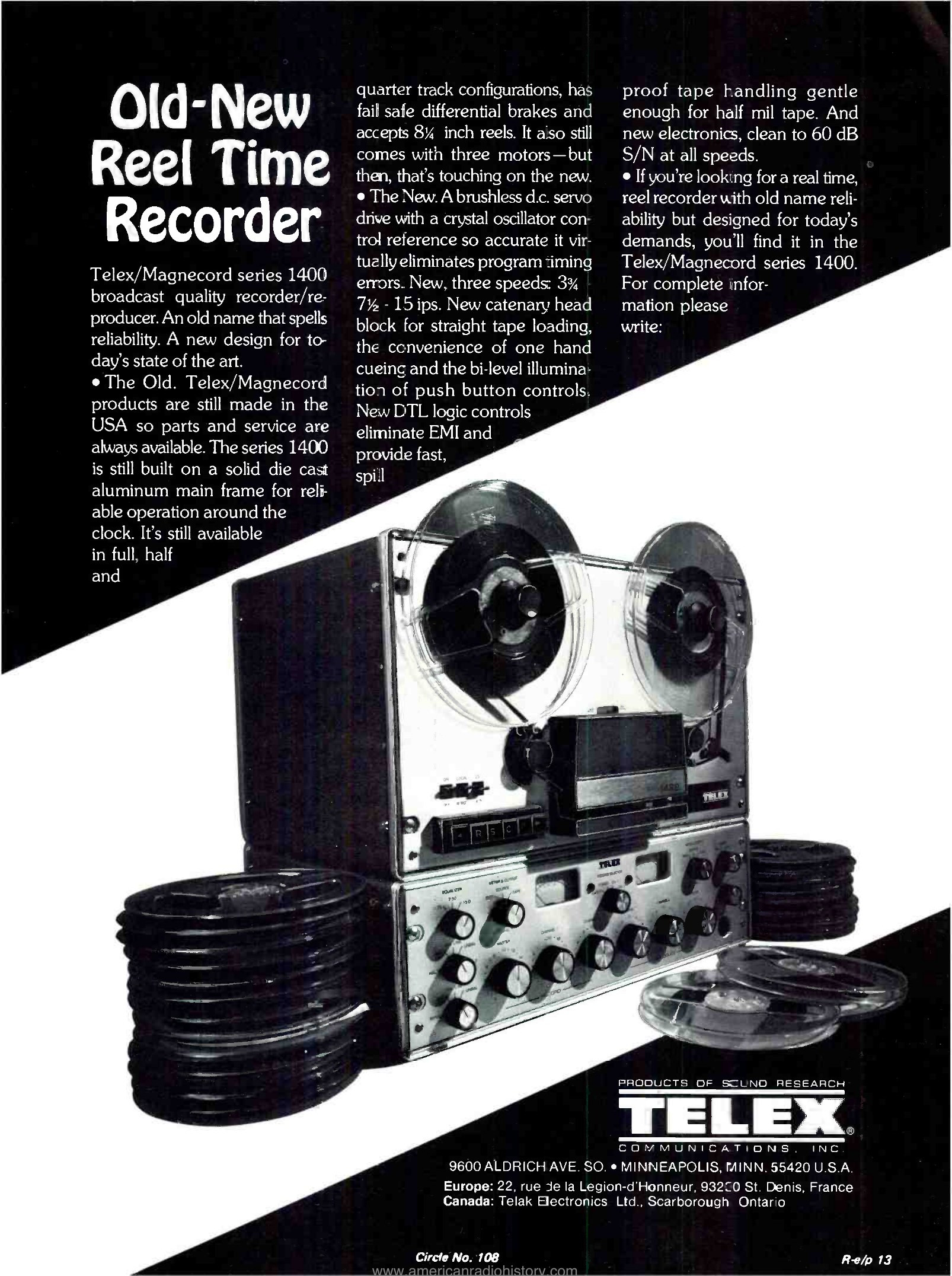
The Magnecord Series 1400 broadcast quality recorder/reproducer carried the brand's reputation for reliability into the colour-television era — die-cast aluminium frame, three speeds (3¾ / 7½ / 15 ips), DTL logic controls, catenary head block. Telex/Magnecord machines populated radio stations and broadcast facilities across America. Today Telex is owned by Bosch Communications.

Telex / Magnecord Magnecord Series 1400

1970s – 1980s  ·  2-track broadcast recorder/reproducer  ·  ¼ inch (6.35 mm)

Transitional 3¾ ips 7½ ips 15 ips

The Magnecord Series 1400 was Telex's flagship broadcast recorder of the 1970s. Built around a die-cast aluminium main frame for stability, with DTL logic controls and a catenary head block (a tape-path design that wraps the tape over a curved bracket rather than across straight pillars, virtually eliminating program timing errors). Three speeds covered radio production needs, and the machine's reliability earned it a place in countless American AM/FM stations and broadcast production facilities. Marketed under the slogan "Old-New Reel Time Recorder" — the heritage of Magnecord (acquired 1957) combined with up-to-date electronics from Telex.

Die-cast aluminium main frame DTL (Diode Transistor Logic) controls Catenary head block Crystal oscillator drive Push-button operation with bi-level illumination Available in full / half / quarter track

Notable users

AM/FM radio stations across the US, Broadcast production facilities, Educational AV institutions

Technical specs

Frequency response 50Hz – 18kHz at 15 ips
Signal-to-noise 60 dB
Wow & flutter 0.10%
Speed accuracy ±0.2%
Head config Erase / Record / Play
Motor Crystal-controlled capstan

Market value

$400 – $1,500

Rarity

Moderate

■ Vintage Ads 1 ad

🇺🇸 Crown

USA — est. 1947

American Workhorse. Tape Recorders and Power Amps.

crownaudio.com ↗

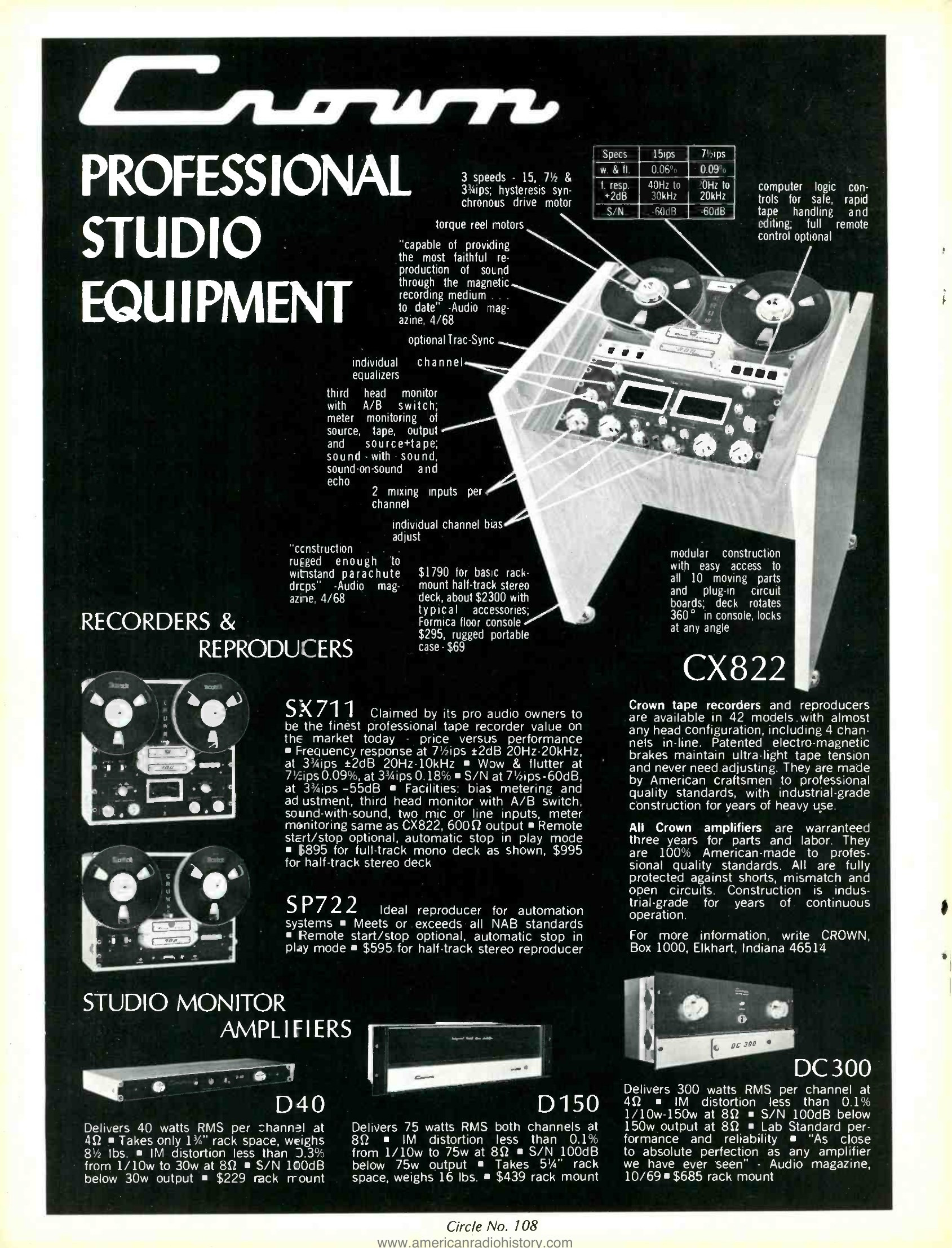
Crown International was founded in 1947 in Elkhart, Indiana by Clarence C. Moore, initially building tape recorders for missionary broadcast work. Through the 1960s and 1970s Crown became a leading American manufacturer of professional open-reel recorders alongside the studio power amplifiers (DC-300, D-150) that made the brand famous.

The CX-822 series and SX-700 became favourites of broadcasters and house-of-worship recording engineers, and the company's combination of tape recorders + power amps + microphones meant a complete signal chain could be sourced from a single American manufacturer. Crown is now part of Harman International.

■ Vintage Ads 1 ad

🇺🇸 Custom Fidelity

USA — est. 1968

American Multitrack. Pro Master 16.

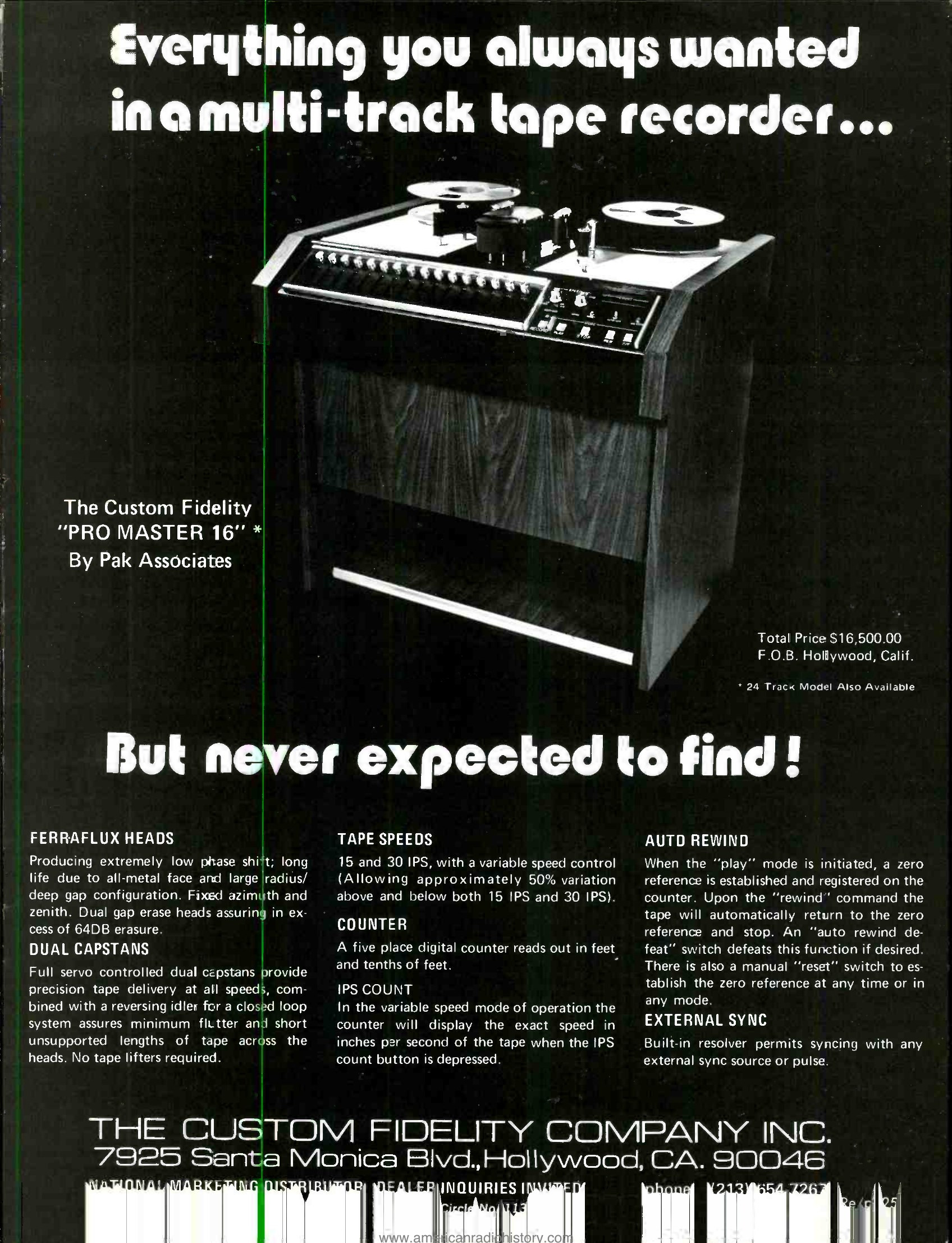
Custom Fidelity was a small American manufacturer of professional multitrack tape machines in the late 1960s and early 1970s, best remembered for the Pro Master 16 — one of the early 2-inch sixteen-track machines available to project studios that could not afford the price of Ampex or 3M equivalents.

The company is largely undocumented in modern reference works; surviving evidence comes primarily from period advertisements in trade magazines such as Recording.

■ Vintage Ads 1 ad

🇺🇸 Gauss

USA — est. 1961

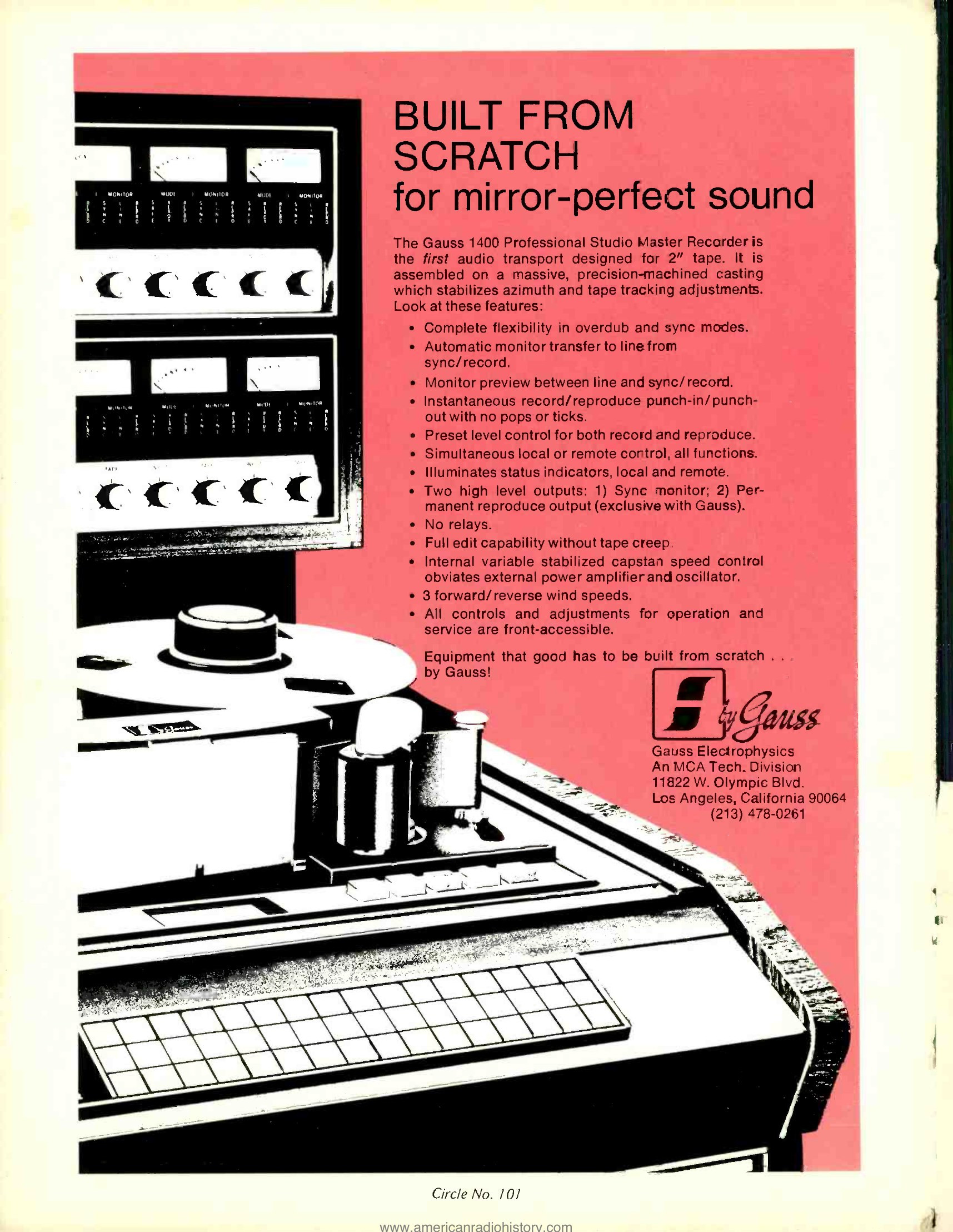
High-Speed Duplication. Mirror-Perfect Sound.

Gauss Electrophysics was founded in California in the early 1960s, building specialised tape duplication machines for the music and broadcast industries (the company was later owned by Cetec, the Los Angeles audio conglomerate). The Series 1200 and 1400 high-speed duplicators were industry standards through the 1970s, mastering pre-recorded cassettes and 8-tracks at 32× and 64× normal speed.

While not a studio recording machine in the strict sense, Gauss duplicators were the bridge between studio masters and the consumer market — making millions of cassette and 8-track copies a standard part of the music distribution chain.

Gauss 1400 Series

1970 – 1980s  ·  High-speed cassette / 8-track duplicator  ·  Cassette 0.150 in (3.81 mm) / 8-track ¼ in

Transitional 32× normal speed 64× normal speed

The Gauss 1400 duplicator system was the industry standard for high-speed manufacturing of pre-recorded cassettes and 8-tracks in the 1970s. A master loop ran at high speed and impressed its content onto multiple slave cassettes simultaneously — typically eight or more copies in parallel. Every major label that pressed cassettes in volume passed product through Gauss machines at some point, and the company's 1400 series ad slogan "Mirror-Perfect Sound" reflected the genuine quality the technology could achieve. As digital duplication eventually replaced analog mastering chains in the 1990s, Gauss machines began their second life as collectibles.

High-speed bin-loop master transport Multi-slave duplication (8+ copies in parallel) Cassette and 8-track configurations Pre-bias / post-bias options Quality-control loop check

Notable users

Major-label cassette manufacturing facilities, Independent cassette duplicators, 8-track production plants, 1970s

Technical specs

Frequency response 40Hz – 16kHz (at normal playback)
Signal-to-noise 55 dB
Wow & flutter 0.10% (master)
Speed 32× or 64× normal
Head config Bin-loop master, multiple slaves
Motor AC servo

Market value

$2,000 – $8,000 (working duplicator)

Rarity

Rare

■ Vintage Ads 1 ad

🇺🇸 Stephens Electronics

USA — est. 1970

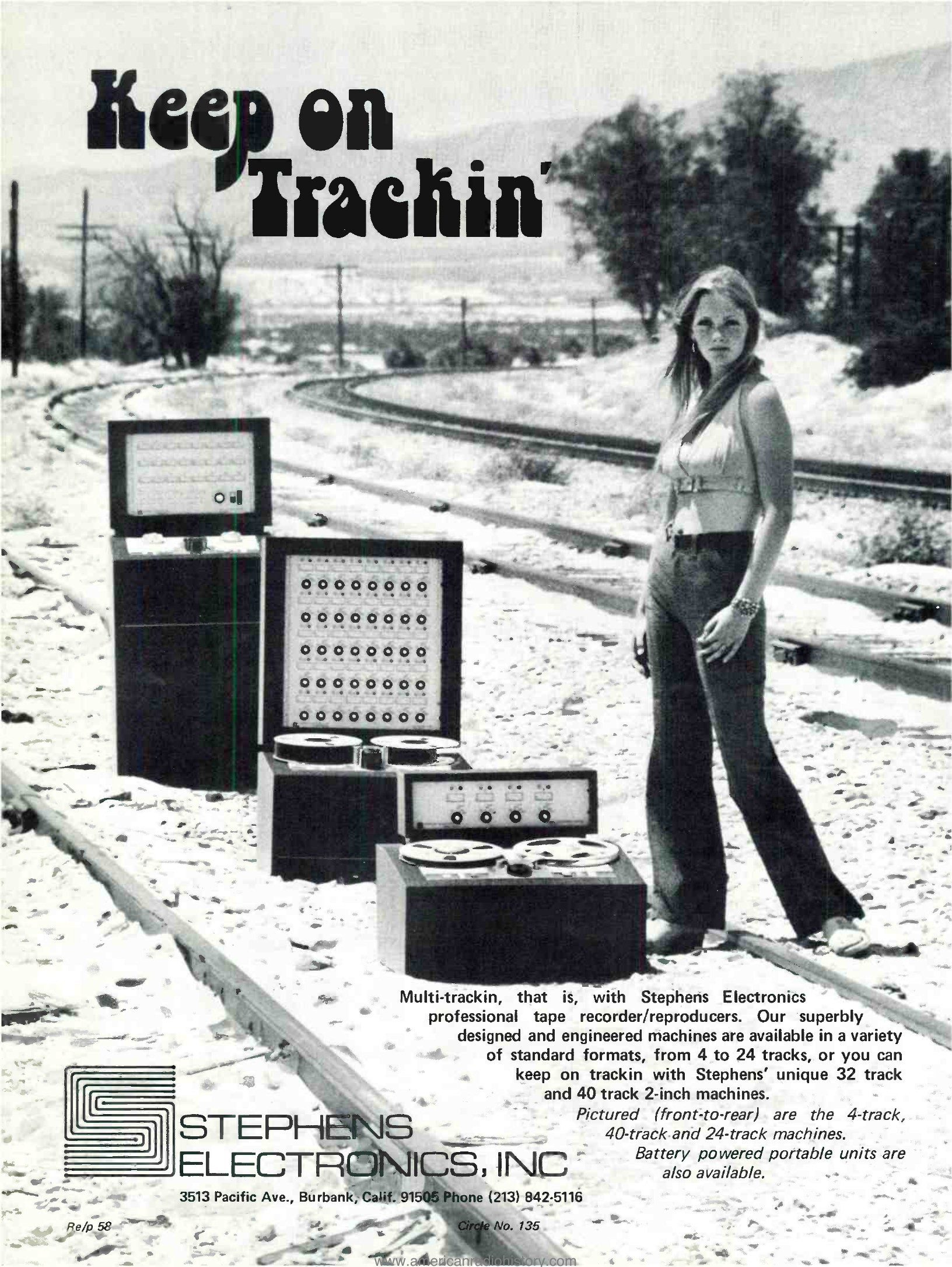
Keep on Trackin'. The 40-Track 2-Inch.

Stephens Electronics was founded in Burbank, California by John Stephens in the early 1970s as a manufacturer of professional multitrack tape recorders. The company's most distinctive product was the only 40-track 2-inch recorder ever produced commercially — a machine that pushed the limits of analog multitrack format density at a moment when 24 tracks was the industry standard.

Stephens machines populated a small but devoted set of Los Angeles studios in the 1970s and 1980s — Crystal Sound, MCA's Whitney Studios, and others. The 821-B (24-track) was the workhorse model; the 40-track was the curiosity. Stephens machines were known for their precise transport, but the company never reached the scale of Ampex, 3M or Studer; production ended in the early 1980s.

Stephens Electronics 821-B

1974 – early 1980s  ·  24-track  ·  2 inch

Golden Age 15 ips 30 ips

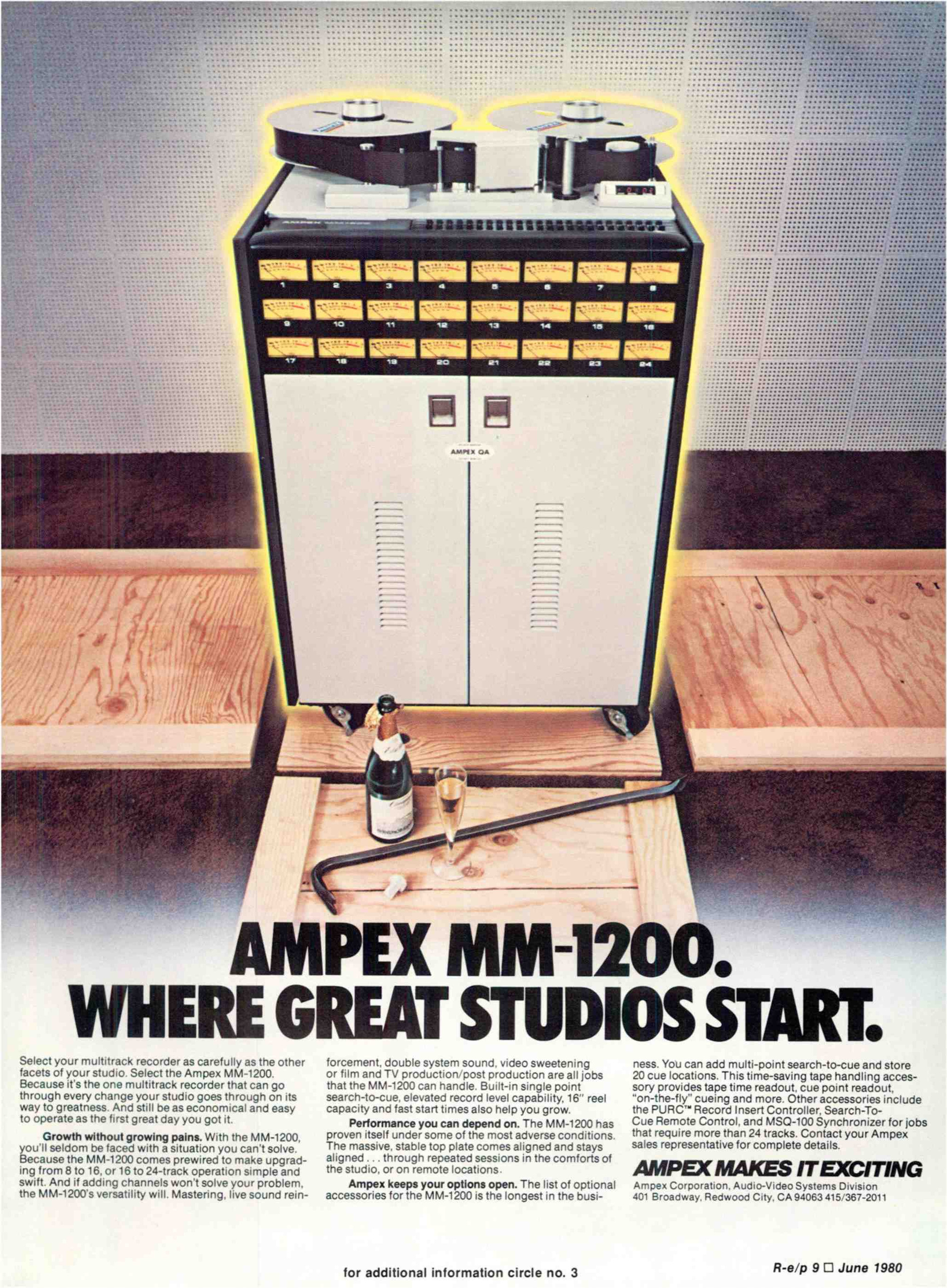
The 821-B was Stephens' production multitrack — a 2-inch 24-track machine that competed with the Ampex MM-1100 and 3M Series 79 in the American studio market. Solid construction and a precise transport mechanism made it a respected if relatively rare alternative to the dominant brands. Crystal Sound in Hollywood, where countless mainstream pop records of the 1970s were tracked, ran Stephens machines for years.

24-track 2-inch format 15/30 ips Variable-pitch transport Independent track electronics Sync/repro select per track

Notable users

Crystal Sound, Hollywood, Whitney Studios (MCA), Select American multitrack rooms, 1970s

Technical specs

Frequency response 40Hz – 18kHz at 30 ips
Signal-to-noise 70 dB
Wow & flutter 0.04%
Speed accuracy ±0.1%
Head config Erase / Sync / Reproduce per track
Motor DC servo capstan

Market value

$3,000 – $8,000 (with electronics)

Rarity

Rare

Stephens Electronics 40-Track 2-Inch

1970s – early 1980s  ·  40-track (unique in industry)  ·  2 inch

Golden Age 15 ips 30 ips

Stephens' signature curiosity: the only 40-track 2-inch recorder ever produced commercially. Where the industry settled at 24 tracks (with occasional 32-track variants), Stephens pushed to 40 tracks on the same 2-inch tape width — narrower track pitch traded raw signal-to-noise for substantially more recording capacity per reel. Few were sold and fewer still survive in working condition. The 40-track is a footnote in mainstream studio history but an icon for analog completionists.

40 tracks on 2-inch tape (narrower pitch) 15/30 ips Same transport platform as 821-B Custom 40-track head block Independent electronics per track

Notable users

A small number of LA studios in the mid-1970s, Experimental/spec projects

Technical specs

Frequency response 40Hz – 18kHz at 30 ips
Signal-to-noise 60 dB per track
Wow & flutter 0.04%
Speed accuracy ±0.1%
Head config 40-track erase / sync / repro stack
Motor DC servo capstan

Market value

Negotiable — extreme rarity

Rarity

Very rare

■ Vintage Ads 1 ad
← Back to Heritage