Retro Recordings XR — Heritage — Outboard
The boxes that shaped
everything in between.

Before plug-ins and DAWs, sound passed through metal boxes. Tube limiters, optical compressors, passive EQs, plate reverbs, tape echoes, and digital effects each left a fingerprint on the records that defined an era. These were the units engineers reached for.

This archive covers 30 classic outboard processors that defined recorded music from the late 1950s through the 1980s — their designers, their mechanisms, the records they shaped, and why studios still hunt for the originals.

Compressors · Equalizers · Reverbs · Delays · Pitch & Multi-FX · Exciters · Specials.

Compressors & Limiters

Six topologies, fifty years of dynamics.

Variable-mu tube, optical, FET, VCA, diode-bridge, and bus-glue — every topology that ever defined a vocal, a drum, or a mix.

photo pending

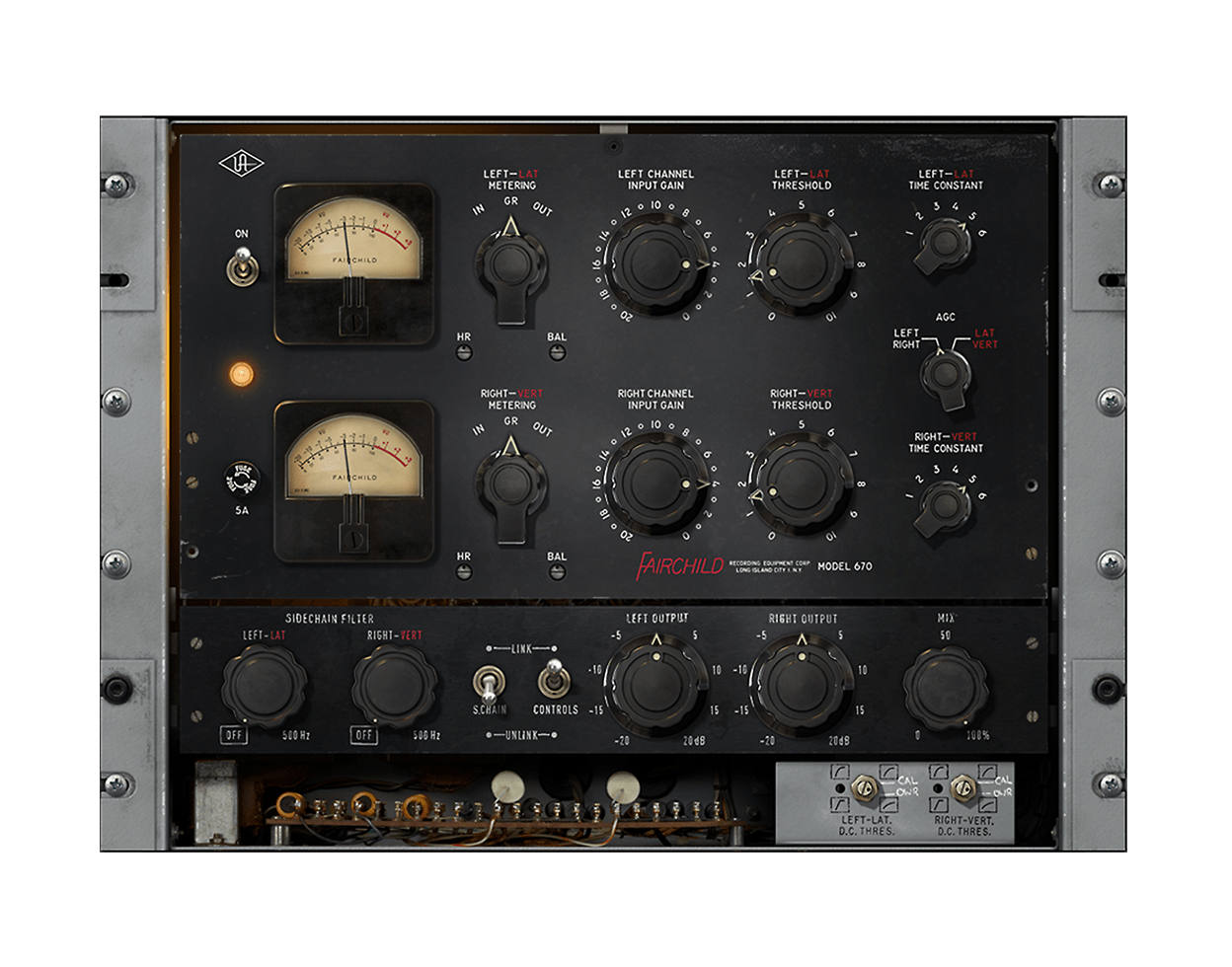
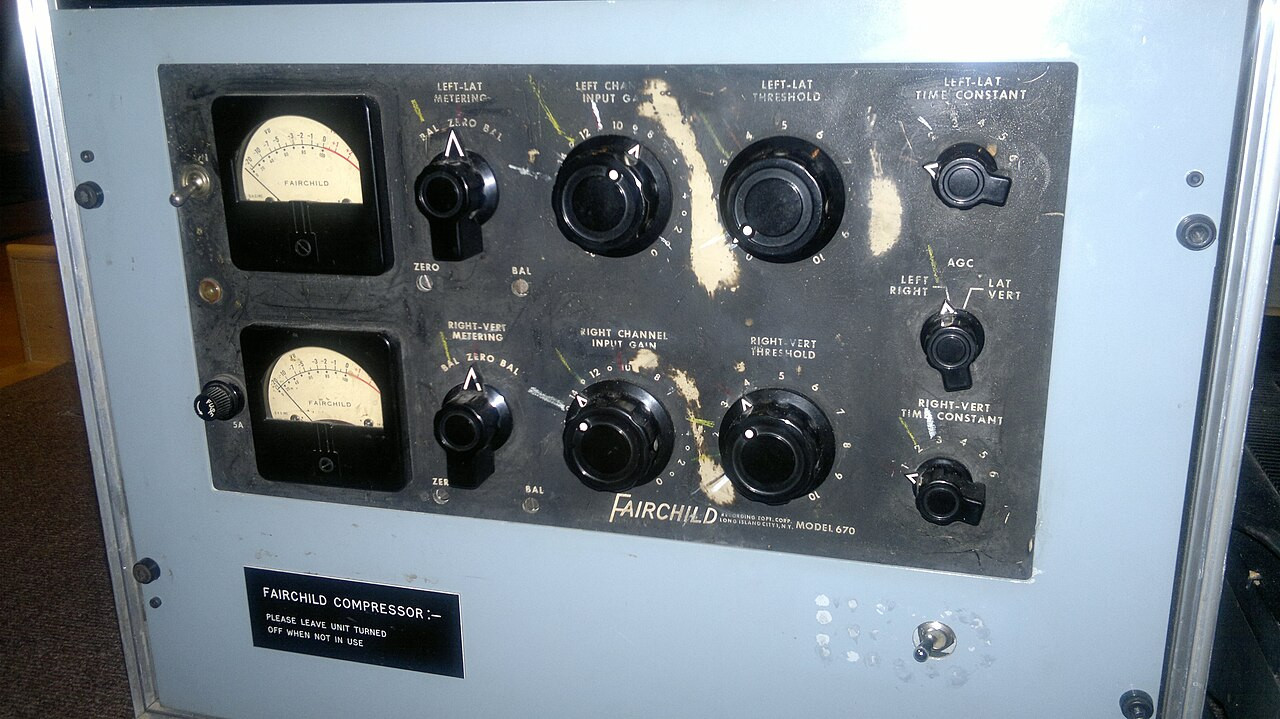
Fairchild 660 / 670

1959 · 🇺🇸 USA · Variable-mu tube

The Holy Grail of vintage limiters.

Designer Rein Narma
Company Fairchild Recording Equipment Corp.
Estonia-born engineer Rein Narma developed the Fairchild compressor design at Gotham Audio. Les Paul — for whom Narma had already built a recording mixer for the Ampex 8-track — asked Narma to build a comp/limiter. Sherman Fairchild (a personal friend of Les Paul) saw it, licensed the design, and hired Narma as chief engineer. The first 10 Fairchild 660s were built by Narma himself. The stereo 670 followed the same year — doubled tubes plus matrixing network.
Mechanism

Variable-mu tube — gain reduction via shifting tube bias. Attack as fast as 0.2 ms; six preset release time constants. The smoothness comes from tubes responding to envelope rather than discrete gain-control elements.

Famous uses
  • Beatles at Abbey Road
  • Pet Sounds mastering chain
  • Glyn Johns sessions
photo pending

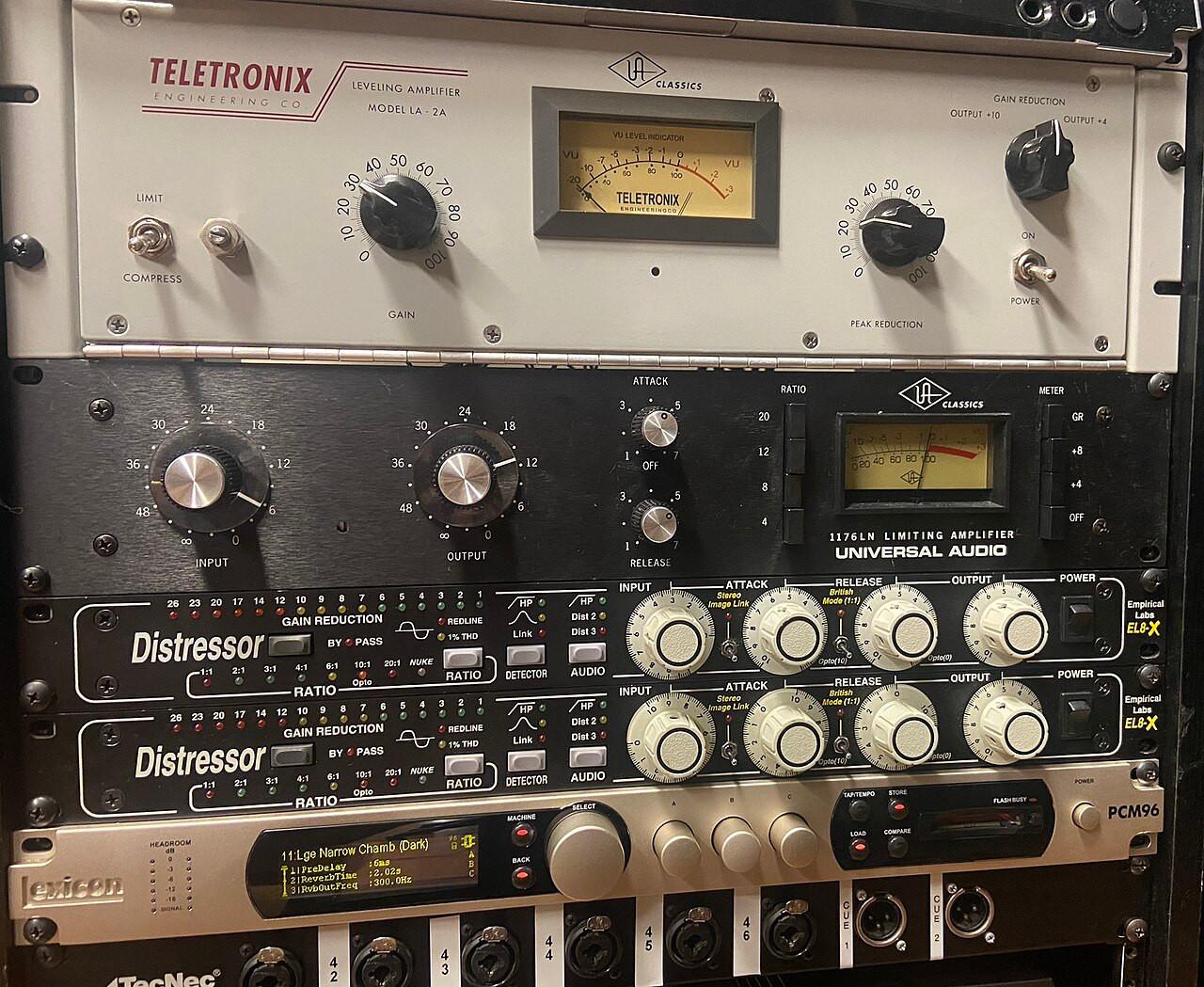
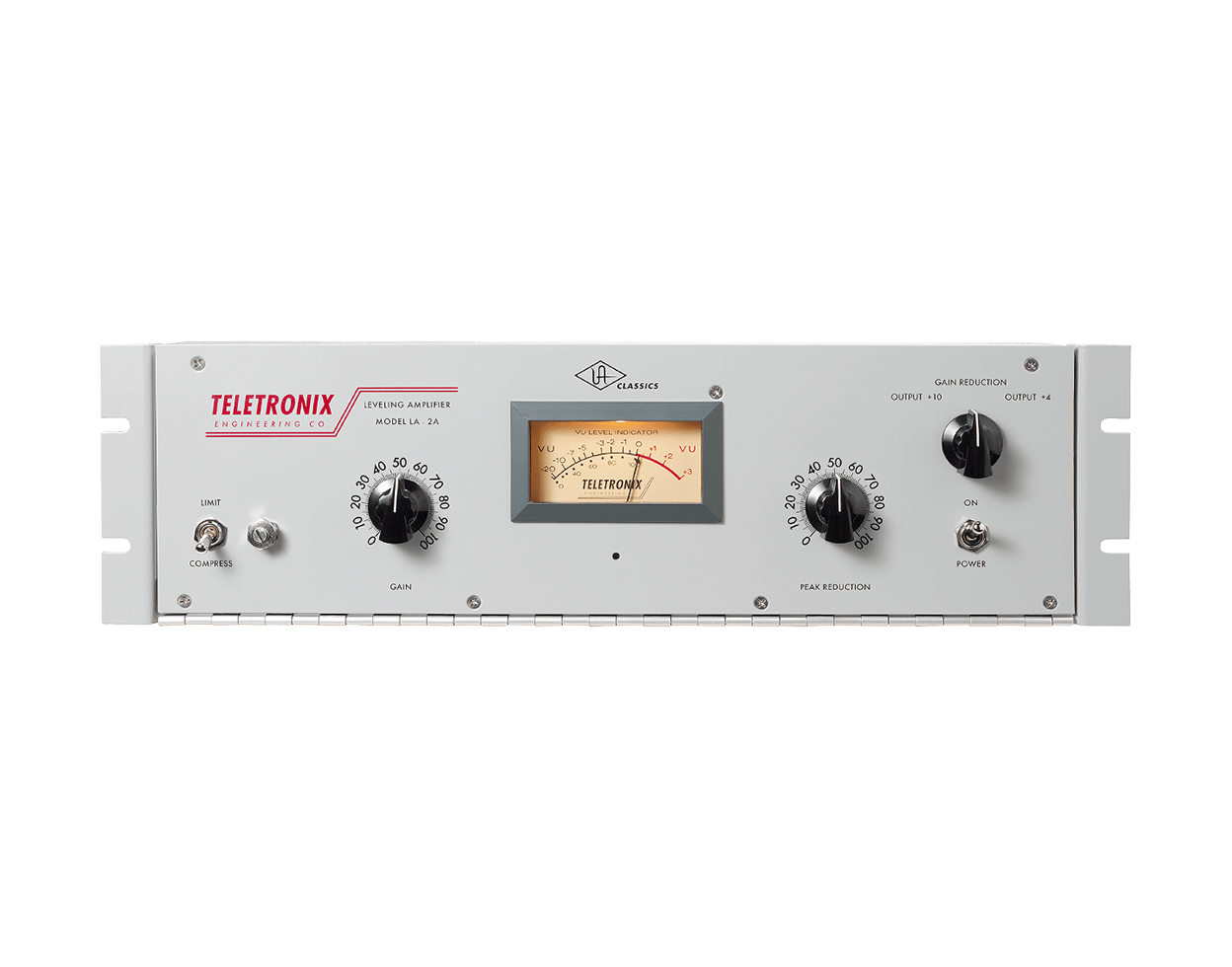
Teletronix LA-2A

1962 · 🇺🇸 USA · Optical (T4 cell)

The slow, gentle, program-dependent classic.

Designer Jim Lawrence
Company Teletronix Engineering Co. (later UA)
Jim Lawrence founded Teletronix in Pasadena, California in 1958 manufacturing broadcast products — transmitter tubes, emergency tone generators, full-scale radio transmitters. In 1962 he reconfigured the LA-2 into the LA-2A: gray faceplate, cleaner turret-board wiring, lower noise floor. Teletronix was acquired by Babcock Electronics (1965), then by Bill Putnam Sr.'s UA in 1967 — bringing the LA-2A into the UREI/UA lineage alongside the later 1176.
Mechanism

T4 optical attenuator — electro-luminescent panel + dual cadmium-sulfide photo resistors sealed in a vacuum-tube-sized canister. One resistor controls gain reduction, the other drives the VU meter. The lag in the luminescent panel's response is what gives the LA-2A its famously slow, program-dependent compression character.

Famous uses
  • Vocal compression on countless American records from mid-60s
  • Aretha Franklin Atlantic sessions
  • Marvin Gaye, Wilson, Brown — Motown + soul vocals
  • Modern reissues remain studio standards
photo pending

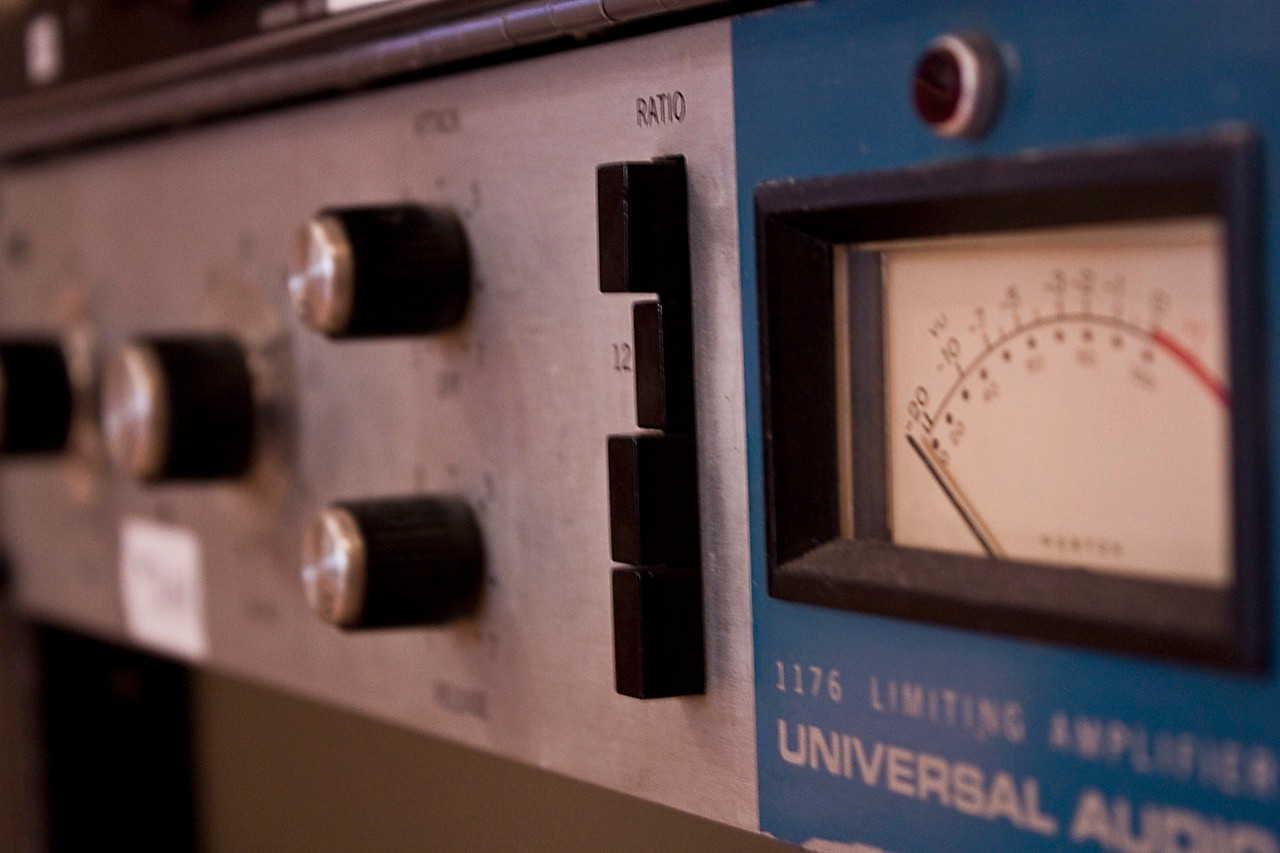
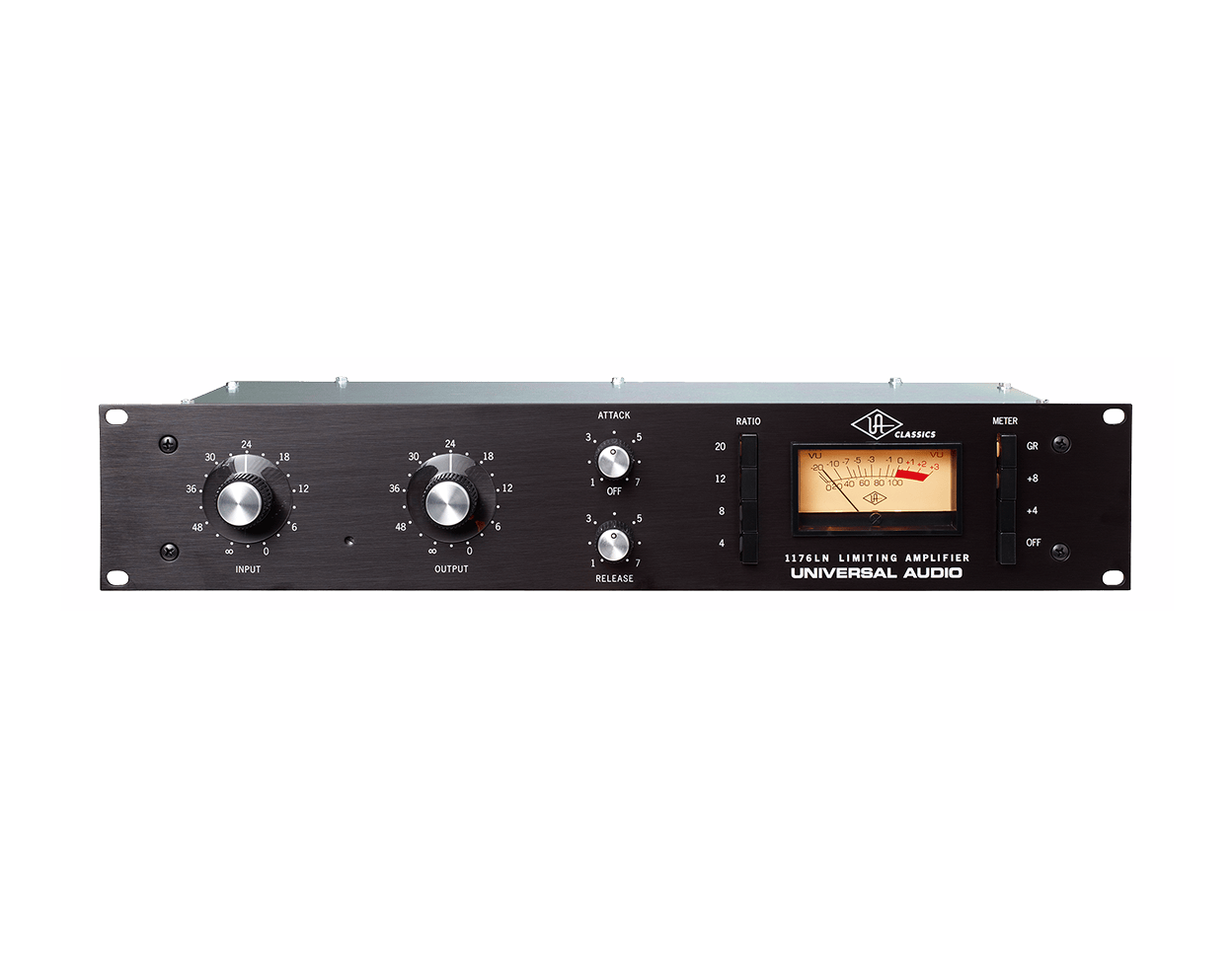
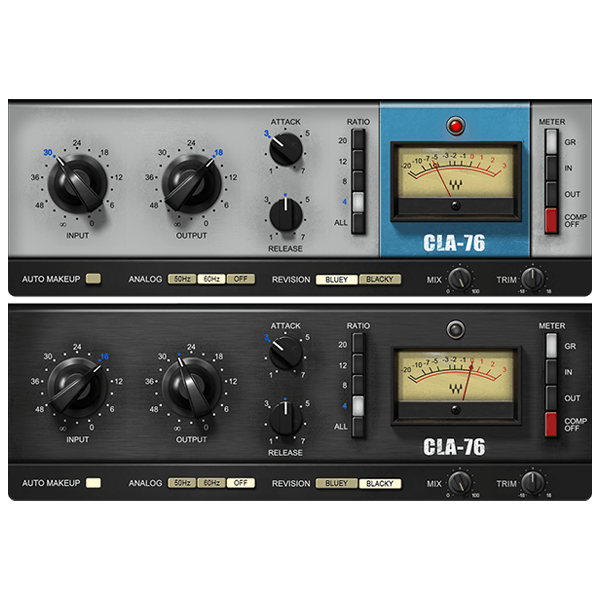
UREI 1176

1968 · 🇺🇸 USA · FET (Field-Effect Transistor)

Fast, aggressive, ubiquitous.

Designer Bill Putnam Sr. (LN circuit by Brad Plunkett)
Company UREI / Universal Audio
Bill Putnam Sr.'s solid-state successor to his own tube-based UA 175/176 limiting amplifier. Originally noisy; Brad Plunkett at UREI designed the Low Noise (LN) circuit that reduced noise 6 dB and improved mid-range linearity — hence "1176LN" from Rev C onwards. Nine major revisions exist: A · A/B · B (Bluestripe) · C · D · E · F · G (Blackface) · H (Silverface). Rev C–E are most revered.
Mechanism

FET as voltage-variable resistor for gain reduction; I/O transformers; Class A line-level amplifier; T-pad resistive attenuator drops input voltage to FET; 1108 circuit preamp uses bipolar Darlington pair.

Famous uses
  • Lennon vocals (every session)
  • Bonham-era Zeppelin drums
  • Bass DI on countless records
  • 4-button "British mode" / "stun mode" on countless rock records
photo pending

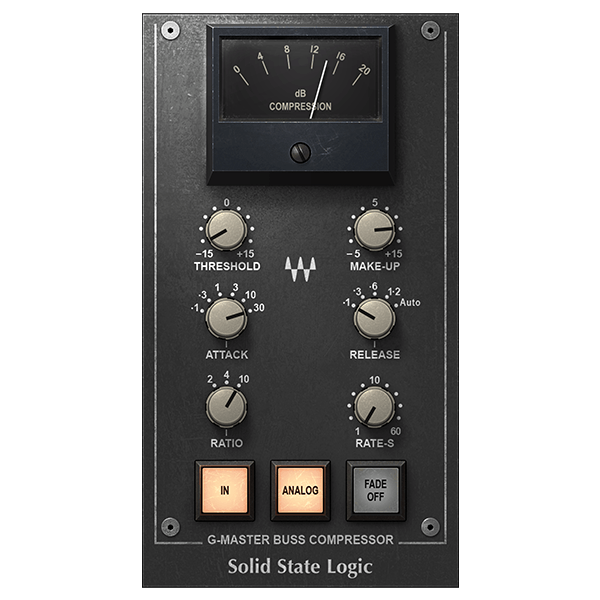
SSL G-Series Bus Compressor

1987 · 🇬🇧 UK · VCA (stereo bus glue)

The "glue" that defined radio-ready mixes.

Designer Solid State Logic
Company SSL (founded by Colin Sanders, 1969)
Originally a module in the SSL 4000 G console (debuted 1987 AES NYC), not a standalone outboard unit. The 4000 G Series upgraded the 4000 E's mix bus with this new compressor circuit + new VCAs. SSL released the standalone rackmount version in 1994 after engineers kept asking for it. The "glue compressor" reputation became part of SSL's console identity through the late 80s and 90s.
Mechanism

VCA-based stereo bus compression with specific gain-reduction character. The "glue" comes from the way the VCAs respond to programme material — subtle, fast, and consistent across the stereo image.

Famous uses
  • Virtually every UK-mixed pop/rock record from late 80s through 90s
  • Michael Jackson Dangerous / HIStory (Swedien mix chains)
  • Madonna Erotica + Bedtime Stories era
  • Modern mastering buses
photo pending

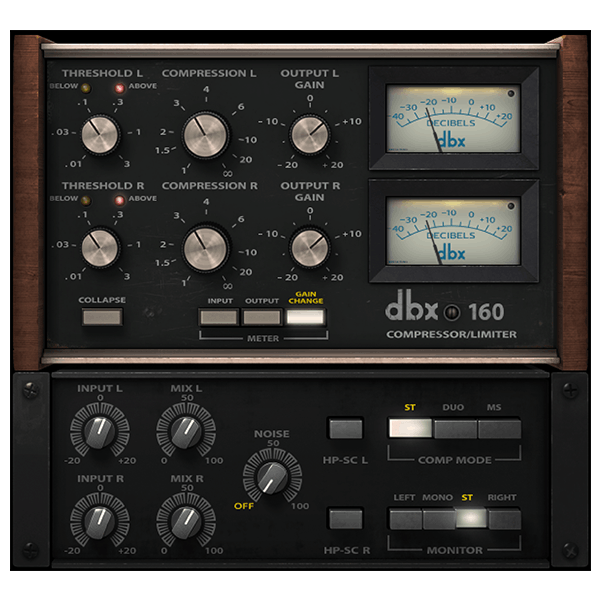
dbx 160 / 160VU

1976 · 🇺🇸 USA · VCA (Blackmer Gain Cell)

The percussive standard. Snare drums everywhere.

Designer David Blackmer
Company dbx Inc. (founded 1971)
David Blackmer founded dbx in 1971 — name from "decibel expansion" — primarily building tape noise reduction systems. The 160 was almost a side product: the first commercially successful VCA compressor in pro audio came out of NR research. The Blackmer Gain Cell — four transistors (2 NPN + 2 PNP) as complementary current mirrors, patented 1973 — was the first VCA with low enough noise + distortion for professional use.
Mechanism

VCA gain reduction using the Blackmer Gain Cell. RMS level detection + feed-forward gain reduction — smoother than feedback designs of the era. Percussive transient response with very fast attack.

Famous uses
  • Snare drum (Hugh Padgham gated-drum era, Steve Lillywhite)
  • Kick drum compression
  • Slap bass DI
  • Modern revival on hip-hop + indie drums
photo pending

Neve 33609

1975 · 🇬🇧 UK · Diode-bridge stereo compressor

The broadcast desert-island comp.

Designer David Rees (Neve Electronics)
Company Neve Electronics
NOT designed by Rupert Neve himself. David Rees at Neve Electronics designed the 2253 limiter first, then the 2254 compressor module (his "masterpiece"). The 33609 rackmount is the standalone adaptation of the later Class A/B 2264, 32264 and 33314 (broadcast) console modules — itself the descendant of the original fully Class A 2254. Originally a console module, then standalone from mid-70s onwards.
Mechanism

Diode-bridge gain reduction — diodes mounted in a bridge configuration with carefully selected control voltages. Pioneering use of this topology in pro audio; significantly reduced distortion vs earlier diode-based designs. Distinct sonic character from VCA / FET / optical / variable-mu.

Famous uses
  • UK / European broadcast mix bus standard from mid-70s
  • Mastering chains worldwide
  • "Desert island" comp per top engineers
  • Mixing buses on rock + classical

Equalizers

Passive, parametric, proportional.

From Pultec's passive 1951 trick to Sontec's 1972 parametric breakthrough to Manley's 1998 modern passive — five EQ philosophies, one shared function.

photo pending

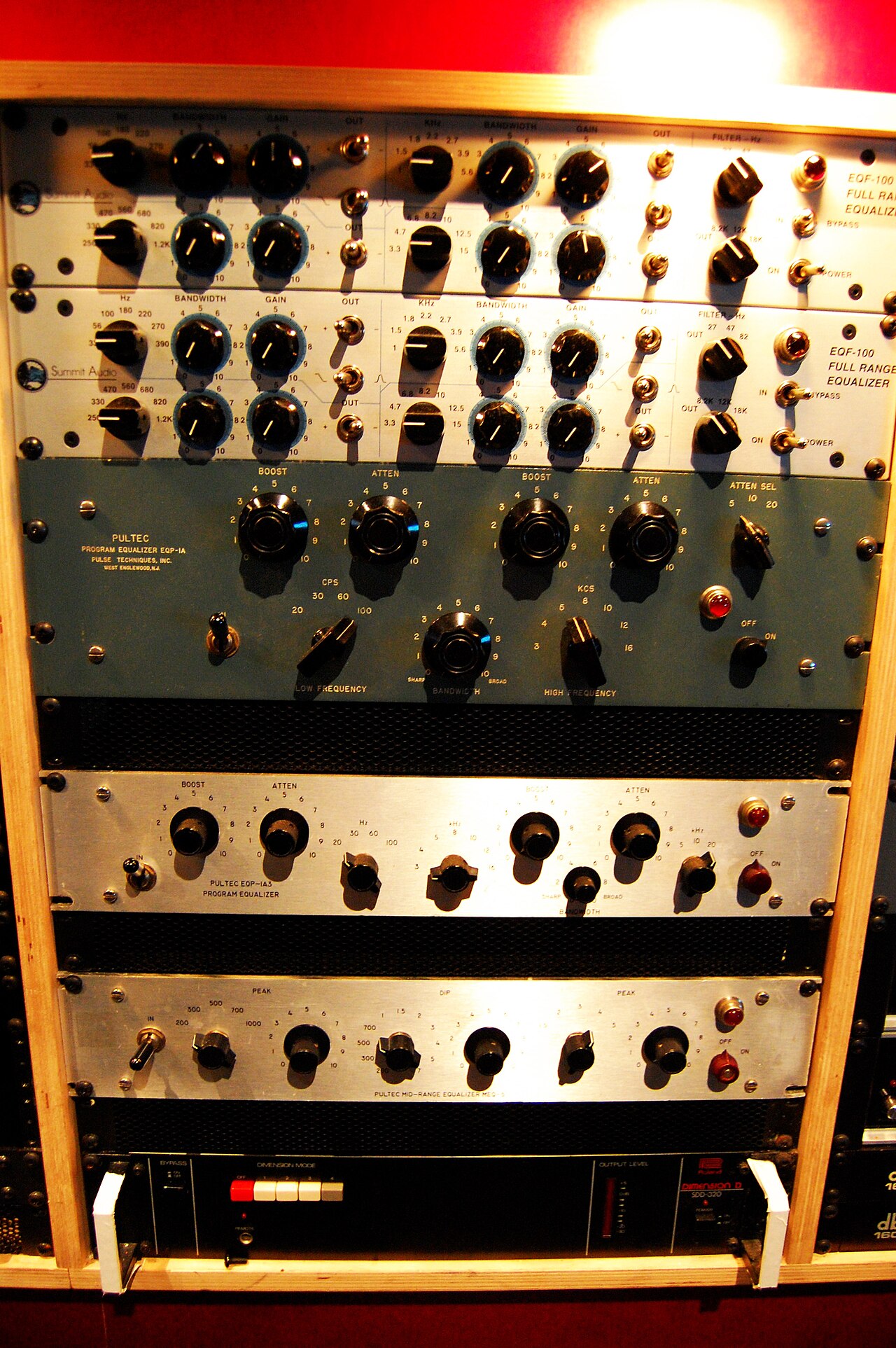
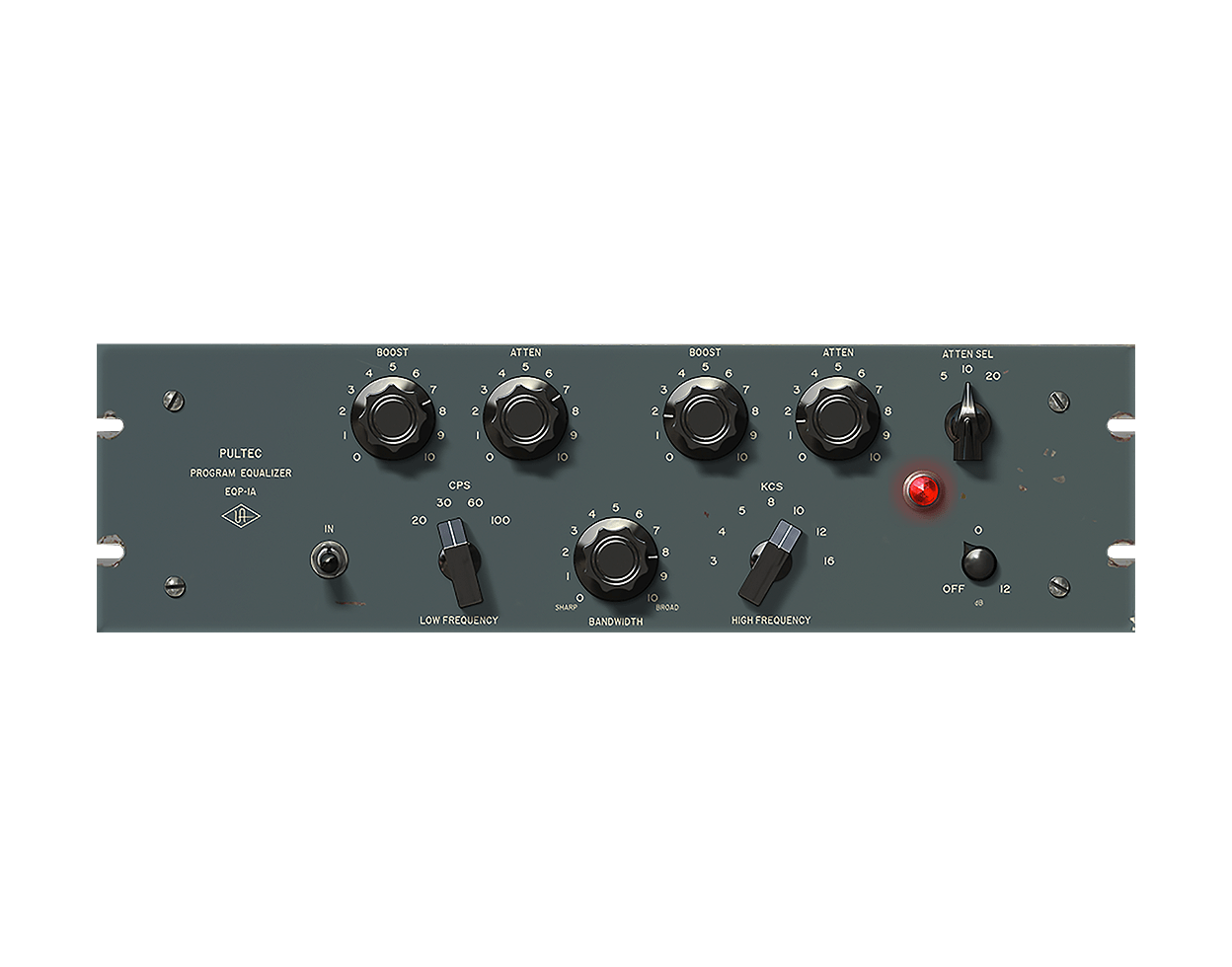
Pultec EQP-1A

1951 · 🇺🇸 USA · Passive LC + tube makeup

The passive trick that defined low-end.

Designer Eugene Shenk + Ollie Summerlin
Company Pulse Techniques Inc. (Teaneck NJ, 1953)
Eugene Shenk and Ollie Summerlin — former RCA Institute classmates — unveiled the first passive program EQ in 1951; officially incorporated Pulse Techniques Inc. on 1 February 1953 in Teaneck, NJ. The EQP-1A (1961) added a 12AU7 / 12AX7 / 6X4 push-pull tube makeup gain stage after the filter. Every unit was built by hand by Shenk and Summerlin — a true two-man operation.
Mechanism

Passive LC (inductor-capacitor) filter section; the negative-feedback amplifier circuitry was licensed from Western Electric, but the filter design was Shenk's own. The "Pultec trick" — simultaneously boosting and cutting at the same low-frequency band — creates a slight dip just above the boost peak, producing more low-end without muddying.

Famous uses
  • Industry-wide standard from the 60s onwards
  • Beatles/Beach Boys/Motown era mastering chains
  • Bass + kick drum on virtually every studio of the 60s/70s
  • Often paired with a Fairchild 670
photo pending

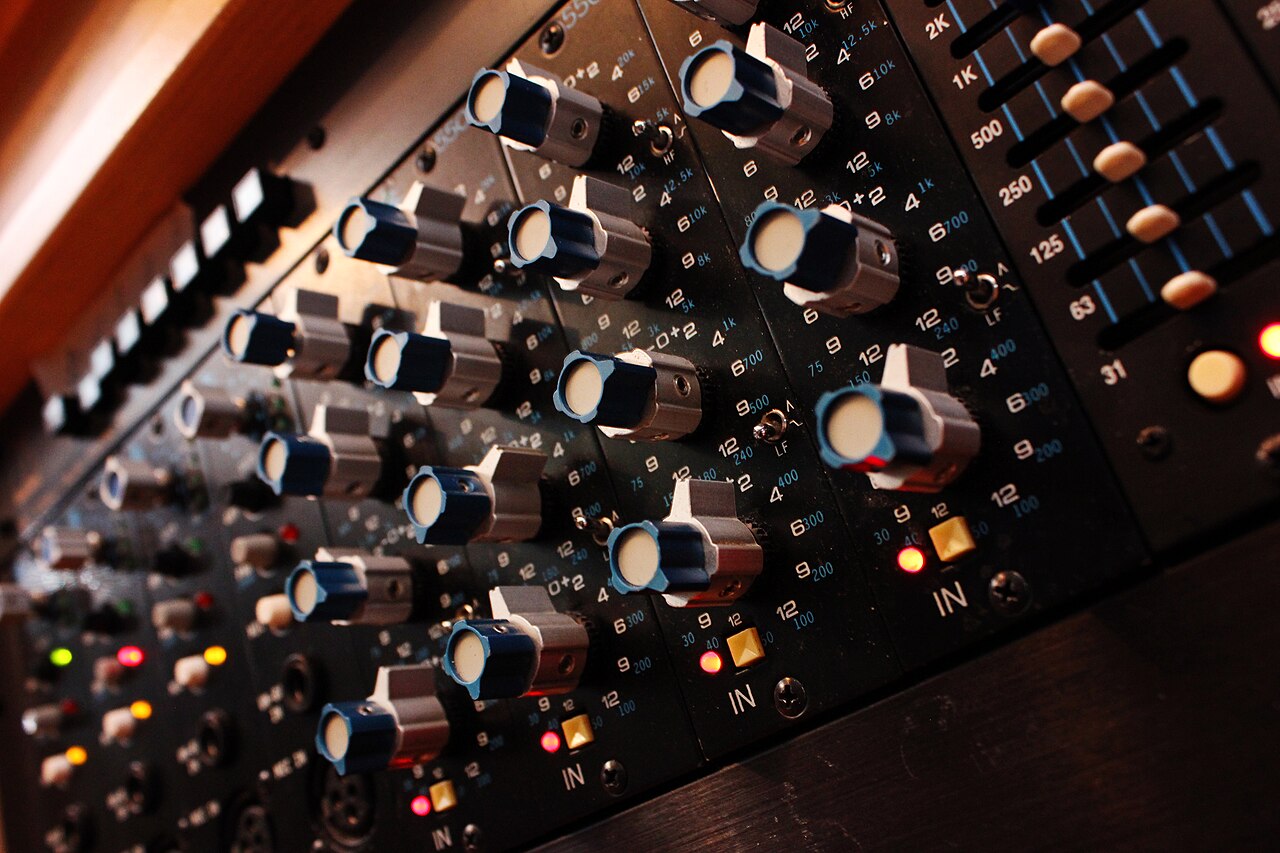
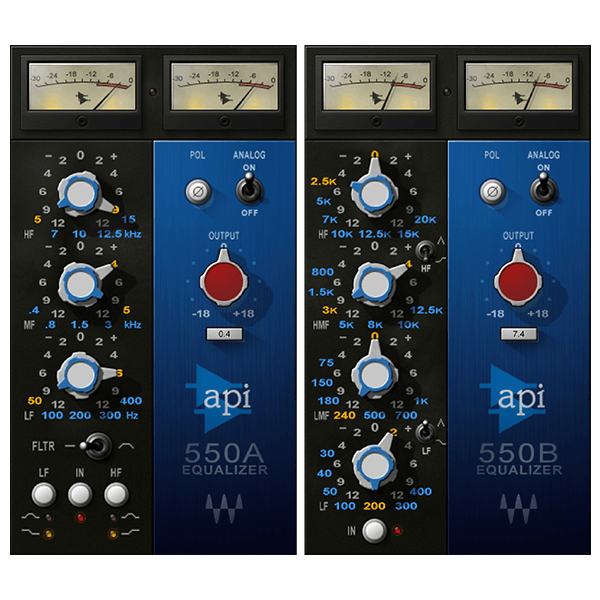
API 550A

1968 · 🇺🇸 USA · Discrete Class-A/B + Proportional Q

Bandwidth narrows as gain rises.

Designer Saul Walker
Company Automated Processes Inc. (API)
Saul Walker founded API in 1968 — the 550A came alongside the company itself. API only started building consoles in 1971, at which point the 550A became their standard channel module EQ. So the 550A is the unusual case where the rack module came first and the console followed — opposite trajectory from Neve 1073 or SSL G Bus Comp.
Mechanism

Combines API's proprietary 2520 discrete Class-A/B op-amp with Proportional Q filter topology. As gain increases, bandwidth narrows: ±2 dB = ~3 octaves wide, ±12 dB = ~1 octave wide. Gentle EQ moves are broad and musical; surgical moves are surgical — both behaviours from one circuit.

Famous uses
  • New York rock + soul (Power Station, Record Plant)
  • Drum bus + snare EQ
  • Eddie Kramer + Bob Clearmountain sessions
  • Steely Dan recording sessions
photo pending

Neve 1073

1970 · 🇬🇧 UK · Class A discrete + Marinair iron

The British sound, in module form.

Designer Rupert Neve
Company Neve Electronics
Designed for the Wessex Studios A88 console commission in 1970. Originally a channel module — NOT standalone outboard — meant to retrofit into Neve 80-Series channel strips. Standalone rack versions came later. Predecessor modules 1056 / 1058 (late 60s, germanium transistors, black-fronted) led to the silicon-transistor 1073 topology. Every modern unit follows Rupert Neve's pencil-on-paper original designs.
Mechanism

Class A discrete transistor amplification. Marinair input transformer (collaboration with Marinair Radar Company, late 60s/early 70s). LO1166 gapped output transformer — designed by Rupert Neve in 1964 for his first transistorised console (Phillips Records), spec still proprietary at Neve HQ. Inductor-based EQ with handcrafted UK-made inductors.

Famous uses
  • 70s rock — Trident, Olympic, Air, Wessex sessions
  • Dave Grohl + Foo Fighters Neve fleet
  • Considered the gold-standard mic preamp + EQ
photo pending

Sontec MES-432

1972 · 🇺🇸 USA · Fully parametric

The first commercially available parametric EQ.

Designer Burgess Macneal + George Massenburg
Company Sontec (after ITI dissolved)
Macneal met Massenburg in the mid-1960s when Massenburg was just 16. After 1968 (when ITI bought Macneal's studio) they began designing a mixing console — the parametric-EQ concept came out of that work. The ITI ME-230 (1972) was the first parametric ever to ship; the Sontec MES-432 followed once Macneal + Massenburg started their own company. The AES paper "Parametric Equalization" (1972) was self-published; the design was never patented, putting it effectively in the public domain.
Mechanism

Fully parametric — independent controls over frequency, bandwidth (Q), and gain on each band. Conceived around 1966 by Macneal as a sweep-tunable EQ avoiding inductors and switches.

Famous uses
  • Bob Ludwig's Gateway Mastering
  • Bernie Grundman Mastering
  • Doug Sax / Mastering Lab
  • Virtually every major mastering studio from late 70s onwards
photo pending

Manley Massive Passive

1998 · 🇺🇸 USA · Passive filter + tube makeup gain

"Pultec 2.0" — passive analog, modern build.

Designer Manley Laboratories (commonly attributed to Hutch Hutchison)
Company Manley Labs (Chino, California; led by EveAnna Manley since 1993)
Launched in 1998 by Manley Laboratories. Explicitly designed to combine the best of Pultec (passive + boost+cut interaction), choice console EQs, parametrics, and graphics into a single modern unit. The Mastering version offers stepped controls for recall precision. One of the rare post-1990 units on this page — qualifies under the analog-heritage rule because the topology is genuinely passive analog, not a modern DAW-era feature-set.
Mechanism

Entirely passive filter network in the EQ signal path — only metal-film resistors, film capacitors, and hand-wound inductors sculpt the sound. Zero active circuitry in the EQ; a clean tube amplifier stage restores gain afterwards.

Famous uses
  • Modern mastering rooms worldwide
  • Tracking + mixing for big-budget productions
  • Late-90s onwards hip-hop + pop mastering signature

Reverbs

Plate to digital — the spaces that aren't there.

Three technological eras: electromechanical plate (EMT 140) → first commercial digital (EMT 250, Lexicon 224) → mature digital + multi-FX (480L, RMX16, SPX90) — plus spring as the parallel tradition.

photo pending

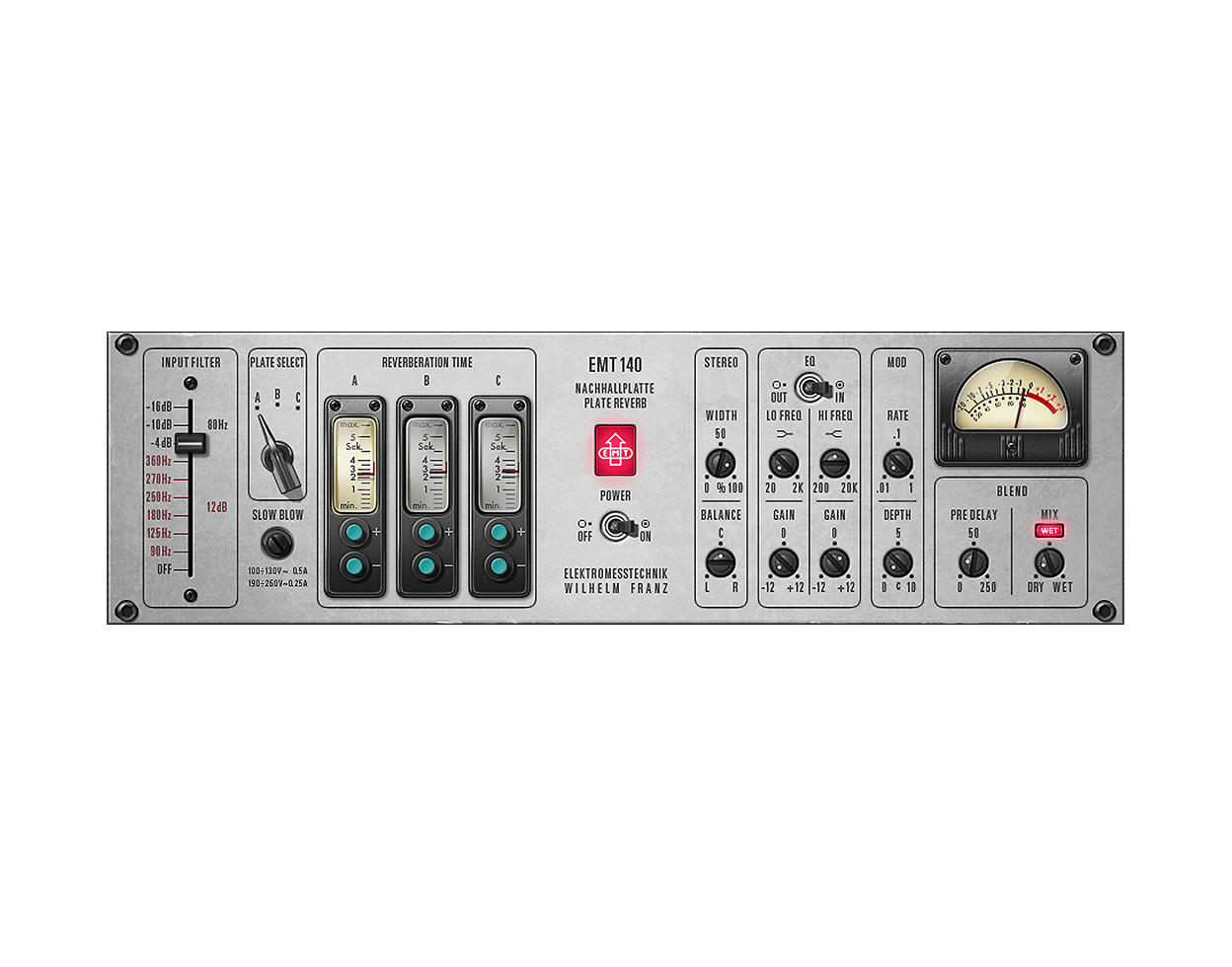
EMT 140

1957 · 🇩🇪 Germany · Plate (electromechanical)

The plate that defined every studio.

Designer Wilhelm Franz
Company Elektromesstechnik (EMT)
Designed in 1957 by Wilhelm Franz (born Bremen 1913, † 10 April 1971), founder of EMT in Berlin (1938). Developed in cooperation with the Rundfunktechnisches Institut (German broadcast technology institute). Remained in production for 25 years. AES Honorary Membership awarded posthumously to Franz in 1983 for the 140, 240, 250 reverbs + EMT turntables.
Mechanism

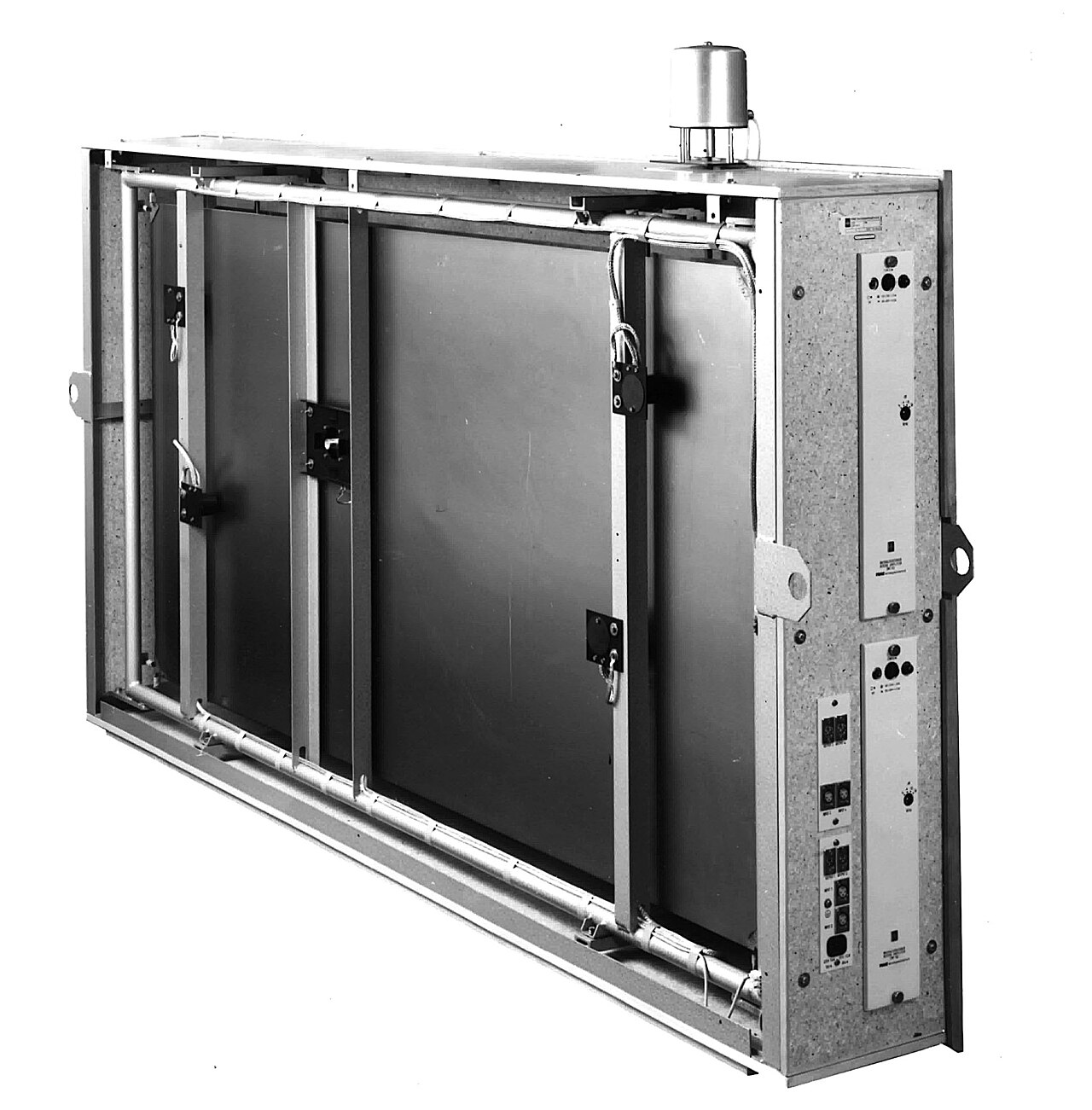
1 m × 2 m thin steel plate suspended in tubular steel frame under controlled tension. Driver transducer induces sound waves; one (mono) or two (stereo) pickups capture wave energy. Decay time controlled by a mechanical damping pad moved closer to / further from the plate via remote.

Famous uses
  • Beatles Abbey Road catalogue (1960s)
  • Pink Floyd Dark Side of the Moon
  • Atlantic / Stax / Motown era standard
  • Heavy use in dub (King Tubby era)
photo pending

EMT 250

1976 · 🇩🇪/🇺🇸 · First commercial digital reverb

The pivot from analog to digital.

Designer Dr. Barry Blesser (Dynatron / MIT)
Company EMT + Dynatron partnership
The first commercially available digital reverb unit, marking the industry pivot from analog to digital. Designed by Dr. Barry Blesser (then MIT professor; he had also helped launch Lexicon in 1971 — making him the through-line for the entire early-digital-reverb lineage). EMT partnered with Dynatron (US) for the build. $20,000 launch price; only ~250 units produced. The 250 directly inspired David Griesinger to create the Lexicon 224.
Mechanism

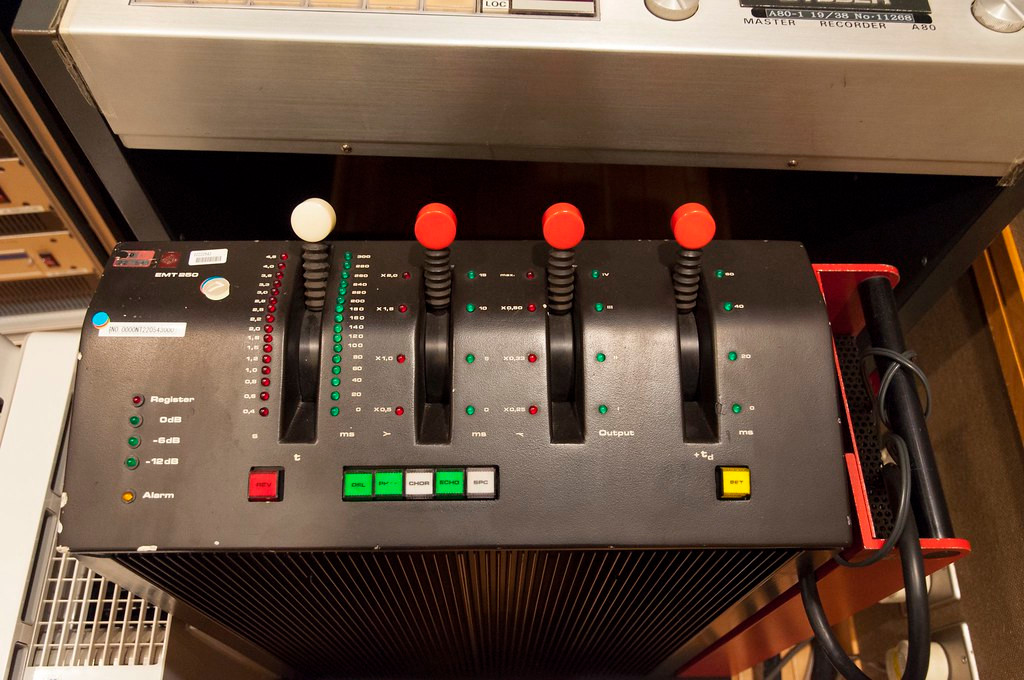
TMS9900-class processors + custom DSP boards. Multiple algorithms (Plate, Chamber, etc.) selectable from front panel. Famous four large coloured paddle controls for parameter adjustment — pre-screen-era UX design.

Famous uses
  • Abbey Road through 80s
  • Lennon Dakota sessions
  • Steely Dan Gaucho
  • High-end studio standard 1976–1986
photo pending

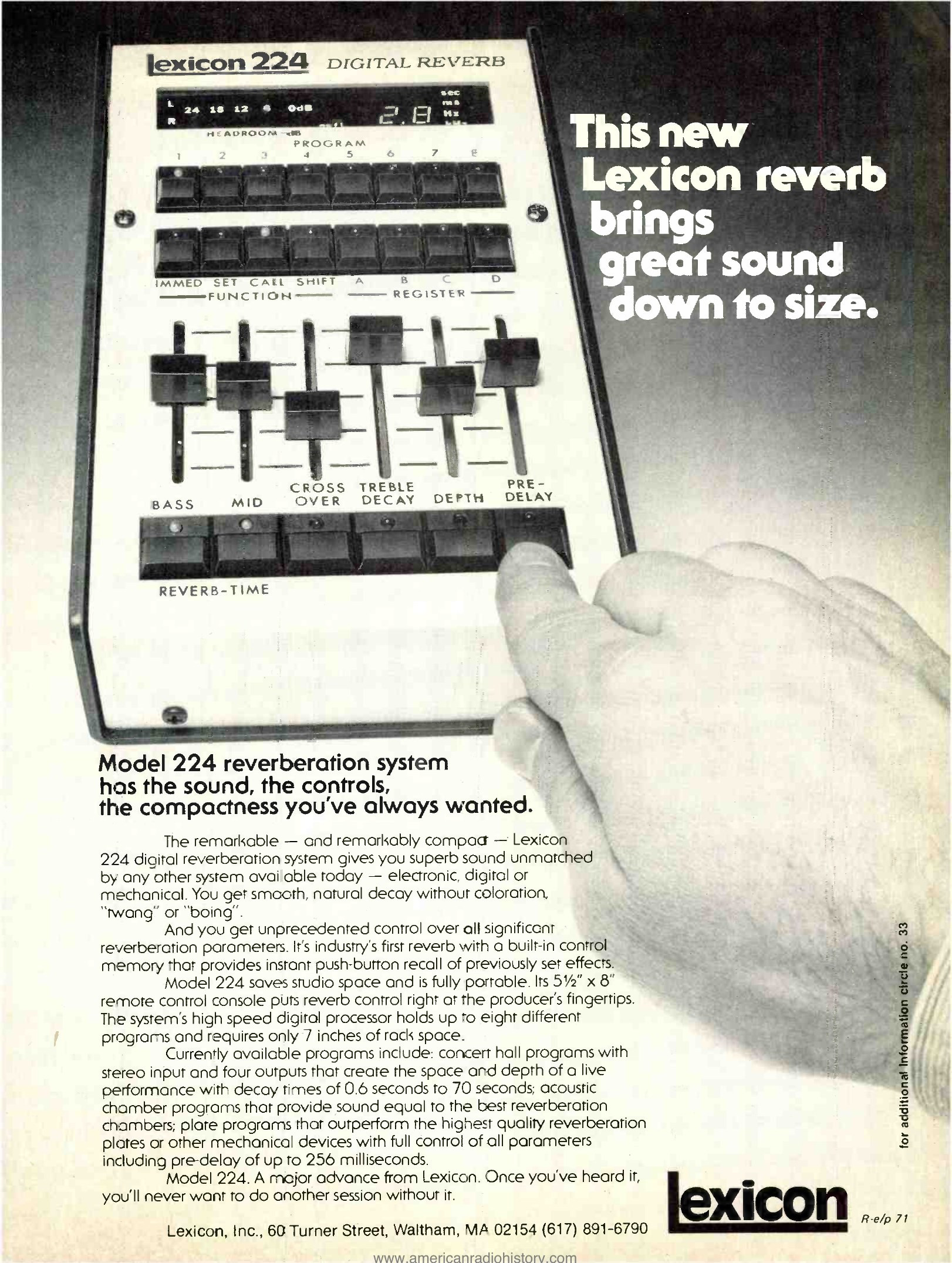
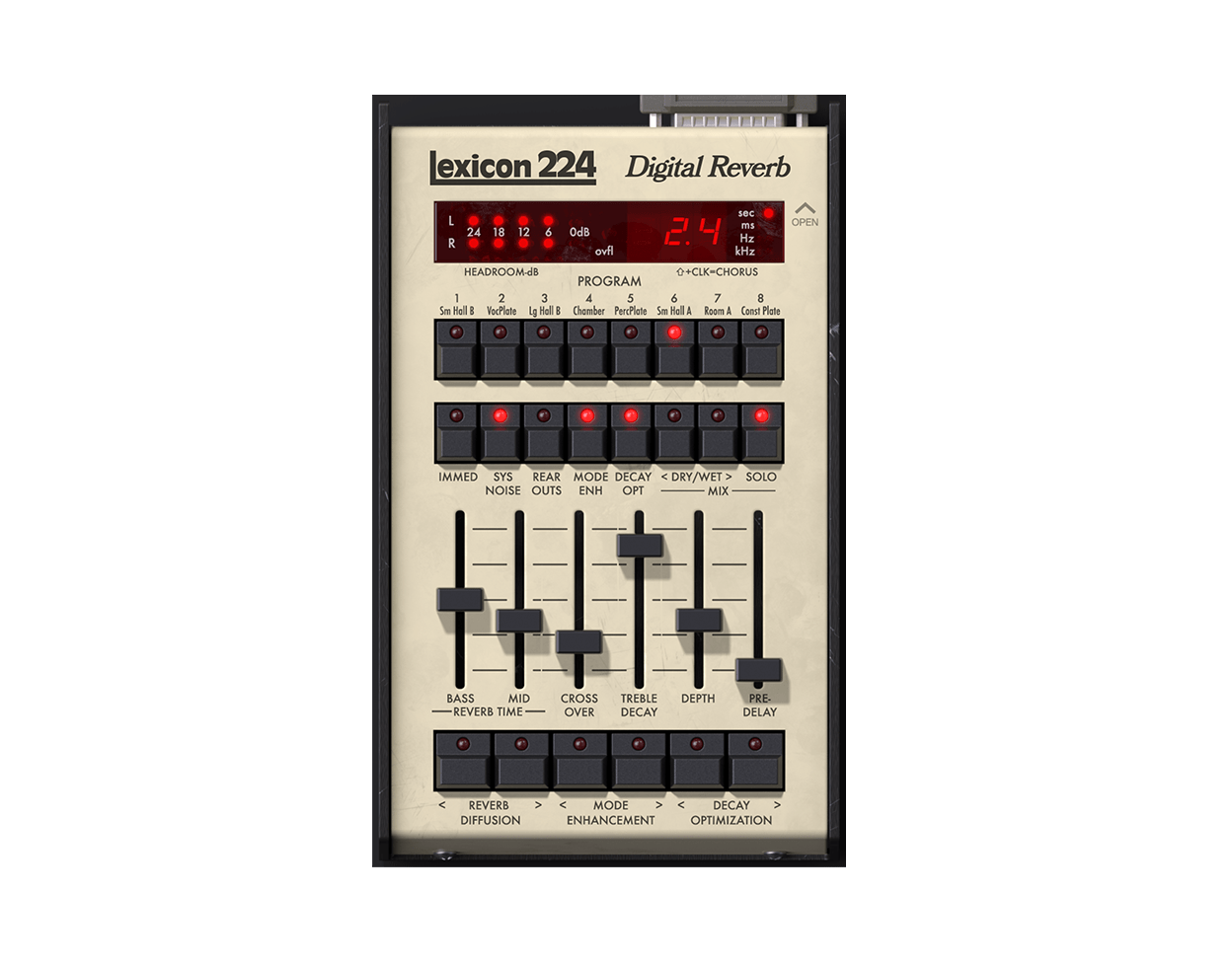
Lexicon 224

1978 · 🇺🇸 USA · Digital, microcomputer-controlled

Digital reverb, democratised.

Designer Dr. David Griesinger
Company Lexicon
Designed by Dr. David Griesinger — nuclear physicist, musician, and classical recording engineer — explicitly inspired by the EMT 250 (1976). Griesinger built a microcomputer-controlled reverb prototype and brought it to Lexicon, who acquired the design and hired him. Launched at AES NYC, November 1978. At $7,500 it was half the price of the EMT 250, democratising digital reverb. Successor line: 224 → 224X → 224XL.
Mechanism

Two-part architecture: 4U mainframe with audio processing + dedicated console-top remote for parameter control. 2 inputs / 4 outputs. Interchangeable program cartridges for different spaces (chambers, plates, rooms).

Famous uses
  • Talking Heads Remain in Light
  • Steely Dan late catalogue
  • New Wave production after 1979
photo pending

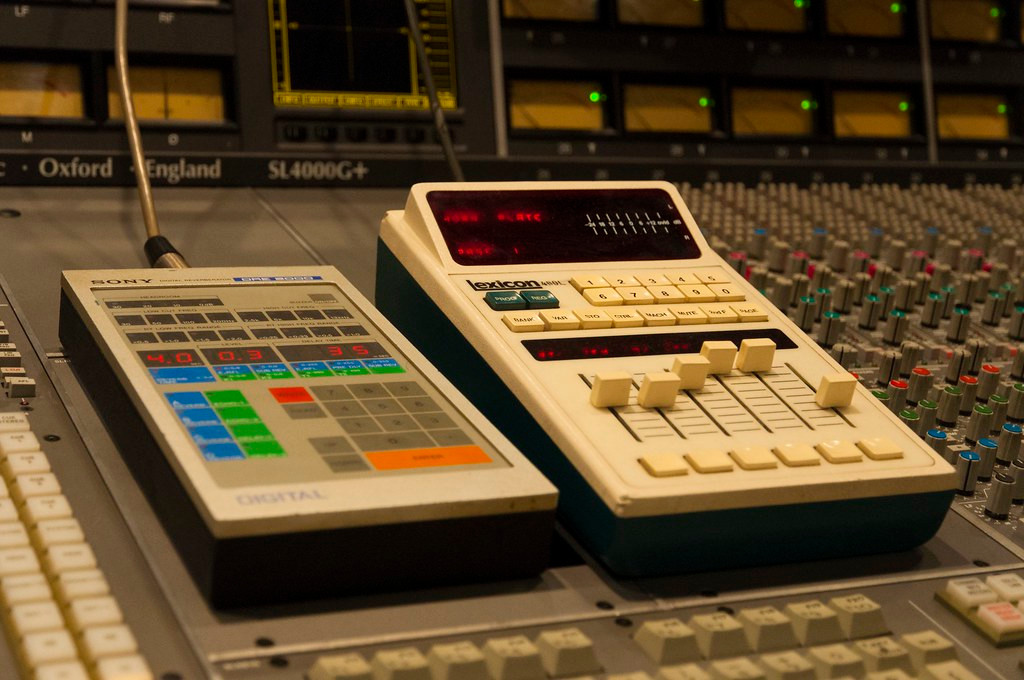
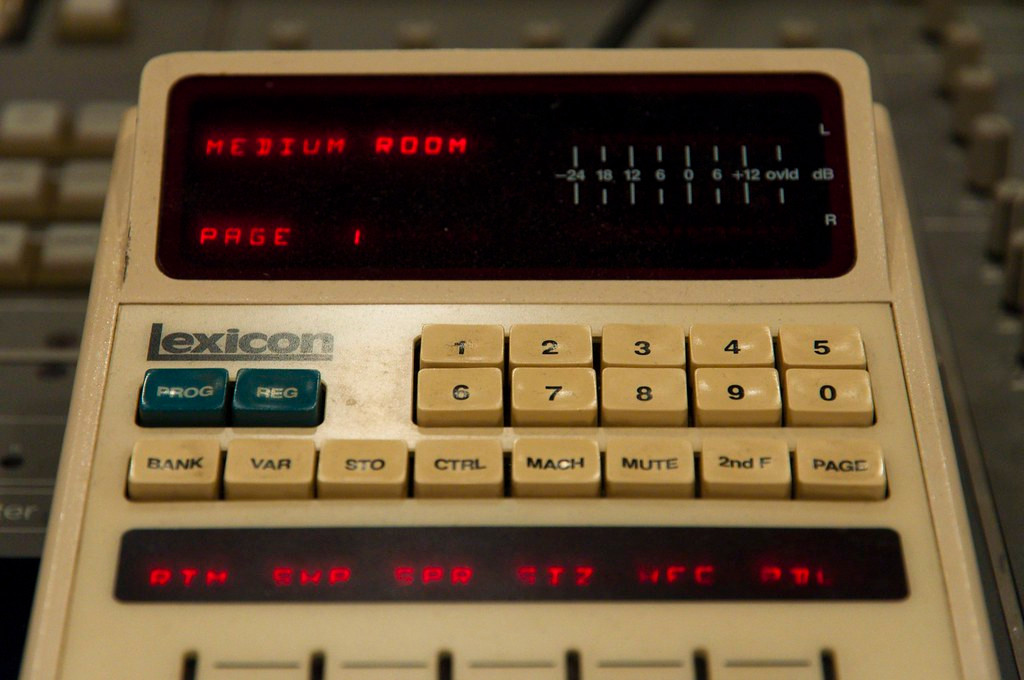
Lexicon 480L

1986 · 🇺🇸 USA · Digital, dual-engine

The LARC remote alone is a studio icon.

Designer Lexicon team
Company Lexicon
Successor to the 224XL. The LARC (Lexicon Alphanumeric Remote Control) — wedge-shaped controller with 6 sliders, chunky buttons, and red-on-black LED display — became as iconic as the box itself. "More gold and platinum records than any other reverb system of its kind." The default high-end digital reverb 1986 → early 2000s, in music and film.
Mechanism

18-bit / 48 kHz sampling, 98 dB dynamic range. Two simultaneous reverb engines that can run in parallel in the same box.

Famous uses
  • Michael Jackson Dangerous / HIStory (Swedien chains)
  • Madonna Like a Prayer + later
  • Tom Petty Wildflowers
  • Film: Titanic, Jurassic Park (dinosaur reverbs)
photo pending

AMS RMX16

1982 · 🇬🇧 UK · Microprocessor-controlled digital reverb

The gated-reverb sound, in one box.

Designer Mark Crabtree
Company AMS (Advanced Music Systems, Burnley UK)
Designed by former aerospace engineer Mark Crabtree, who founded AMS in 1976. The RMX16 (March 1982) was the first microprocessor-controlled, full-bandwidth digital reverb as a standalone integrated unit — superseding the earlier DMX 15-80/15R expansion-card combo. Prince and Kate Bush were among the first adopters who popularised its use.
Mechanism

Microprocessor-controlled DSP with 9 reverb programs (Hall, Plate, Chamber, Ambient, Non-Linear — the gated-reverb program). Front-panel parameter editing; internal converters.

Famous uses
  • Phil Collins "In the Air Tonight" + Face Value era (Townhouse Studio 2)
  • Peter Gabriel III
  • Every major 80s production with gated drums
  • Modern revival on hip-hop + indie
photo pending

Yamaha SPX90

1985 · 🇯🇵 Japan · Programmable multi-effects with MIDI

Multi-FX, democratised — every PA rack had one.

Designer Yamaha multi-effects team
Company Yamaha
Launched 1985 — same year as the Lexicon PCM70 — as the affordable answer for project studios and live PA. While the PCM70 went to pro studios, the SPX90 went everywhere else: small studios, demo rooms, regional touring bands. First time real multi-FX became affordable. Cultural reach was vastly larger than higher-end peers despite — or because of — compromises in sampling rate.
Mechanism

16-bit linear converters at 31.25 kHz sampling rate (compromised to keep cost down — 20 Hz–12 kHz on processed signals; full bandwidth in bypass). 30 preset algorithms: 4 reverb / 6 chorus-flange / 4 pitch + 14 others (gates, comps, vibrato, panning, freeze, gated reverb). MIDI program change + parameter control + footswitch trigger.

Famous uses
  • Madonna Like a Virgin
  • Alanis Morissette Jagged Little Pill
  • Virtually every demo + project studio 1985–~1995
  • Live PA racks of every regional touring band
photo pending

AKG BX20

1968 · 🇦🇹 Austria · Mechanical-electronic spring reverb

Spring reverb, but professional.

Designer AKG engineering team
Company AKG Acoustics (Vienna, Austria)
Production cited 1968–1974 (one source dates intro to 1965). Austrian, AKG Acoustics — the microphone company. Where most spring reverbs were guitar-amp accessories, the BX20 was a professional studio unit that competed directly with plate reverb. Dark-wood and light-wood cabinet versions exist.
Mechanism

Long springs in a tensioned chassis with carefully matched transducers and pickups + electronic conditioning + adjustable damping. Two independent channels (dual mono or stereo configuration); each signal has individual decay time adjustable 2.0 to 4.5 seconds.

Famous uses
  • Rolling Stones
  • Pink Floyd
  • Led Zeppelin
  • Heavy reggae/dub creative use (King Tubby era)

Delays & Tape Echo

Four nationalities, four traditions.

USA (Echoplex EP-3) · Japan (Roland RE-201) · Italy (Binson Echorec) · UK (Watkins Copicat) — tape echo emerged in parallel across four pro-audio cultures, each with its own character.

photo pending

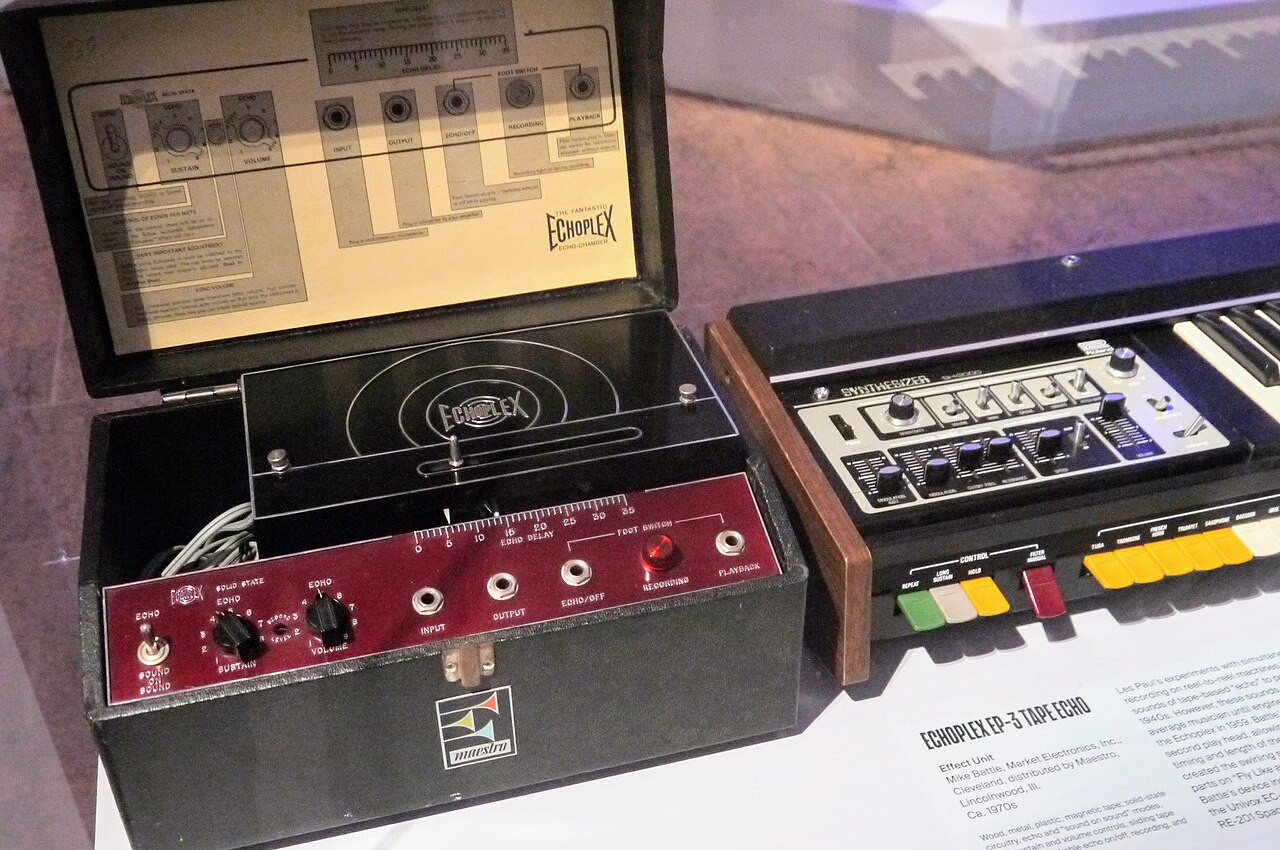
Maestro Echoplex EP-3

1970 · 🇺🇸 USA · Tape echo with moving record head

Variable delay without changing tape speed.

Designer Mike Battle + Don Dixon
Company Market Electronics / Maestro
Original Echoplex (tube EP-1 / EP-2) by Mike Battle and Don Dixon dates to 1959 (Chicago Musical Instruments). Patent sold to Market Electronics (Cleveland OH) in 1962. Battle and Dixon developed the solid-state EP-3 in the late 60s; released 1970, produced until 1991 — 21-year run, longest of any Echoplex. Battle was reportedly unhappy with the EP-3 sound and sold his interest.
Mechanism

Tape loop in cartridge format; moving record head as the core innovation — variable delay without changing tape speed. Plus dedicated playback head + erase head. The preamp section became famous in its own right (many players ran signal through an Echoplex with delay off for the colour alone).

Famous uses
  • Jimi Hendrix (Band of Gypsys era)
  • Eddie Van Halen
  • Jimmy Page (Zeppelin live)
  • Robert Fripp Frippertronics
photo pending

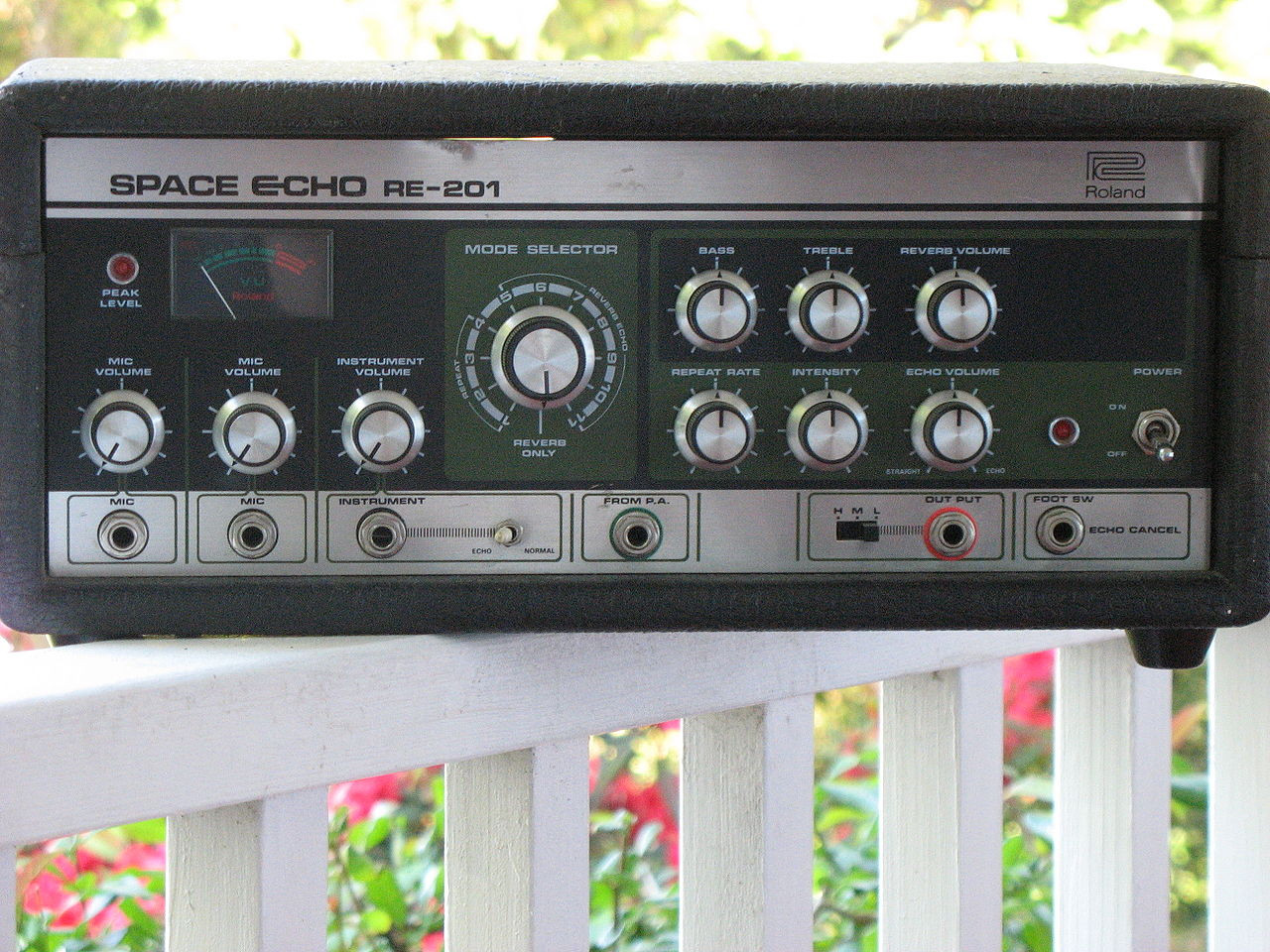
Roland RE-201 Space Echo

1974 · 🇯🇵 Japan · Tape echo + spring reverb

The dub-mixing staple.

Designer Ikutaro Kakehashi
Company Roland Corporation (founded 1972)
Ikutaro Kakehashi founded Ace Electronic Industries in 1960, then Roland Corporation in 1972. Roland released the RE-100/RE-200 in 1973 (1/4" tape loop); the RE-201 followed in 1974 with circuit refinements + spring reverb built in. Produced until 1990 — 16-year run. The floating-tape transport improved reliability + delivered the characteristic wow + flutter that producers actually wanted.
Mechanism

Free-floating 1/4" tape loop in tape chamber (no cartridge). Single capstan transport with three playback heads + multi-tap selector — produces the characteristic syncopated delay pattern. Spring reverb built-in (the RE-101 was identical minus the spring tank).

Famous uses
  • King Tubby (Waterhouse studio)
  • Lee "Scratch" Perry — Black Ark
  • Pink Floyd (post-Binson era)
  • Modern dub + ambient: Adrian Sherwood, Boards of Canada
photo pending

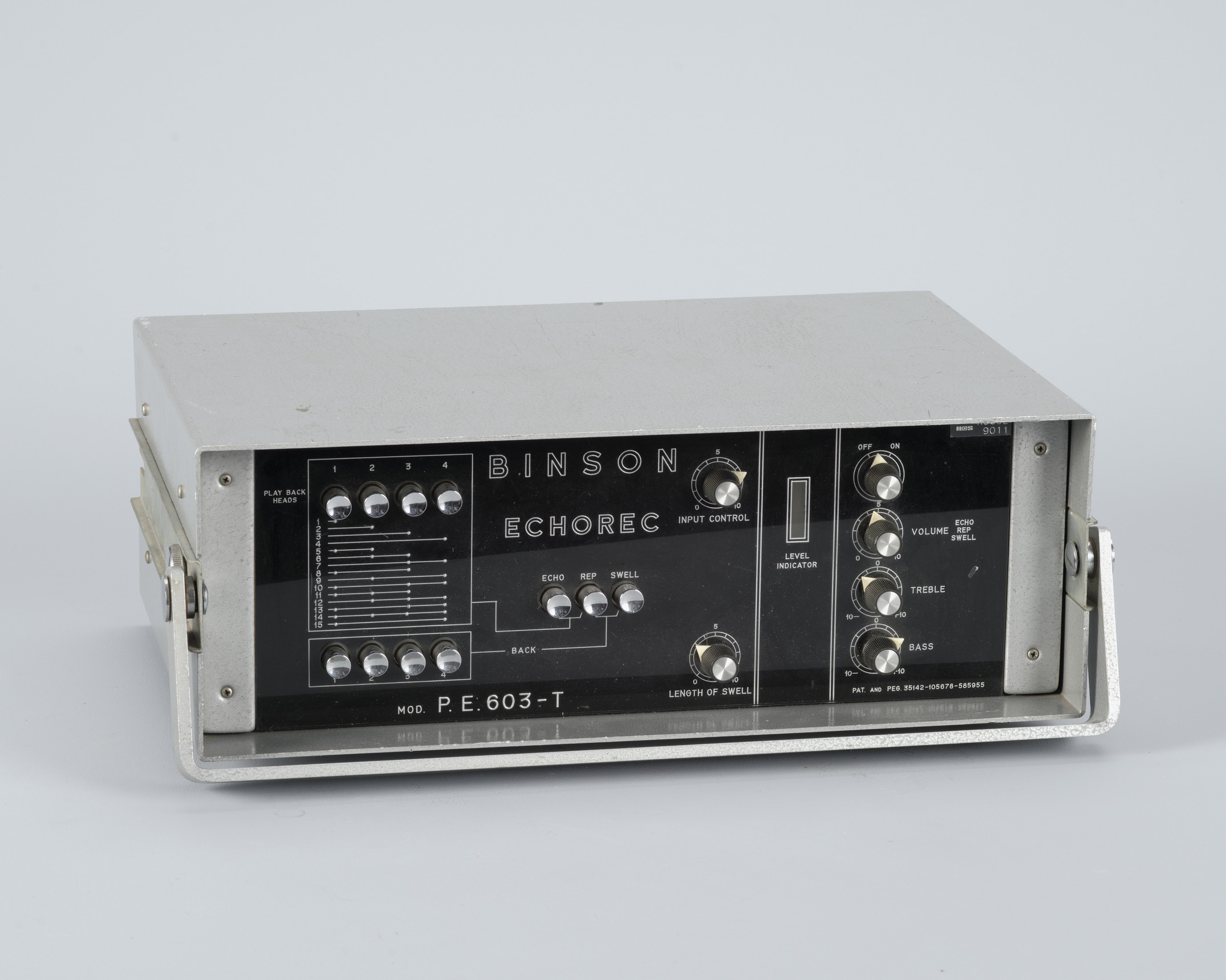
Binson Echorec

1955 · 🇮🇹 Italy · Magnetic-drum echo (no tape)

David Gilmour's atmospheric repeats.

Designer Dr. Bonfiglio Bini + Scarano Gaetano
Company Binson (Milan, Italy)
Bonfiglio Bini built tube radios since the end of WWII, then guitar amps. His extensive research-phase goal: a delay medium more durable than plastic magnetic tape. His answer was a magnetic drum. The Echorec line launched 1955; iconic B1 specifically late 50s. After using Meazzi Echomatic machines, Hank Marvin switched to Binson. Pink Floyd adopted it via Syd Barrett (1965–68), then David Gilmour from 1968 onwards.
Mechanism

Steel-alloy drum spinning over 4 playback heads. 100 super-fine stainless-steel recording wires wrapped around the drum exterior — each 0.1 mm diameter (pencil-line thin). 6× 12AX7 tube preamps. Each playback head selectable independently — multi-tap echo before "multi-tap" was a marketing term.

Famous uses
  • Pink Floyd — Syd Barrett era + Gilmour Echoes / Time / One of These Days
  • Hank Marvin / The Shadows
  • Jimmy Page (Zeppelin live)
  • David Gilmour solo era
photo pending

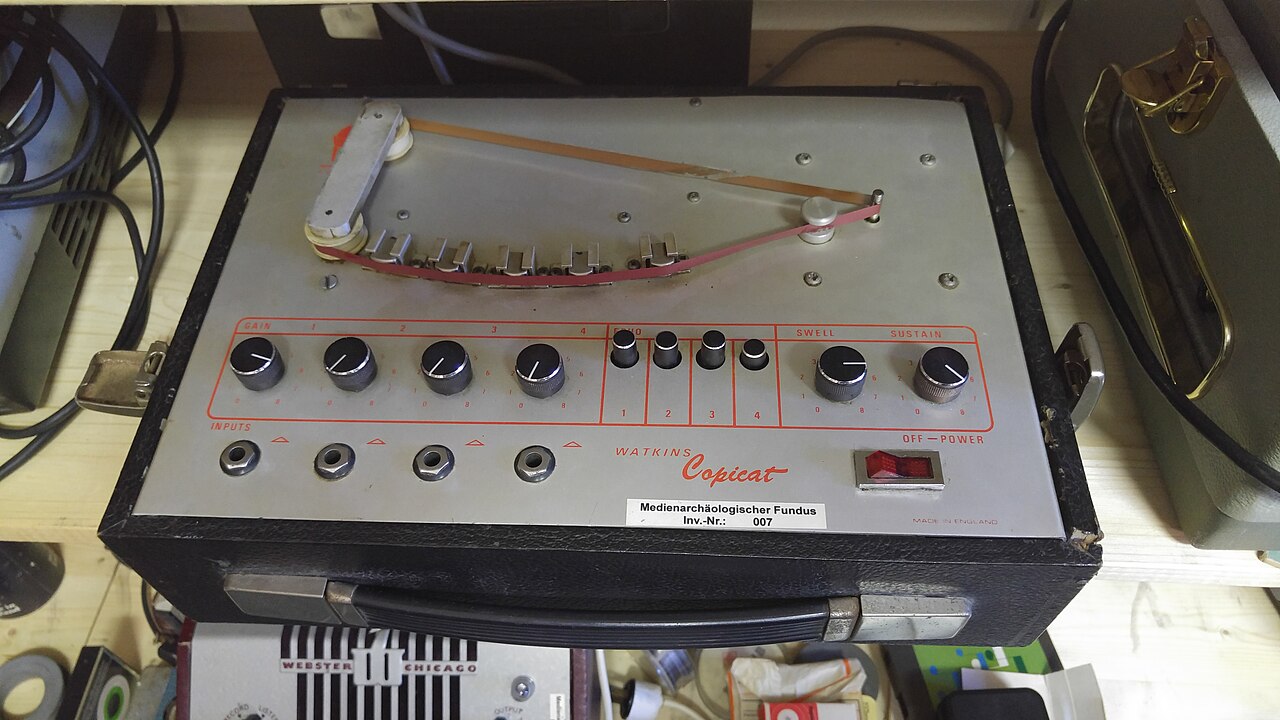
Watkins Copicat (WEM)

1958 · 🇬🇧 UK · Compact valve tape echo

The first repeat-echo machine as one compact box.

Designer Charlie Watkins + Bill Purkis
Company Watkins Electric Music (WEM)
Designed 1958, introduced 1960 in UK. Charlie Watkins heard the tape-echo effect on an Italian Marino Marini record produced by linking two studio tape recorders, and designed the Copicat to do it in one compact box. Watkins's shop sold the entire first production run of 100 units the day they opened them; the very first went to Johnny Kidd of Johnny Kidd & the Pirates. MK I–III were valve; MK IV onwards (1965+) transistor — biggest-selling variant by far.
Mechanism

Continuous loop of 1/4" tape passing three replay heads + one record head; each head switchable independently. Feedback loop sends output back to record head for runaway/oscillating echo. Wow + flutter from worn capstans is part of the signature.

Famous uses
  • The Shadows — Hank Marvin (FBI, Apache)
  • Joe Meek productions (Telstar era)
  • Pink Floyd live rigs
  • Modern dub + ambient — Adrian Sherwood

Pitch & Multi-Effects

The Eventide trilogy.

H910 (1975, first commercial digital FX) → H949 (1979, first de-glitched pitch shifter) → H3000 (1987, first programmable multi-FX with MIDI). Three Eventide boxes that mark twelve years of digital effects evolution.

photo pending

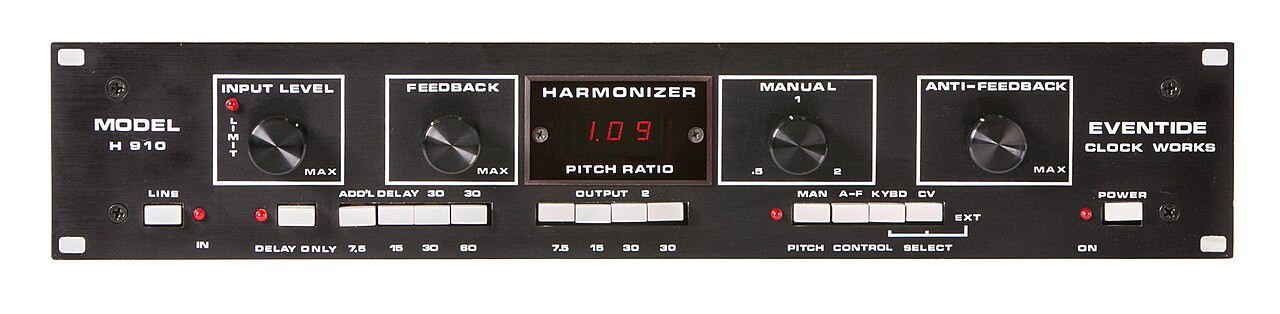
Eventide H910 Harmonizer

1975 · 🇺🇸 USA · First commercial digital audio effects unit

The first digital pitch shifter, ever.

Designer Tony Agnello (with Richard Factor)
Company Eventide
Developed 1974, released 1975 — the world's first commercially available digital audio effects device. Designed by Tony Agnello (later of Princeton Digital). Built on a technique developed by Richard Factor for Eventide's earlier 1745 digital delay line — adapted from delay-buffer manipulation to real-time pitch transposition. Inducted into the AES TECnology Hall of Fame twice (1976 + 2007).
Mechanism

Digital pitch-shift via buffer-splice technique — splice points were audible as "glitches", a quirk later solved by the H949. Plus delay + simple modulation. Red 7-segment readout.

Famous uses
  • Tony Visconti vocal doubling — Bowie Low / Heroes (Berlin trilogy)
  • AC/DC Back in Black vocal pitch-shift
  • Eddie Van Halen guitar harmonies
  • Every well-funded studio from 1975 onwards
photo pending

Eventide H949 Harmonizer

1979 · 🇺🇸 USA · First de-glitched pitch shifter

MicroPitch + Reverse — precision pitch tools.

Designer Eventide engineering team
Company Eventide
Successor to H910 (1975), predecessor to H3000 (1987). Released at AES Convention NYC 1979; produced 1979–1984. The first de-glitched pitch shifter — Eventide's earlier H910 had audible "glitches" at splice points; the H949 eliminated this with intelligent splice-point detection.
Mechanism

MicroPitch mode — proprietary single-sideband modulation for very small pitch shifts (0.1% resolution, 4-digit display) — used as a precision tuning + tempo tool. Reverse mode digitally emulates cutting tape into ~6-inch segments (~400 ms), reversing each, then splicing in original order. RAM-based memory architecture. Unique flange + randomized-pitch effects.

Famous uses
  • Tony Visconti vocal doubling
  • Trevor Horn productions (Frankie Goes to Hollywood, Yes Owner of a Lonely Heart)
  • Pink Floyd The Wall / Final Cut era
  • Eddie Van Halen pitched guitar harmonies
photo pending

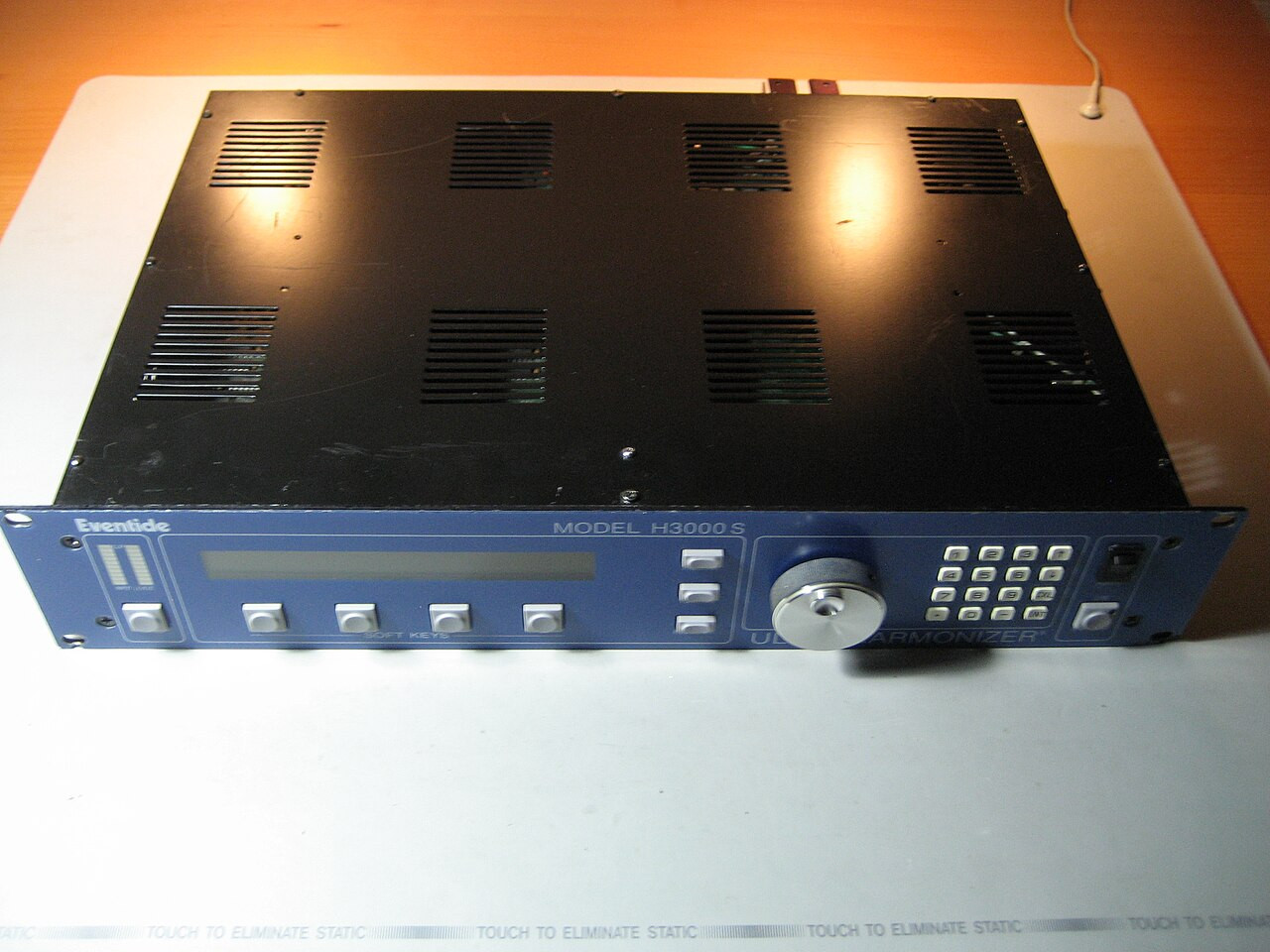
Eventide H3000 Ultra-Harmonizer

1987 · 🇺🇸 USA · Programmable multi-FX with MIDI

The first programmable multi-FX with MIDI.

Designer Ken Bogdanowicz + Bob Belcher
Company Eventide
Released 1987 (some sources cite 1986 prototype). Variants followed through the 90s: H3000S (1988), B, SE, D/SE, D/SX. Inducted into the TEC Awards Hall of Fame 2016. Often called the "holy grail" of multi-FX — virtually every major 80s/90s pop/rock record had a H3000 somewhere in the chain.
Mechanism

2U 19" rack. 11 effect categories × 100 presets — diatonic stereo pitch-shift, multi-tap delays, modulation (chorus / flange / doubler / etc.), reverb algorithms, modular + upgradeable cards. MIDI implementation for external control.

Famous uses
  • Vocal doubling on countless 80s/90s pop records
  • Trevor Horn productions
  • Brian May Queen later albums
  • Tony Visconti, Daniel Lanois signature box

Exciters & Enhancers

Accidental harmonics.

The Aphex Aural Exciter was discovered in the late 1950s when Curt Knoppel miswired a Heathkit DIY stereo amplifier kit. The misconnection produced harmonics that no one had heard before. He sat on the discovery for 17 years.

photo pending

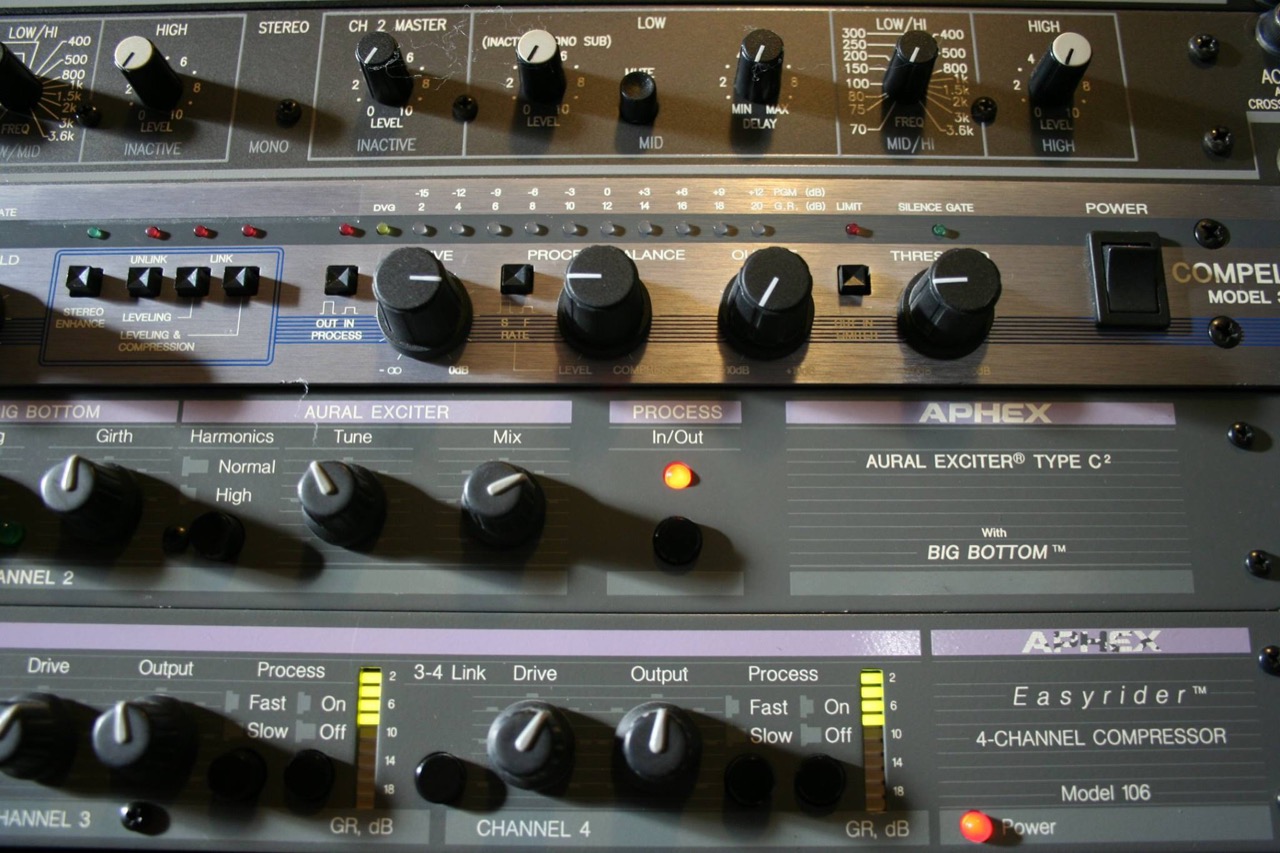
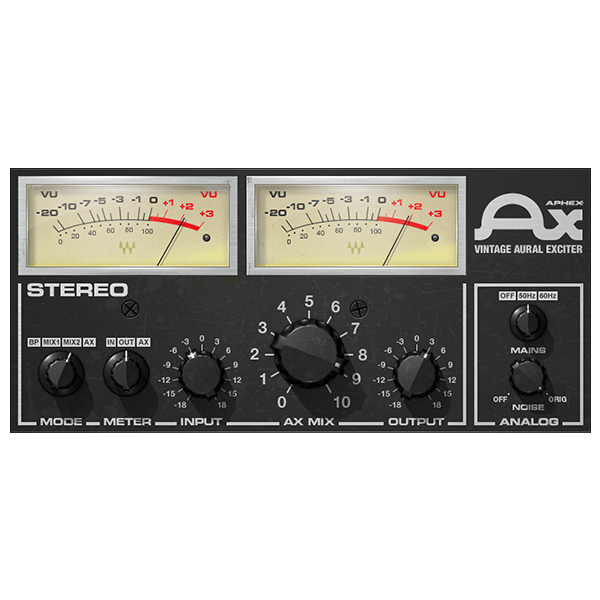
Aphex Aural Exciter (Type B / 402 / Type C)

1975 · 🇺🇸 USA · Psychoacoustic harmonics + intermodulation

$30/minute, rental only. Five units exist.

Designer Curt Knoppel + Marvin Caesar
Company Aphex Systems (Massachusetts, founded 1975)
In the late 1950s Curt Knoppel wired one channel of a Heathkit stereo amp kit incorrectly; the miswiring produced bright "previously unheard" harmonic enhancement. He sat on the discovery until 1974, when he approached Marvin Caesar at Aphex. The tube model 402 (1975): only ~5 units ever produced. Rental-only, US-only, at $30 per minute of finished recording — never sold outright. The 602 solid-state version followed and expanded the rental fleet. The business model: keep the "Aphex sound" scarce, meter by musical use.
Mechanism

Adds phase-shifted harmonics + intermodulation distortion + slight compression. Produces perceived brightness + "air" that simple EQ cannot replicate — psychoacoustic enhancement: the ear hears more clarity without signal energy being simply boosted.

Famous uses
  • Linda Ronstadt Hasten Down the Wind (early rental session)
  • James Taylor late-70s catalogue
  • Jackson Browne
  • Entire late-70s LA softrock sound — "Aphex Aural Excited" credited on sleeves

Specials

Infrastructure + character units.

Dolby A/SR (tape noise reduction infrastructure), Drawmer DS201 (the gated drum sound), EMS Vocoder 2000 (Kraftwerk's machine voice), Roland SDD-320 Dimension D (clean-guitar chorus).

photo pending

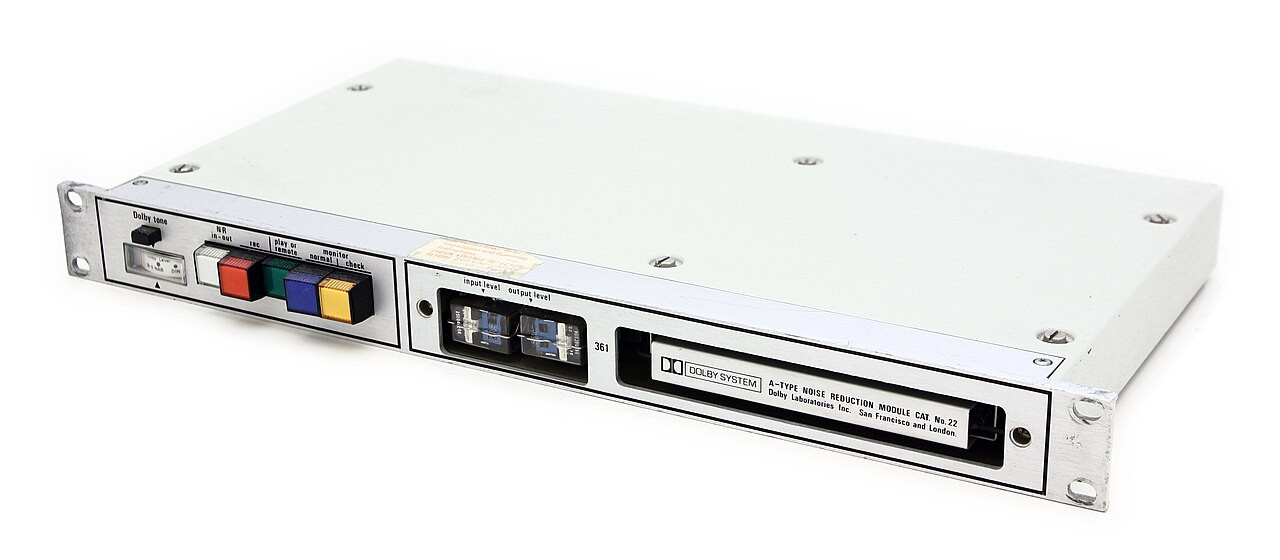
Dolby A / Dolby SR

1965 · 🇬🇧 UK · Tape noise reduction (companding)

Infrastructure, not a creative effect.

Designer Ray Dolby
Company Dolby Laboratories (founded 1965 London)
Ray Dolby founded Dolby Laboratories in London in 1965 after encountering the tape-hiss problem while recording sitar music in India — counter to the pop-history narrative that Dolby is American studio culture. Decca was first to adopt (1966); RCA, MCA, CBS by 1967. By mid-70s essentially universal in pro multitrack studios. Dolby SR (Spectral Recording, 1986) replaced Dolby A in pro studios from mid-80s onwards — more bands, sliding-band action, ~24 dB noise reduction.
Mechanism

Dolby A: 4-band split-frequency companding. Input split via filters at 80 Hz, 80 Hz–3 kHz, 3 kHz high-pass, 9 kHz high-pass. Each band compresses on record + complementarily expands on playback → ~10 dB NR at low end, up to 15 dB at 15 kHz. Dolby SR (1986): more bands, sliding action, ~24 dB NR.

Famous uses
  • Every major-label multitrack 1968–~2000
  • Beatles Abbey Road + everything after
  • Pink Floyd Dark Side of the Moon
  • Steely Dan, every Atlantic / Stax / Motown era multitrack
  • Dolby SR on most 80s/90s pro studio + film soundtracks
photo pending

Drawmer DS201 Dual Noise Gate

1982 · 🇬🇧 UK · Musical noise gate with frequency-conscious key

The "gated drum" sound, in one rack.

Designer Ivor Drawmer
Company Drawmer Electronics (UK, 1981)
Ivor Drawmer — born and raised on Sark (Channel Islands) — was waiting in a studio to play a keyboard overdub when he watched the engineer fight with crude on/off gates on the toms. The DS201 was specifically designed to solve this. The DS201 (1982) was the watershed product that officially founded Drawmer Electronics (started 1981 with the Multitracker delay line).
Mechanism

Dual-channel musical noise gate with separate range + release controls + frequency-conscious key filter (high-cut + low-cut on the side-chain detection). External key input enables one signal to trigger the gate on another — the snare-triggers-ambient-mic technique that defined 80s drums.

Famous uses
  • Phil Collins "In the Air Tonight" (Hugh Padgham at Townhouse Studio 2)
  • Peter Gabriel III + IV
  • Trevor Horn productions
  • Every major 80s pop/rock drum kit
photo pending

EMS Vocoder 2000

1977 · 🇬🇧 UK · 16-channel analog vocoder

Kraftwerk's machine voice.

Designer Tim Orr
Company Electronic Music Studios (EMS, London — founded 1969)
EMS — founded 1969 by Peter Zinovieff, Tristram Cary, David Cockerell — also built the VCS3 / Synthi A / Synthi AKS used by Pink Floyd, Brian Eno, Roxy Music. The Vocoder 2000 (1977) was developed from the earlier Vocoder 5000 (1975). Designer Tim Orr also designed multiple EMS synths plus work for Akai and a long-running DIY column in Electronics Today International. Vocoders existed since Bell Labs' 1939 Voder — the EMS 2000 was the first commercial unit that was studio-practical, portable, and affordable.
Mechanism

Splits incoming voice (modulator) into 16 frequency bands; each band's envelope controls the corresponding band of a carrier signal (typically a synth pad or sawtooth). Mic/line inputs, internal oscillator + noise source, voiced/unvoiced detector, slew + freeze control.

Famous uses
  • Kraftwerk — Trans-Europe Express (1977), Man-Machine (1978), Computer World (1981)
  • Pink Floyd — The Wall ("Goodbye Cruel World")
  • Jean-Michel Jarre
  • Herbie Hancock Sunlight, ELO Time
photo pending

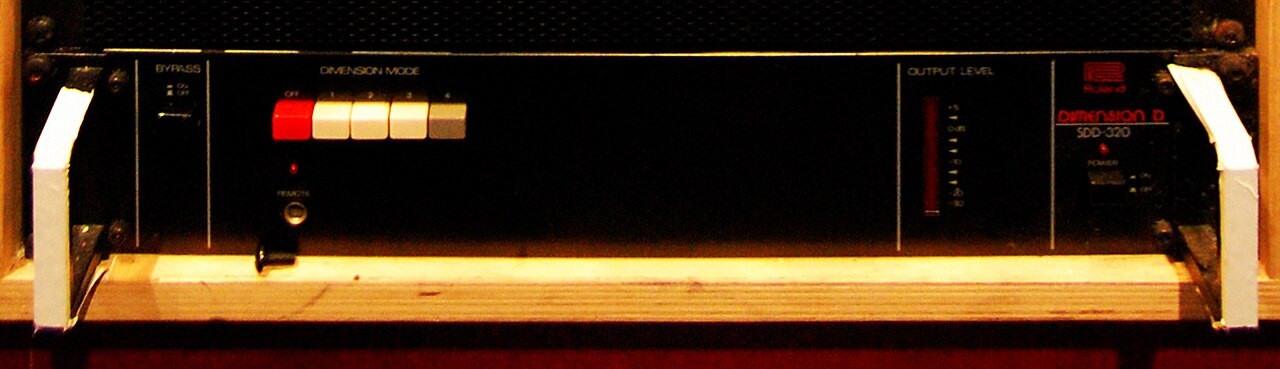
Roland SDD-320 Dimension D

1979 · 🇯🇵 Japan · BBD analog chorus (no pitch modulation)

The clean-guitar chorus that defined the 80s.

Designer Roland engineering team
Company Roland
Launched 1979 (some sources reference early 80s rollout). The signature clean-guitar sound of early 80s — the Edge (U2 War / Joshua Tree era), David Gilmour (post-The Wall), Brian Eno ambient work, Andy Summers (The Police Synchronicity arpeggios). Non-programmable, all-analog, four-button preset interface (off / 1 / 2 / 3 / 4) — simplicity that became part of its appeal.
Mechanism

BBD (Bucket Brigade Device) analog charge-coupled delay lines for very short delay times, modulated subtly. Distinct from typical chorus: no pitch modulation, only spatial widening + slight time offset between channels. Result is "wider stereo" rather than the warbling vibrato most choruses produce.

Famous uses
  • U2 (every record 1983–1990)
  • Pink Floyd live + studio mid-80s
  • Sade Diamond Life clean guitars
  • Police Synchronicity
  • Modern revival — Mac DeMarco, Tame Impala