Euphonix
Digital Control, Analog Soul
Avid (Artist Series) ↗Euphonix was founded in Palo Alto, California in 1988 by engineers coming out of Integrated Media Systems. Their pitch was simple and — for the market at the time — radical: build a fully-featured large-format mixing console where every knob, fader and switch is digitally controlled, but the audio path stays analogue. Total recall, full automation, and an unprecedented level of ergonomic reconfiguration at a price that undercut SSL and Neve while adding features neither offered.
The original CS series consoles landed in major-label studios, post houses and broadcast facilities through the early-to-mid 1990s, and by the late 1990s Euphonix had pivoted the platform into film and TV post with the R-1 hard-disk multitrack and System 5 fully digital console. The System 5 took over scoring stages at Fox, Sony and Skywalker and became the Euphonix of the 2000s just as the earlier CS had been the Euphonix of the 1990s.
Avid acquired Euphonix in 2010, rolling the control-surface technology into the Pro Tools ecosystem (Artist Series, S5 Fusion, S6). The name quietly disappeared, but every Pro Tools user who has worked on an S6 has a direct line back to the CSII and System 5 — the consoles that proved digitally controlled audio didn't have to mean cold, sterile sound.
🎛 Mix on a vintage-inspired analogue desk in VR — explore the Retro Recordings XR experience →
Notable Consoles
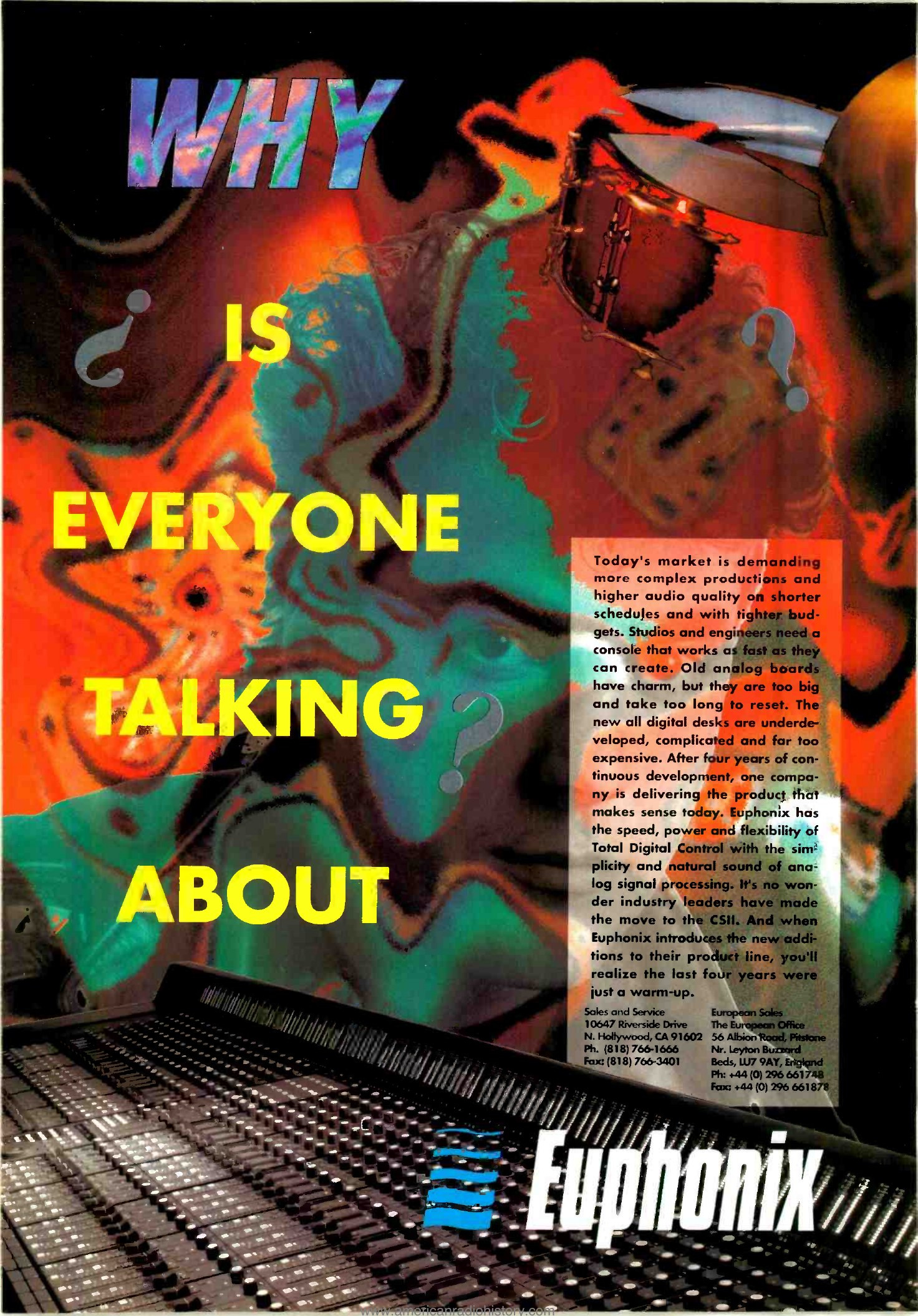
CS II
1990 – 1995- Channels
- 72 – 108
- Layout
- Digitally-controlled analog (in-line)
- EQ
- 4-band parametric
CS3000
1994 – 2001- Channels
- 96 – 148
- Layout
- Digitally-controlled analog
- EQ
- 4-band parametric
System 5
2001 – 2010- Channels
- 384 DSP paths
- Layout
- Digital (DSP)
- EQ
- Parametric + dynamics